

Sometimes the kindest thing you can do for yourself is say the thing you’re never going to send.
That’s really what an unsent letter is for. Not closure in the neat, movie-scene version of closure. Not a perfect breakthrough. Just a place to let your inner voice stop performing, stop explaining, stop being reasonable for five minutes, and tell the truth on paper.
If you’ve been hard on yourself, stuck in shame, replaying a conversation, or carrying feelings that don’t seem to go anywhere, an unsent letter can give those feelings a container. And weirdly, that container often makes compassion easier. Not because you talk yourself out of pain, but because you finally stop arguing with the fact that it’s there.
Why this works better than “just journal about it”
Regular journaling can help, but it can also get slippery. You start writing, then drift into analysis, then somehow end up reorganizing your whole personality by paragraph four. An unsent letter gives your mind something more specific to hold onto.
You’re writing to someone. Maybe it’s a parent. An ex. A friend. The version of you that was trying so hard and still got hurt. Maybe it’s the you who made a mess of something and can’t stop replaying it.
That direction matters.
It gives shape to feelings that usually stay tangled. Anger sounds different when it has an address. Grief does too. Even self-blame starts to change once it leaves the courtroom in your head and lands on a page where you can actually look at it.
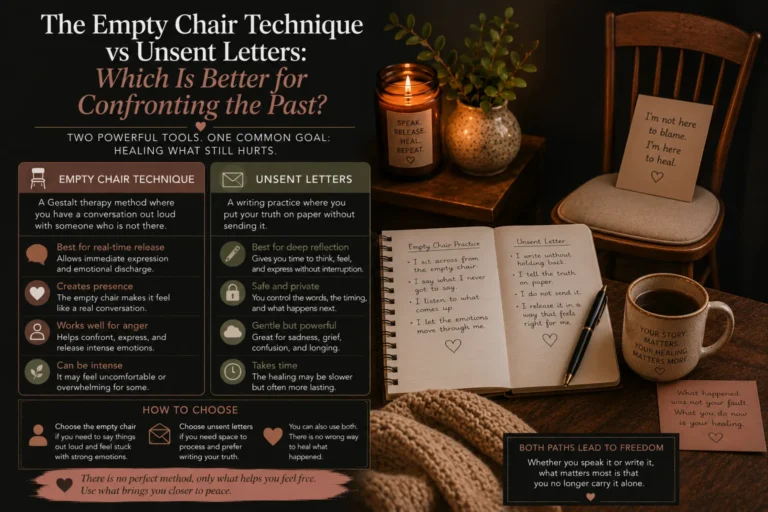
This is also why some people find that therapeutic letter writing for difficult emotions feels easier than open-ended reflection. You’re not trying to produce insight on command. You’re responding to a real emotional thread.
Self-compassion doesn’t always sound nice at first
This part matters, because people often assume self-compassion means writing something soft and wise right away. Usually it doesn’t.
Sometimes the first honest version sounds irritated, petty, ashamed, repetitive, or harsh. That doesn’t mean you’re doing it wrong. It usually means you got past the polished version.
Self-compassion starts earlier than most people think. It starts the moment you let yourself say, “This hurt more than I wanted to admit,” or “I’m still angry,” or “I didn’t handle that well and I feel sick about it.”
That’s not indulgent. That’s accurate.
And accuracy is often a better doorway into compassion than forced positivity. If you try to jump straight to forgiveness or gratitude, your nervous system may just roll its eyes. Fair enough.
The point of the letter isn’t to manufacture a better attitude. It’s to create enough honesty that kindness has somewhere real to land.
Who the letter is really for
On the surface, you might be writing to someone else. But the deeper audience is usually you.
You’re the one who gets to stop swallowing the sentence halfway through. You’re the one who gets to name what happened in your own words. You’re the one who gets to witness your reaction without rushing to edit it into something more acceptable.
That’s part of what makes this a self-compassion practice instead of just an emotional dump. You’re not only expressing pain. You’re staying present with yourself while you do it.
That can look a few different ways:
- letting your anger exist without calling yourself dramatic
- admitting you wanted more from someone than they were ever going to give
- saying you miss a version of life that isn’t coming back
- writing down the apology you keep waiting for, even if it never arrives
None of that fixes the situation. But it often softens the loneliness inside it.
What to write when you don’t know where to start
The blank page can make people weirdly formal. Suddenly it’s “Dear Person, I hope this letter finds you well,” which is almost never where the real feeling lives.
Start closer to the actual nerve.
You might begin with a line like:
- Here’s what I never got to say.
- I’m still carrying this.
- I keep pretending this didn’t affect me, but it did.
- You don’t get to hear this, but I need to say it anyway.
- I wish this had gone differently.
That’s enough. You don’t need a beautiful opening. You need a true one.
If the letter is really about how you’ve been treating yourself, you can aim it inward more directly. Write to the part of you that feels ashamed, defensive, exhausted, embarrassed, needy, numb, or behind. Not the polished adult voice that already knows what the “healthy response” should be. The actual hurting part.
Sometimes that ends up sounding a lot like the tone people use in a letter to your younger self, especially when the pain you’re touching is old and familiar. The point isn’t to be poetic about it. Just honest enough that you recognize yourself in it.
Let the first draft be unfair, messy, and a little repetitive
This is the part people resist, because most of us want to be decent even in private. Which sounds noble, but it can turn into emotional censorship fast.
Your first draft does not need to be balanced. It does not need to include their perspective. It does not need to end with grace.
It just needs to reveal what’s true for you right now.
That might mean you repeat yourself. That might mean you contradict yourself. That might mean one paragraph says, “I’m over it,” and the next one makes it obvious you are absolutely not over it. Fine.
Human feelings are not tidy. A useful unsent letter usually isn’t either.
If you start worrying that you sound dramatic, there’s a decent chance you’re getting close to something real. Not always, but often. A lot of people have spent years minimizing their own reactions, so plain honesty can feel suspiciously intense at first.
Try not to edit too early. The sentence you almost delete is often the one the rest of the letter was circling.
Then change seats
This is where the self-compassion part gets more deliberate.
Once you’ve written the raw version, pause. Step away if you need to. Get water. Fold laundry. Stare out a window like someone in an indie movie. Then come back and read what you wrote as if it came from someone you care about.
Not someone perfect. Just someone you wouldn’t want to abandon in the middle of their worst moment.
Now write back.
You can do this as a second letter, or just a response underneath the first one. The tone matters more than the format. You’re not trying to correct yourself. You’re trying to meet yourself.
That response might sound like:
- Of course this hurt.
- You were trying to hold too much by yourself.
- You don’t have to pretend it didn’t matter.
- Yes, you made mistakes. That’s still not the whole story.
- You were asking for care, not asking for too much.
This is often the moment where people realize how harsh their default inner voice has been. Not in a dramatic revelation kind of way. More in a quiet, “wow, that was meaner than necessary” kind of way.
And that shift matters. Because self-compassion isn’t always a feeling first. Sometimes it’s a different way of speaking to yourself before your emotions fully catch up.
When the letter is about grief, regret, or someone unavailable
Unsent letters become especially powerful when the conversation can’t happen in real life.
Maybe the person died. Maybe contact would reopen harm. Maybe they would never respond in a way that helps. Maybe you’re not even sure what you’d want from them anymore.
In those cases, the page becomes a place to stop negotiating with reality long enough to write the apology you never sent and say what remains unsaid.
You can write the apology you never got. The anger you never expressed. The tenderness that still has nowhere to go. If the loss is part of what you’re carrying, writing a letter to someone who died can be gentler than trying to force your feelings into a cleaner narrative than they actually have.
And if what hurts most is uncertainty rather than finality, it may help to write toward the version of you who hasn’t gotten through this yet but might. There’s something steadying about writing to your future self when life feels uncertain because it gives your fear somewhere to go besides endless looping.
A small thing that helps more than people expect
Be specific.
Not performatively specific. Just enough that your nervous system knows you’re talking about the real thing.
Instead of “you always dismissed me,” write what happened. The look on their face. The text they didn’t answer. The way you laughed it off and then felt awful in the grocery store three hours later.
Instead of “I hate myself for messing up,” name the mistake. Name what you regret. Name what you were scared of. Shame gets vaguer as it gets stronger. Specificity brings it back down to human size.
That’s usually where compassion becomes possible. Not because the facts get prettier, but because they get clearer.
You do not have to keep the letter
People get hung up here, like the letter has to become a meaningful artifact. It doesn’t.
You can keep it. Rip it up. Delete it. Fold it into a drawer and forget about it for six months. The value is in the writing, not in building a shrine to the feeling.
Sometimes destroying the letter is part of the relief. Sometimes keeping it lets you come back later and notice that your pain had shape even when it felt huge and confusing. Either choice is fine.
The only thing worth watching is whether you’re trying to get rid of it too fast because being witnessed by your own words feels unbearable. If that’s what’s happening, maybe wait an hour. Maybe wait a day. You don’t have to be brave in some grand way. Just brave enough to let the truth exist for a minute.
If it brings up more than you expected
That can happen.
An unsent letter can sound simple, but once you stop editing yourself, deeper things can come up fast. Old grief. Buried anger. Memories you thought were settled. A level of self-judgment you didn’t realize was running in the background all day.
If that happens, slow it down. You don’t need to excavate your whole history in one sitting. Write for ten minutes and stop. Put both feet on the floor. Eat something. Text someone safe if you need to. If the emotions feel overwhelming or tied to trauma, it may help to bring the writing into therapy or another kind of steady support.
The goal isn’t to flood yourself. It’s to make contact with your experience without leaving yourself alone inside it.
What people usually get wrong
The biggest mistake is treating the letter like a performance, even if no one will ever read it.
Trying to sound evolved. Trying to be fair too soon. Trying to end with a wise sentence that proves you’re healed. It’s such a familiar habit, and honestly, it can sneak in everywhere.
The second mistake is using the letter only to intensify the wound. Going over the same injury again and again without adding any witnessing, softness, or truth-telling beyond the pain itself. That can leave you feeling scraped raw instead of relieved.
That’s why the reply matters. Or the pause. Or the second pass where you notice what your own words are asking for.
Usually it’s something simple. To be believed. To be grieved. To be forgiven a little. To stop being talked to like an enemy.
That last one tends to land harder than people expect.
You may not finish the letter feeling peaceful. You may just feel clearer. A little less split in two. Sometimes that’s the whole gift.
Need help putting hard feelings into words?
Use a guided unsent letter prompt when you know something hurts but can’t quite find the starting point. A little structure can make self-compassion feel more reachable.