
Sometimes the hardest part isn’t knowing you should apologize. It’s knowing what to say when the person you hurt may not want to hear from you, or maybe shouldn’t have to.
If that’s where you are, an apology letter you never send can still do something real. It can separate guilt from clarity. It can show you whether you’re actually sorry, or just desperate to feel less bad.
That’s why writing one matters. Not because every apology deserves delivery, and not because putting your feelings on paper fixes what happened. Mostly because your mind gets slippery when shame is involved. It edits. It defends you. It turns “I was cruel” into “things got messy.” An unsent letter while grieving slows that down.
What this kind of letter is actually for
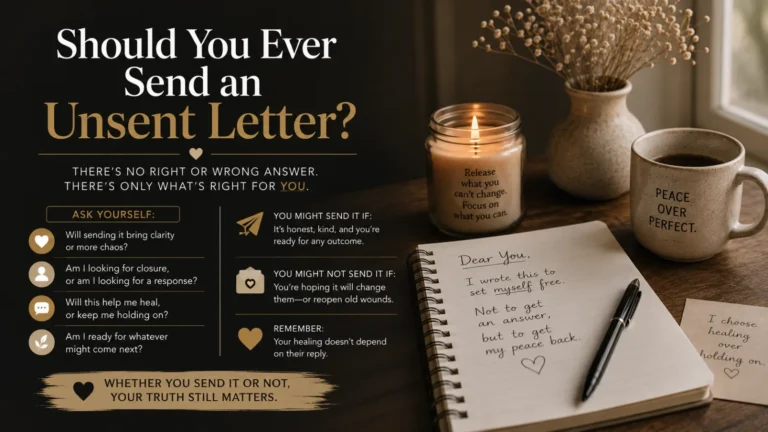
An unsent apology letter isn’t a draft you’re definitely building toward sending later. It can be, but it doesn’t have to be. Sometimes it’s the whole point.
You’re writing to tell the truth more cleanly than you’ve been able to tell it in your head. You’re writing without the usual side goals mixed in. No hoping they’ll reassure you. No trying to reopen contact. No sneaking in your own pain like it balances the scale.
That’s the part people tend to underestimate. A real apology is narrow. It names what happened, takes ownership, and leaves room for the other person’s experience without trying to manage it.
If you already know the other person needs distance, this kind of letter can help you respect that distance while still facing yourself. And if what you really need is less about apology and more about emotional release, you may end up closer to writing a closure letter you do not send than a true apology. Those are not the same thing, even if they can look similar from the outside.
Start with the part you’re probably avoiding
Most people want to begin with context. What was going on. Why they reacted the way they did. What they meant. That urge makes sense. It also usually weakens the letter.
Start with the action instead.
Not “I’m sorry for everything.” Not “I’m sorry if you felt hurt.” Definitely not “I’m sorry but I was under a lot of stress.”
More like: you lied. You disappeared. You humiliated them in front of other people. You kept reaching out after they asked you not to. You said something meant to wound them because you wanted them to hurt too.
Specific is harder, and that’s usually a sign you’re getting closer.
If you can’t name what you did in one or two plain sentences, stay there longer before writing the rest. Everything after that depends on whether you’re being honest at the center.
What belongs in the letter
You do not need a perfect structure. This isn’t school. Still, it helps to know what tends to make an apology feel real instead of performative.
Name what happened plainly
Plainly means no soft-focus language. No “mistakes were made” energy. No hiding inside passive wording.
Instead of “things got out of hand,” say what got out of hand. Instead of “I wasn’t myself,” name the choice you made while being very much yourself.
If the letter feels blunt here, that’s probably fine.
Acknowledge the impact without controlling it
This part matters because harm is not only about intent. You may not know exactly how the other person experienced what happened, so don’t act like you have access to their inner life. But you can still recognize likely impact, which is one reason the psychology of unsent letters matters here.
You can say that what you did was confusing, humiliating, destabilizing, unfair, cruel, manipulative, or dismissive if those words fit. You can admit they may have felt less safe with you afterward. You can say your actions likely made them question their own memory or judgment if that’s true.
What you don’t want to do is script their reaction for them. Not “I know you were devastated beyond words.” You don’t know that. Stay grounded.
Take responsibility for your choices
This is where excuses usually try to sneak in wearing nicer clothes.
Context isn’t always useless. Sometimes it matters that you were grieving, drinking too much, panicking, or repeating an old pattern you never dealt with. But context belongs after responsibility, not instead of it.
The difference is easy to hear.
“I did this because I was overwhelmed” lands very differently from “I was overwhelmed, and I still chose to take it out on you.”
One explains. The other owns.
Don’t ask for anything
This is the part that stings. Especially if some part of you wants the letter to reopen the door.
But if you’re writing an apology you may never send, the cleanest version usually asks for nothing. No response. No forgiveness. No chance to explain more. No reminder that you were hurting too.
Wanting those things is human. Putting them inside an apology can turn it into a pressure tactic fast.
What usually makes the letter worse
A lot of apology letters collapse in the same few places.
One is over-apologizing in a way that becomes theatrical. Five versions of “I’m a terrible person” might feel honest in the moment, but they often drag attention back to you. The other person ends up cast in the role of witness to your self-hatred, which isn’t the job.
Another is sneaking in a defense. Sometimes it’s obvious. Sometimes it’s one little sentence doing a lot of damage, like “I only reacted that way because I felt shut out.” That kind of line can undo the whole letter.
Then there’s the weirdly polished version. Very thoughtful. Very emotionally literate. Completely bloodless. It sounds right and says almost nothing. If that’s happening, you’re probably still writing the version of yourself you’d like to be seen as.
You may need to write the messier one first. The one that’s a little uncomfortable to reread.
And if what you’re really wrestling with is the opposite pain—the ache of being harmed and never getting the apology—then this may not be your letter at all. You may need something more like a letter to someone who never apologized, where the point is naming what happened without waiting for them to become the person who can admit it.
One thing to watch for if shame is running the show
Shame loves drama. Not always loud drama. Sometimes very quiet, noble-looking drama.
It says things like: write the longest letter possible, make it devastatingly honest, confess every flaw you’ve ever had, make sure the suffering shows. That can feel like accountability. Sometimes it’s just self-absorption in a more tragic outfit.
A useful apology letter is usually more restrained than shame wants it to be.
It stays with the actual harm. It doesn’t turn into your autobiography. It doesn’t wander off into childhood wounds unless those are somehow more relevant than the thing you did, which they usually aren’t in the letter itself.
If you’re not sure whether you’re being accountable or just flooded, put the letter away for a day and come back when your nervous system isn’t sprinting.
If you do write a draft, don’t trust the first version
The first draft is often where the hidden motives show up. Which is useful, honestly.
You may notice a sentence that’s really asking to be comforted. A paragraph that’s trying to prove you’re not “that kind of person.” A closing line that’s basically bait for a response. Better to see it there than in something you send.
One slightly unflattering but common thing: people often spend far more time trying to sound sincere than actually being specific. That’s not villainous. It’s just easier to manage tone than truth.
So when you reread, don’t ask only “Does this sound heartfelt?” Ask:
- Does this clearly name what I did?
- Did I slip in a reason that functions like an excuse?
- Am I asking the other person to take care of my feelings?
- Would this still feel honest if nobody ever read it?
That last one catches a lot.
When sending it would do more harm than good
Sometimes the kindest thing is not contact.
If the person has blocked you, asked for distance, or made it clear they do not want further communication, sending an apology may mostly serve your need to discharge guilt. Same if the relationship involved repeated boundary-crossing and your message would force them back into a dynamic they’re trying to leave.
This can be hard to accept because apology feels morally urgent. But urgency doesn’t always equal permission.
There are also situations where the apology itself could reopen confusion. Breakups do this a lot. So does ghosting, especially when the silence already did the damage. In those cases, what you need to say may overlap with grief, regret, and unfinished attachment more than straightforward accountability. If that’s the knot you’re in, the shape of the writing may look closer to an unsent letter to an ex after a breakup or even something written after being ghosted with no explanation, where the missing conversation is part of what’s making the words hard to place.
Not every unsent letter wants to become contact later. Some are better as witness than message.
A simple way to know whether the letter is honest
Read it and remove every sentence that’s about your intentions.
What’s left?
If almost nothing remains, the letter may still be centered on how you meant well, how confused you were, how deeply you care, how unlike you this was. None of that is irrelevant to your inner life. It’s just not the spine of an apology.
Now remove every sentence that tries to predict or influence their reaction.
What’s left then?
The remaining lines are usually the ones worth keeping. They tend to be simpler. Less dramatic. More solid.
You harmed someone in a specific way. You can name it. You can stop arguing with reality. You can let the letter tell the truth even if nobody else ever sees it.
If you keep the letter, let it do its job
You don’t need to make the letter into a ceremony unless that helps you. You can fold it up and put it in a drawer. Save it in a notes app. Delete it after writing it. The value was never in producing a beautiful object.
The value was in becoming a little less slippery with yourself.
Sometimes that’s as far as this goes. No reconciliation. No reply. No clean ending. Just a more honest record of what happened and your part in it.
That’s smaller than redemption, maybe. But it’s not nothing.
Need help getting the words out honestly?
Use a guided letter tool to put the apology into words without softening what happened or turning it into a plea for forgiveness.