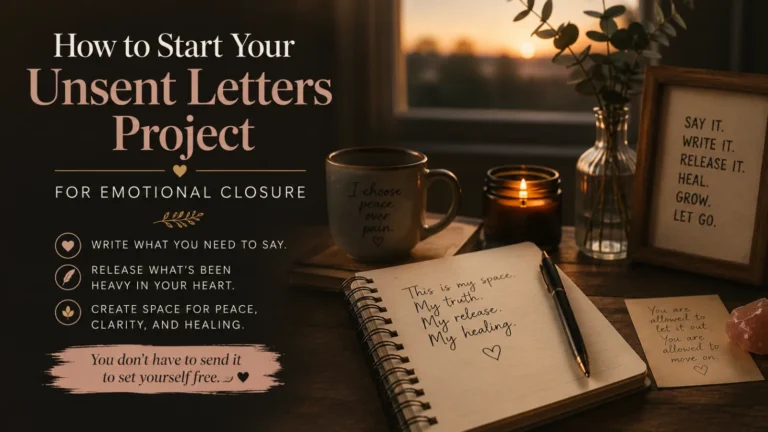


Sometimes the hardest letter to write is the one you know you had every right to avoid. Not because leaving was wrong, but because being the one who walked away can leave you with a strange kind of unfinished noise.
An unsent letter can help with that. Not to justify yourself perfectly. Not to rewrite the relationship into something neat. Just to give the part of you that is still circling the same memories somewhere to go.
When you were the one who ended it, people often assume your side is simpler. You made the decision, so you must be clear. Relieved. Done. But that’s not usually how it feels in real life. You can know you needed to leave and still feel wrecked by what it cost. You can feel grief, guilt, anger, tenderness, doubt, and even longing all at once. None of that cancels the decision. That’s why writing an unsent letter to an ex after a breakup can still matter here, because it gives those mixed feelings somewhere to go.
That’s why writing an unsent letter can be so useful here. It gives you a place to say the things that don’t belong in a text thread, a late-night voicemail, or one more “just checking in” message that only pulls both of you back into the same loop.
What this kind of letter is actually for
This isn’t a performance. It isn’t evidence for a trial you’re holding in your head. It’s not even really about being fair, at least not in the polished, balanced way people usually mean that word.
It’s for honesty.
Not courtroom honesty. Private honesty. The kind that sounds more like: you loved them, and staying was hurting you. Or: you kept hoping things would change, and eventually you had to believe what was already happening. Or: you miss them, but you don’t miss what the relationship was doing to your nervous system.
That’s the real value of an unsent letter when you were the one who left. It lets you tell the truth without turning that truth into another interaction.
And if what you need most is the broader shape of a private closure process, writing a closure letter you do not send can help you see where this fits.
The guilt tends to get loud
A lot of people sit down to write this kind of letter and end up writing a defense. That makes sense. If you were the one who walked away, there’s a good chance part of you still feels accused, even if nobody is actively accusing you.
You may feel guilty because they were blindsided. Because they cried. Because they wanted another chance. Because you didn’t leave at the first bad moment, which means there were good moments too, and now your brain keeps holding those up like evidence. Emotional writing can make you feel worse when you’re already carrying that much guilt, so it helps to notice whether the page is making you spiral instead of settle.
Guilt has a way of flattening everything. It can make you forget why you left in the first place. It can also make you write like you’re trying to win permission to have left. That usually leads to a letter full of overexplaining, softening, backtracking, and sneaky invitations for them to understand you so completely that you feel forgiven.
That’s not what this letter is for.
Your job here is not to make your choice impossible to disagree with. Your job is to tell the truth about what you knew, what you ignored, what finally became impossible to keep carrying, and what still hurts anyway.
Start with what you’ve been editing out
The useful version is usually not the polite version.
If you’ve been mentally drafting this letter for weeks or months, you’ve probably already noticed that you keep cutting certain lines before they fully form. Those are usually the lines worth writing down first.
Maybe it’s:
- You made me feel lonely even when we were together.
- I kept shrinking so we could avoid another fight.
- I didn’t trust myself by the end.
- I still miss you, and I hate that I do.
- I wanted you to be someone you weren’t.
That last one can sting. Sometimes the slightly unflattering truth is part of what makes the letter real. Not because you need to blame yourself for everything, but because closure gets harder when you write yourself as flawless. Most endings are messier than that. You may have stayed too long. You may have dropped hints instead of saying the hard thing plainly. You may have waited until resentment did the talking for you. That doesn’t mean leaving was wrong. It just means you’re human, which is less clean than most breakup narratives allow.
Write to the actual person, not the version in your head
This part matters more than it seems.
When people write unsent letters, they often slip into writing to a fantasy audience. Sometimes it’s the gentle version of the other person who finally understands. Sometimes it’s the cruel version who confirms every fear. Neither one helps much.
Try to write to the person as they really were. Complicated. Limited. Sometimes loving. Sometimes harmful. Sometimes trying. Sometimes not trying hard enough.
That keeps the letter grounded. It also keeps you from wandering into one of the two most exhausting traps: making them all bad so you can feel less conflicted, or making them almost perfect so you can stay emotionally attached to a version of the relationship that never really existed.
If the relationship was specifically romantic and the emotions still feel tangled in that very particular breakup way, writing an unsent letter to an ex after a breakup may feel closer to what you’re trying to do here.
What to include if you want the letter to actually help
You don’t need a formula, but most honest letters like this end up touching a few things.
What was true
Not every truth has to be dramatic. Sometimes the most important sentence is painfully plain. You stopped feeling safe. You stopped being able to imagine a future together without dread. You were becoming someone you didn’t like inside the relationship. You knew you were staying out of guilt, not love.
What still hurts
This is the part people try to skip when they were the one who left. As if your grief becomes suspicious the second you made the decision.
But loss is still loss. You can miss their family, their voice, the ordinary routine, the version of yourself that existed before things got so hard. You can grieve what was good without turning that grief into a reason to go back.
What you never said cleanly
Maybe you were too careful. Maybe you were too tired. Maybe every conversation turned into a debate, so you started speaking in half-sentences and hoping they’d somehow hear the part you couldn’t get out.
The letter gives you room to say it straight now, even if nobody else ever reads it.
What is not yours to carry anymore
This is often the quiet center of the whole thing.
You may still be carrying their confusion, their disappointment, their opinion of you, their version of the breakup, or the fantasy that one more perfect explanation would make the ending painless. Usually it won’t. Usually there is no explanation good enough to remove all hurt.
That doesn’t mean you failed at ending it. It means endings hurt.
What not to do in the letter
A few things tend to make this harder instead of easier.
Don’t write it like a text you secretly might send. You’ll feel the difference right away. The tone gets strategic. The honesty gets cautious. Suddenly every sentence has one eye on how it might land.
Don’t use the letter to reopen negotiations you already ended. If you find yourself writing, “unless things are different now,” pause. That’s a different letter, and probably not a wise one if your real goal is closure.
And don’t force yourself to be saintly. You do not need to sound perfectly evolved for a private document to be healing. If part of you is angry, let that be on the page without turning the whole letter into a character attack.
If the relationship still has that painful “I love you and I left anyway” quality to it, the emotional shape may overlap with writing a goodbye letter to someone you still love. Sometimes that’s the layer people are actually trying to reach.
If you keep explaining yourself, try this instead
Some people get stuck because every paragraph turns into a closing argument. If that’s happening, strip the letter down.
Write sentences that begin like this:
- I left because…
- I stayed longer than I should have because…
- What I wish you had understood is…
- What I’m finally admitting is…
- What I cannot keep carrying is…
That kind of structure can cut through the fog fast. It also makes it harder to hide in pretty language.
You don’t need every sentence to be graceful. Actually, if the letter is too graceful, it may mean you’re still performing clarity instead of letting yourself have it.
You might not feel better right away
This part is annoying, but it helps to know.
Sometimes people expect an unsent letter to create instant relief. Sometimes it does. Sometimes you finish and feel lighter in a very obvious way. But sometimes you finish and feel worse for a bit, because now the truth is visible and you can’t tuck it back behind distractions.
That doesn’t mean the writing failed. It may just mean you touched the real thing.
If the first draft sounds controlled and reasonable and somehow dead on the page, there’s a decent chance you wrote the acceptable version first. That’s common. The more useful draft is often underneath it. The one that says the quieter, less flattering, less tidy things. The one that admits you wanted them to become different. Or that you knew earlier than you let yourself know. Or that part of you still wants them to come back changed, even though you don’t actually believe that would fix it.
Not every thought needs to be resolved before the letter has done its job.
After you write it
You don’t have to do anything dramatic.
You can fold it up and put it away. Delete it after reading it once. Save it in a notes app with a boring title so you stop opening it like a wound. Handwrite it if typing keeps you too polished. Come back a week later and see what still feels true.
What matters is that you don’t automatically turn the letter into contact.
That urge can be strong, especially if writing made you feel suddenly tender, ashamed, or nostalgic. But relief and reconnection are not the same thing. Neither are honesty and access.
If part of what’s happening is that you need to say hard things without tearing yourself open all over again, there’s a reason people look for ways of writing to someone who hurt you without reopening the wound. Sometimes the real skill is not expression. It’s containment.
Let the letter hold what the relationship couldn’t
Some endings don’t get mutual understanding. They don’t get a final conversation where both people suddenly become wise, calm, and painfully articulate. Usually they get confusion, mixed signals, silence, relief, second-guessing, and a few memories that still know exactly where to hit.
So the letter doesn’t need to create a perfect ending. It just needs to hold the truth long enough for you to stop carrying all of it in your body.
You can be the one who walked away and still need closure. You can be sure and sad. You can know it was necessary and still replay it at inconvenient times, like while folding laundry or standing in line for coffee or trying to answer an email that has nothing to do with any of this.
That overlap is brutal sometimes. Also normal.
The letter gives that conflict somewhere to live besides your throat, your chest, your phone, or the message box you absolutely do not need to open again.
And if what comes out is messy, contradictory, loving, angry, relieved, and a little embarrassing, it’s probably getting closer to the truth.
Make the next step easier
If this article described the problem you are trying to fix, use the next step to get a clearer path instead of guessing your way through it.