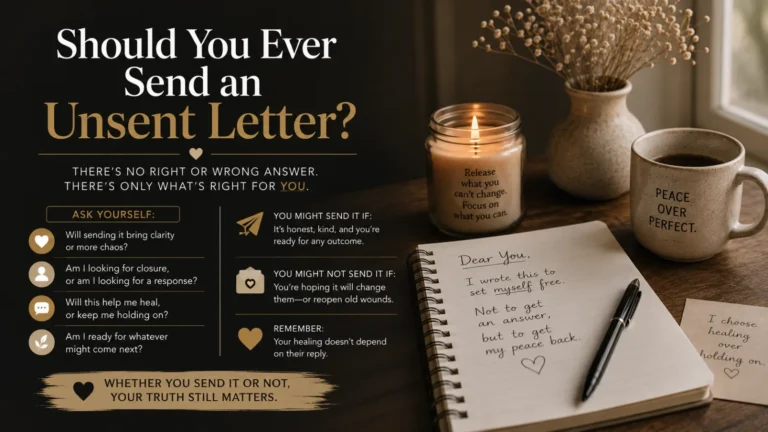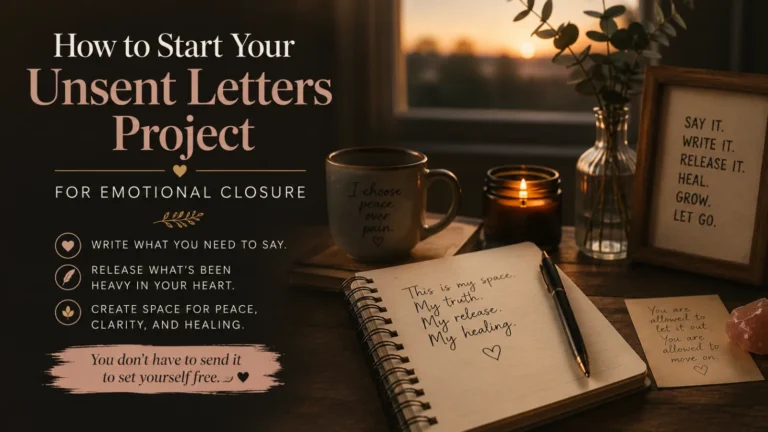


Most people try to write this letter too early or too politely. That’s usually the whole problem. An unsent letter to an ex works better when you let it be honest, messy, specific, and completely free from the job of getting a response.
That’s the part that makes it useful. You’re not writing to reopen the relationship. You’re not writing to sound mature. You’re not even writing to be fair in every sentence. You’re writing to get the truth out of your body and onto a page where it can stop circling for a minute.
If that sounds dramatic, fine. Breakups are dramatic even when you’re being very composed about them. Especially then.
What this letter is actually for
An unsent letter is private emotional housekeeping. Not glamorous, but effective.
It gives your mind one place to put the things it keeps replaying: what happened, what hurt, what you wish you’d said, what you still don’t understand, what you miss, what you absolutely do not miss, and the part you’re a little embarrassed to admit. Usually there is one.
The letter is not a performance. It doesn’t need balance. It doesn’t need a soft ending. It doesn’t need to make your ex look nuanced and complex if that’s not where you are right now. You can get to nuance later. The first draft is often just truth with the manners removed.
That’s why people sometimes freeze before they start. They think they’re supposed to produce something wise. Really, you’re trying to produce something honest enough that your nervous system stops acting like there’s an unfinished conversation happening at 2:14 a.m.
Before you write, make one decision
Decide that you are not sending it. Not tonight. Not after one edit. Not after your friend reads it. Not after you “sleep on it.”
If you leave the door open even a crack, your brain will start writing for reaction instead of release. You’ll shape lines to sting, persuade, explain, impress, punish, or tempt. And then you’re not really writing to clear anything. You’re still in dialogue with them, just privately.
If it helps, put a note at the top of the page: “This is not being sent.” It sounds small, but it changes the whole tone.
Without that pressure, you can say the ugly, true things. You can say the tender things too. Those are often harder.
What to put in the letter when your mind is all over the place
You do not need a perfect structure. But most people need somewhere to begin, because “just write your feelings” is not actually useful when your feelings are fighting in the parking lot.
Start with the sentence you keep rehearsing.
Usually it’s one of these:
- You hurt me when…
- I still can’t believe…
- What I needed from you was…
- The thing I never said was…
- I miss…
- I don’t miss…
- I’m angry that…
- I wish I had…
Pick the one that makes your chest tighten a little. That’s probably the real door.
Then stay concrete. Not “you were toxic.” That word has been asked to do way too much work. Say what actually happened. “You disappeared for three days after promising we’d talk.” “You made me feel ridiculous for needing reassurance.” “You were kind in public and cold in private, and it made me doubt my own memory.” Concrete sentences have somewhere to go. Vague ones just pace.
If you’re still stuck, move through three parts:
What happened
Write the events as you experienced them. Not like a court statement. Just plain. What changed, what broke, what kept happening, what you kept excusing.
What it did to you
This is where the letter usually gets real. Not “it was hard.” More like: “I started checking my phone like it was my job.” “I felt foolish for how long I explained your behavior back to you in nicer words.” “I kept pretending I was less hurt than I was.”
That last kind of sentence matters because it stops the story from being only about them. It brings you back into the room.
What you’re leaving behind
This doesn’t have to sound healed. It can be as simple as: “I’m done carrying the hope that one conversation will fix the way this ended.”
That kind of line can become the whole point of the letter.
Let it be unfair for one draft
This is the part people resist because they want to be good. Understandable. Also not always helpful.
Your first draft does not need to be balanced, generous, spiritually evolved, or beautifully restrained. If you try to make it admirable too soon, you’ll skip the part that actually needs air.
Maybe you repeat yourself. Fine. Maybe half the page says some version of “I cannot believe you did that.” Fine. Maybe you sound pettier than you’d like. Still fine.
There’s often one slightly unflattering truth hiding under all that, and it usually needs to be said too. Maybe you wanted them to regret losing you. Maybe part of you still wants them to read your words and finally understand your value in one cinematic burst of remorse. Very human. Not always comfortable to admit, but there it is.
Once that part is on the page, the letter usually gets quieter and more honest.
If you still love them, the letter changes shape
That’s where people get confused. They think love makes the letter less valid or more dangerous. Sometimes it just makes it more layered.
You can still love someone and not want them back. You can still miss someone and know the relationship was breaking you down. You can still want tenderness from a person who isn’t safe for you to reach toward anymore.
So if your letter keeps slipping between anger and longing, that doesn’t mean you’re doing it wrong. It means you’re writing about a breakup, not a spreadsheet.
Sometimes it helps to separate the threads. One paragraph for what you miss. One for what hurt. One for what you know now. If your situation sits more in that aching middle ground, writing a goodbye letter to someone you still love can feel closer to what you’re actually trying to say.
What not to worry about
You do not need the right tone.
You do not need to sound calm.
You do not need to include their good qualities so no imaginary jury thinks you were biased.
You do not need to end with forgiveness if forgiveness would feel fake and weird on the page. Some people get there. Some don’t. Some do later. The letter can still do its job without that final glow.
You also do not need to explain every detail of the relationship from the beginning like someone’s grading your emotional timeline. Write from the live wire. The moment that still catches. The sentence that still follows you into the grocery store for no reason.
What to do after you write it
Do not read it and immediately make a life decision.
Give it a little space first. An hour. A night. A weekend if the letter came out hot enough to power a small city.
Then come back and ask a quieter question: what in this letter is still true once the adrenaline drops?
Usually a few lines survive. Those are the lines worth paying attention to. Not because they should be sent, but because they tell you what your pain has been trying to say clearly.
You might underline a sentence and realize the breakup isn’t the only thing hurting. Maybe the real wound is feeling ignored. Or replaceable. Or foolish for having tolerated more than you want to admit. That’s useful information. Pain is obnoxious, but it does point.
If the letter ends up feeling less like a message to your ex and more like a way to find your own footing, you may want the slower version of this process in a closure letter you do not send. That kind of letter usually has less heat and more finality.

When the letter starts turning into a text
This happens all the time. You write three raw paragraphs, then suddenly the tone shifts and now it sounds like something you could actually send at 11:48 p.m. after staring at the ceiling too long.
That’s your cue to stop and check what you want.
Do you want release, or contact?
Do you want clarity, or reaction?
Do you want to say the truth, or do you want them to finally behave differently inside your imagination?
No judgment. Those are tangled for a lot of people. But if the real goal is to get them to answer, apologize, chase, explain, or suffer a little, the page can start working against you. You’ll feel temporary relief and then hand your nervous system right back to them.
Sometimes the best move is to keep the honest draft private and, if needed, write a separate practical message later. Very short. No emotional archaeology. Just logistics. The two kinds of writing do not belong in the same body, and an unsent letter when you were the one who walked away can stay with the private draft instead of the practical reply.
If what you need to say is mostly about the hurt
Not every breakup letter is about missing someone. Some are about injury. Betrayal. Cruelty. The weird, lingering damage of being handled carelessly by someone who said they loved you.
If that’s where your writing keeps going, let it. You don’t have to force the letter into a softer shape just because the relationship was romantic. There’s a difference between writing from pain and writing to reopen the wound, and sometimes putting words to what someone did without handing them access to you again is the whole work.
The key thing is this: name what happened, name what it cost you, and stop there if that’s where the truth ends today. You don’t owe the page a redemptive arc.
A few things that help more than people expect
- Write by hand if typing makes you edit too fast.
- Use their name if “you” feels slippery and unreal.
- Set a timer if you tend to spiral for hours.
- Hide the letter somewhere mildly inconvenient so you don’t reread it 14 times before bed.
That last one sounds silly until you’ve watched someone keep reopening the note like it’s going to transform overnight into peace.
Also, if the letter leaves you feeling more activated instead of less, step away. Drink water. Go outside. Fold laundry badly. Anything ordinary helps. The point is not to win the breakup on paper. The point is to stop carrying every unfinished sentence in your body all at once.
The version that’s actually enough
A lot of people imagine this letter has to be profound to matter. It doesn’t.
Sometimes the letter that helps most is painfully simple. A page that says: this hurt me. I kept waiting for you to care differently. You didn’t. I’m trying to accept that now.
That’s enough. More than enough, sometimes.
You’re not trying to write the definitive account of the relationship. You’re trying to tell the truth in a form that doesn’t require anything back. And that can feel strange at first because so much heartbreak is tied to waiting — for a reply, an apology, a reversal, a sign that it mattered as much to them as it did to you.
This letter steps out of that waiting, at least for a minute. Not forever, maybe. Maybe not cleanly. But long enough to hear your own voice again, which is more useful than it sounds.
And if the letter ends unresolved, that’s not failure. A lot of real endings do.
Get the words out without opening the door again
If you want a private place to say everything you still carry without sending a text you’ll regret, start here. This gives you a clear next step when your thoughts keep looping after the breakup.