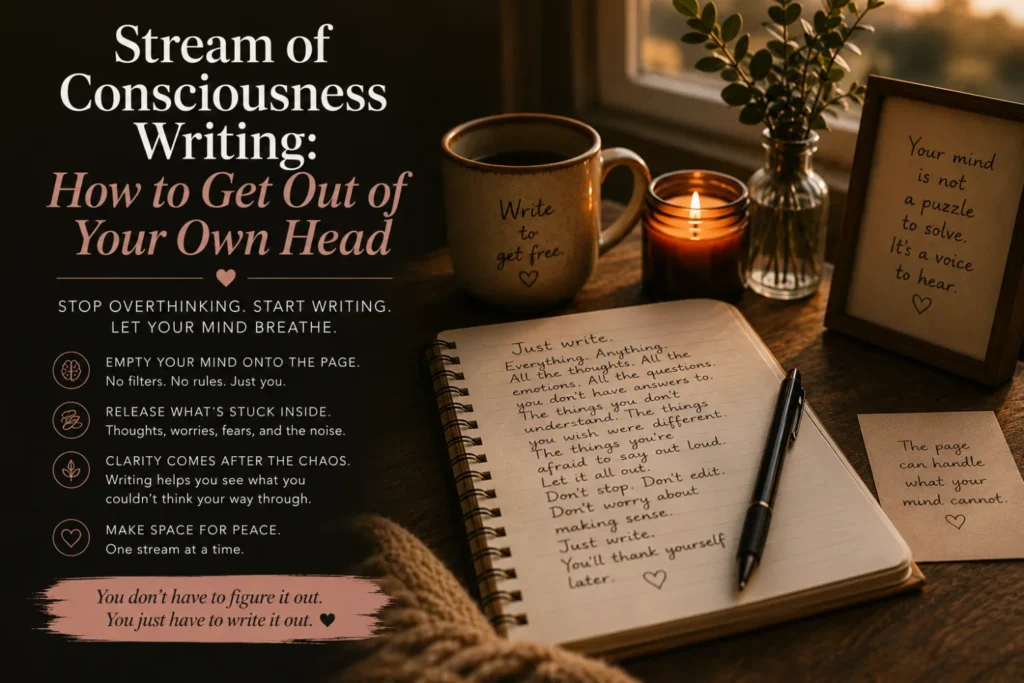

Most people think they need to clear their mind before they can write. Usually it’s the opposite. The mess in your head is often exactly what needs somewhere to go, and stream of consciousness writing gives it a place to land.
What should you understand first about stream of consciousness writing?
A loose, unfiltered way of writing where you keep going without stopping to organize, polish, or make the thoughts sound better than they are.
If you’ve ever sat down to journal and somehow ended up staring at the same blank page for ten minutes, this is probably the kind of writing that helps. Not because it turns you into a better writer. Because it gets you out of the weird little performance you can slip into when you’re trying to sound wise, productive, healed, or even coherent.
Stream of consciousness writing is basically writing without stopping to organize, edit, or make it nice. You let the thought happen on the page while it’s still a little messy. That’s the point. You’re not building an argument. You’re not making a diary entry anyone should ever read. You’re not trying to impress your future self, which is honestly where a lot of journaling goes sideways.
It can look chaotic. Sometimes it is. But chaotic and useless aren’t the same thing.
What this kind of writing is actually doing
When you’re stuck in your own head, the problem usually isn’t that you have no thoughts. It’s that you have too many, and they’re all talking over each other. One part of you is trying to explain. Another part is trying to stay in control. Another part is censoring everything before it even gets fully formed.
Stream of consciousness writing interrupts that traffic jam.
You write the sentence before you know where it’s going. Then the next one. Then the next. No pausing to fix the wording. No deleting because it sounds dramatic. No cleaning up the emotional parts so they seem more reasonable. You give your mind less time to stage-manage itself.
That’s why this can feel surprisingly relieving even when what comes out isn’t profound. Sometimes the win is just that the thought stopped circling. It existed somewhere outside your body for a minute.
If you’ve been trying to use journaling to process something heavier, not just clear mental clutter, expressive writing for emotional healing goes into that deeper territory. Stream of consciousness is looser. Less structured. More like opening a valve.
The part that throws people off
A lot of people try this once, write three awkward lines, and decide they’re doing it wrong.
Because the first few minutes can be deeply unimpressive.
You might write things like:
- I don’t know what to say
- This feels fake
- Why am I writing about this
- I should probably answer that email instead
That still counts.
Actually, that’s often the doorway. The surface-level noise usually comes first because it’s the part closest to your mouth, so to speak. If you keep going without trying to force depth, the more honest material tends to show up after the polished, defensive, mildly irritating stuff burns off.
Not always in some dramatic breakthrough way. Sometimes it arrives sideways. You start writing about being annoyed at a small thing, and five minutes later it’s very obvious you’re not upset about the small thing.
That’s useful.
You’re allowed to write badly
This sounds obvious until you’re the one holding the pen.
One reason people stay trapped in overthinking is that they keep trying to produce a version of themselves they can approve of in real time. Calm version. Insightful version. Spiritually evolved version. The version who already knows the lesson.
That version is exhausting.
Stream of consciousness writing works better when you let the page hold the unflattering draft of your mind. Petty thoughts. Repetitive thoughts. Contradictory thoughts. The sentence that makes you pause and think, wow, that’s embarrassingly honest. Especially that one.
There is usually a moment where you want to pull back because what you’re writing sounds needy, angry, jealous, dramatic, confused, or just less noble than you’d prefer. That’s often the exact moment to keep going.
Not because every raw thought is true. It isn’t. But because censored writing tends to stay on the surface, and surface writing rarely gets you anywhere new.
What to do when your brain tries to turn this into homework
It probably will. Very fast.
You sit down to write freely, and suddenly your mind wants rules. Should this be in the morning? How long should it be? Should you use prompts? Should you write by hand? Should you keep it or throw it out? Somehow a practice meant to loosen your grip becomes one more thing to optimize.
If you’re comparing routines, morning pages vs evening journaling really comes down to when you’re most honest, not when you’re most disciplined. Some people are foggier and freer first thing in the morning. Some finally tell the truth at night when they’re too tired to perform.
For stream of consciousness writing, the useful rule is just this: keep the pen moving, or keep typing, long enough to get past your own editor.
That might be five minutes. It might be fifteen. You do not need the perfect notebook, a sacred ritual, or a better lamp.
And if you spend three weeks thinking about starting instead of starting, that would be an extremely human thing to do. Not ideal. Very common.
What it can sound like on the page
Not elegant. That’s part of the charm, if charm is the word.
It might look like one long paragraph. It might jump from a grocery list brain to an old memory to a sentence you didn’t know you needed. It might repeat itself. It might contradict itself two lines later. Good. Your mind does that too.
A lot of people quietly assume meaningful writing should arrive in complete thoughts. But real thought is lumpy. It doubles back. It changes tone in the middle. It says, actually no, that’s not it, and then gets closer on the next line.
So if your writing sounds like this:
I’m annoyed, which is probably not the real thing, the real thing is I felt dismissed, no that’s still too clean, the real thing is I wanted to matter more than I did in that moment
that’s not failure. That’s movement.
You can learn a lot from seeing your mind correct itself in real time.
When this helps most
This kind of writing tends to help when you’re mentally jammed rather than simply uninspired.
For example:
- you keep replaying the same conversation
- you know you’re upset but can’t name what the actual injury was
- you feel emotionally crowded and a little snappy for no clear reason
- you keep trying to think your way into clarity and somehow get less clear
It’s also useful when your feelings are coming out sideways. A lot of people think they’re dealing with procrastination, numbness, irritation, or random restlessness when they’re actually dealing with fear. Or grief. Or resentment they’ve been trying to behave their way around.
If the thing underneath all that is anxiety, what actually helps with journaling for anxiety is often less about getting the thoughts perfectly sorted and more about giving them shape before they run the whole room.
When it gets uncomfortable
Sometimes the page gets honest faster than you expected.
You start out writing because you’re overwhelmed at work, and suddenly you’re writing about your marriage. Or your loneliness. Or the fact that you’ve been pretending something is fine because naming it would make it more real.
That can be a lot.
You don’t have to force yourself to stay in material that feels destabilizing. This isn’t a moral test. If writing starts to leave you more flooded than relieved, scale it back. Shorter session. More grounding. More structure. Sometimes a completely open page is too open, especially when you’re already carrying a lot.
That’s where more guided forms of journaling can help. Some people do better when there’s a container around the mess, especially if they keep bumping into parts of themselves they’d usually avoid. shadow work journaling can be useful there, not because it makes things lighter, but because it gives shape to what feels vague and loaded.
You don’t have to choose one method forever, either. Free writing one day, prompts the next, no journaling at all the day after that. Your mind is not a machine. It doesn’t need one setting.
A few things that make it easier
Not better. Easier.
- Start in the middle of the thought, not at the beginning. Write the sentence that’s already pressing on you.
- Give yourself a time boundary. An open-ended session can turn weirdly intimidating.
- Don’t reread while you’re still writing. That’s where the self-consciousness sneaks back in.
- If you freeze, write exactly that. “I froze because I don’t want to admit…” is still movement.
The main thing is not to turn this into a purity test. You’re not trying to become the kind of person who journals correctly. You’re trying to hear yourself a little more clearly.
The strange relief of seeing the thought outside you
There is something oddly humbling about watching a giant feeling become three uneven sentences on a page.
Not smaller, exactly. Just more visible.
That’s often the shift people are actually looking for. Not instant peace. Not a breakthrough they can frame and keep. Just a little separation between themselves and the mental weather. Enough to notice, oh, that’s the thought I’ve been living inside. That’s the story running on a loop. That’s the part that’s scared.
And once it’s visible, you can respond to it instead of just being pushed around by it.
Some days you’ll write for ten minutes and end up with nothing especially useful. Just static. Complaints. Fragments. Fine. Other days one line will show you exactly where the pressure is.
You usually can’t predict which day will be which, which is annoying. Still true.
If this practice helps, it probably won’t be because you suddenly became deep and articulate. It’ll be because you stopped interrupting yourself long enough to hear what was already there. That shift is quieter than people expect. But it tends to matter.
Get the thoughts out without sending them anywhere
If your mind feels crowded and regular journaling turns into self-editing, Unsent Letters gives those unfiltered thoughts a private place to land.