

It usually comes down to energy, not discipline
A lot of people get stuck on the idea that one of these is the “better” journaling practice. After reviewing how both tend to work in real life, the split is usually simpler than that: morning pages help when your mind is crowded before the day even starts, and evening journaling helps when your thoughts pile up because of the day you just had.
That’s the short version. The longer version is that the right fit has less to do with journaling theory and more to do with your actual schedule, your mental habits, and the kind of friction that keeps showing up for you.
Morning pages and evening journaling can both be useful. They just do different jobs.
Morning pages usually mean writing a few pages first thing, before email, before conversations, before your brain fully starts performing for other people. The point isn’t to create anything good. It’s to clear mental clutter and catch thoughts before they get edited.
Evening journaling is looser. Sometimes it’s reflection, sometimes emotional processing, sometimes a brain dump so you can stop replaying one weird comment from 2:17 p.m. while brushing your teeth. Same notebook, very different timing, and timing changes the whole feel of it.
What morning pages are good at
Morning pages tend to work best for people whose minds are loud early.
If you wake up already negotiating with yourself, already thinking through ten tasks, already feeling behind before you’ve left bed, writing in the morning can take some of the pressure out of that first hour. It gives all that half-formed noise somewhere to go.
In testing and comparison, this is the biggest difference morning pages seem to create: they reduce interference. You’re not necessarily solving anything. You’re just getting your own static off the line.
There’s also something useful about writing before the day starts shaping your mood for you. You catch your unfiltered thoughts sooner. That can be messy, repetitive, petty, anxious, dramatic, boring. Usually several at once. But it’s honest in a way that later writing sometimes isn’t, because later you’ve already edited yourself for survival.
Morning pages can be especially helpful if you:
- overthink before the day begins
- freeze when you have too many priorities
- feel mentally “sticky” after waking up
- want a practice that is less about insight and more about clearing space
The downside is pretty obvious. Mornings are rude. If your life involves kids, commuting, shift work, medication timing, chronic fatigue, or just a deep hatred of being conscious at 6:30, morning pages can start feeling like one more thing you’re failing at before breakfast.
That matters more than people admit. A practice that sounds meaningful on paper can become weirdly annoying in real life.
Morning pages are bad at performance
This is where people often trip over the format.
If you approach morning pages hoping to produce wisdom, track habits neatly, or uncover a clean emotional arc every day, you’ll probably hate them. They are often repetitive and boring. Some days the writing is basically a transcript of mental lint. That’s normal.
The value is in the uncensored patterning. You start noticing what your brain circles when nobody’s around yet. That can be useful, especially if you’re trying to understand anxious loops, old narratives, or moods that seem to show up out of nowhere. If that’s the part you want to work with more directly, writing that leans toward what actually helps with anxiety may fit better than forcing yourself through three pages every morning.
What evening journaling does better
Evening journaling tends to suit people who don’t really know what they think until the day is over.
Some people need lived material before writing feels real. Morning pages can feel thin to them, like trying to squeeze insight out of a brain that hasn’t fully loaded yet. Evening writing has more to grab onto. A conversation. A trigger. A win you almost skipped past. A moment you handled badly and can now look at with a little distance.
That makes evening journaling better for reflection and emotional sorting.
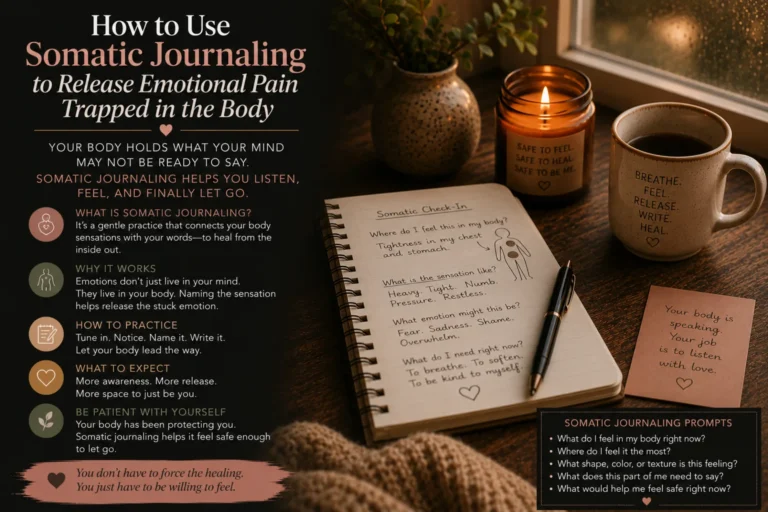
It also gives you a natural place to close things out. If your problem is not mental noise at sunrise but mental replay at night, evening writing is often the cleaner match. You can put the day somewhere besides your nervous system. For people carrying stress physically, that overlap between body tension and written reflection can matter more than the time of day. If that’s familiar, the piece on somatic journaling and emotional pain in the body gets into a side of this that basic journaling advice usually skips.
Evening journaling can work well if you:
- process emotions slowly
- replay conversations at night
- want to reflect instead of just unload
- need help transitioning out of the day
There’s also less pressure to do it “correctly.” Morning pages have a reputation and a structure. Evening journaling can be five lines, two pages, one list, a letter you never send, or a page of nonsense followed by one sentence that actually says the thing. Some people take that looseness further and treat the page as disposable on purpose, writing it out and then burning it or tearing it up once it’s done its job, since the point was never to keep the page, just to stop carrying the feeling alone for one evening.
That flexibility helps a lot of people stay with it.
Evening journaling can drift into rumination
This is the catch.
If you already spiral at night, journaling can either interrupt that pattern or feed it. The difference is usually in how you write, not whether you write. Reflection helps. Repetition doesn’t.
A useful evening entry often moves somehow. From event to feeling. From feeling to need. From stress to one clear sentence. A not-so-useful one just keeps restating the same grievance with slightly different adjectives until you’re somehow more activated than when you started.
That doesn’t mean evening journaling is a bad idea if you’re anxious. It just means the style matters. A lot. There’s a reason some people do better with more contained prompts or a clearer emotional frame, especially if they’re already keyed up at bedtime.
The real question is what part of the day you lose yourself
This is the comparison that tends to be more useful than any rule about “best practice.”
If you lose yourself in the morning, choose the practice that meets you there.
That might look like waking up scattered, grabbing your phone too fast, and spending the next two hours reacting to other people’s needs before you’ve had one complete thought of your own. Morning pages can interrupt that. They create a buffer between your inner voice and the day’s noise.
If you lose yourself at night, evening journaling makes more sense.
That might look like getting through the day reasonably well, then collapsing into second-guessing once everything gets quiet. Suddenly you’re reviewing your life like a hostile committee. Evening writing can give that energy a shape, which is sometimes enough to make it smaller.
People often assume the choice should reflect personality. Early bird versus night owl, structured versus reflective. Sometimes that’s true. But often it’s more about where your mind becomes hardest to live with.
What each one asks from you
Morning pages ask for willingness before readiness.
You usually have to write before you feel eloquent, before you feel awake, sometimes before you feel like a person. That can be freeing if perfectionism is your problem. It can be miserable if your mornings are already stretched thin.
Evening journaling asks for honesty after impact.
You’re writing with more context, but also with more emotional residue. Some nights that makes the page richer. Some nights it just makes you tired and dramatic. Which, to be fair, is still information.
One slightly awkward reality here is that a lot of people pick the version that sounds more virtuous, then quietly stop doing it. Usually because it never fit their life in the first place. There’s no prize for choosing the more literary option and then avoiding your notebook for three weeks.
That’s why it helps to judge both practices by friction, not fantasy.
Try the version you’re most likely to repeat
This is less romantic, but more useful.
The better journaling practice is usually the one you can return to without turning it into a moral referendum on your character. If a method makes you feel like you need ideal lighting, forty minutes, and a purified emotional state, it probably won’t survive an ordinary week.
A simple way to test the fit is to try each style for a few days and pay attention to what changes.
With morning pages, notice:
- whether your mind feels clearer or just annoyed
- whether the writing helps you start, decide, or focus
- whether the structure feels containing or weirdly rigid
With evening journaling, notice:
- whether you feel calmer afterward or more stirred up
- whether the writing helps you reflect or just relive
- whether bedtime becomes gentler or more mentally crowded
That kind of testing tells you more than any abstract promise about creativity or healing ever will.
And if what you actually want is deeper emotional material, not just daily processing, you may end up leaning toward practices that are more intentionally exploratory, like beginner-friendly shadow work journaling or the broader approach covered in the guide to expressive writing for emotional healing. Those aren’t automatic substitutes for morning or evening journaling, but they can explain why a plain daily entry sometimes feels too shallow for what you’re trying to do.
You don’t have to marry one format
A lot of the confusion disappears once you stop treating this as a permanent identity choice.
You can use morning pages during overloaded weeks and switch to evening journaling when you need reflection. You can do quick morning clearing and longer evening check-ins. You can abandon both for a month and come back when life feels less like a dropped tray in a crowded restaurant.
The all-or-nothing version of journaling is what tends to break people, not the writing itself.
There’s also a seasonality to this stuff that people don’t talk about enough. Morning writing can be great when you’re trying to reclaim attention or create momentum. Evening writing can be better when you’re grieving, processing conflict, or trying to sleep without dragging the whole day into bed with you.
So if you’re choosing between them, I’d go with the one that meets the messiest part of your day first. That’s usually the one that earns its place.
Find the journaling rhythm you’ll actually keep
If you’re torn between writing in the morning or at night, Unsent Letters gives you a low-pressure place to try both and see what fits your real life.