You can get a lot out of both, but they do different jobs. The empty chair technique is usually better when the thing you’re carrying is live, physical, and hard to access with words alone. Unsent letters are usually better when you need time, privacy, and enough distance to say what you actually mean without spiraling halfway through.
That sounds neat on paper. In practice, the choice often comes down to one boring detail: can you stay with the feeling long enough to finish the exercise?
I’ve reviewed both approaches through the lens of what they ask from you in the moment, where people tend to get stuck, and which one is easier to repeat when you’re already emotionally tired. They overlap, but they don’t feel the same at all.
They look similar, but they pull different things out of you
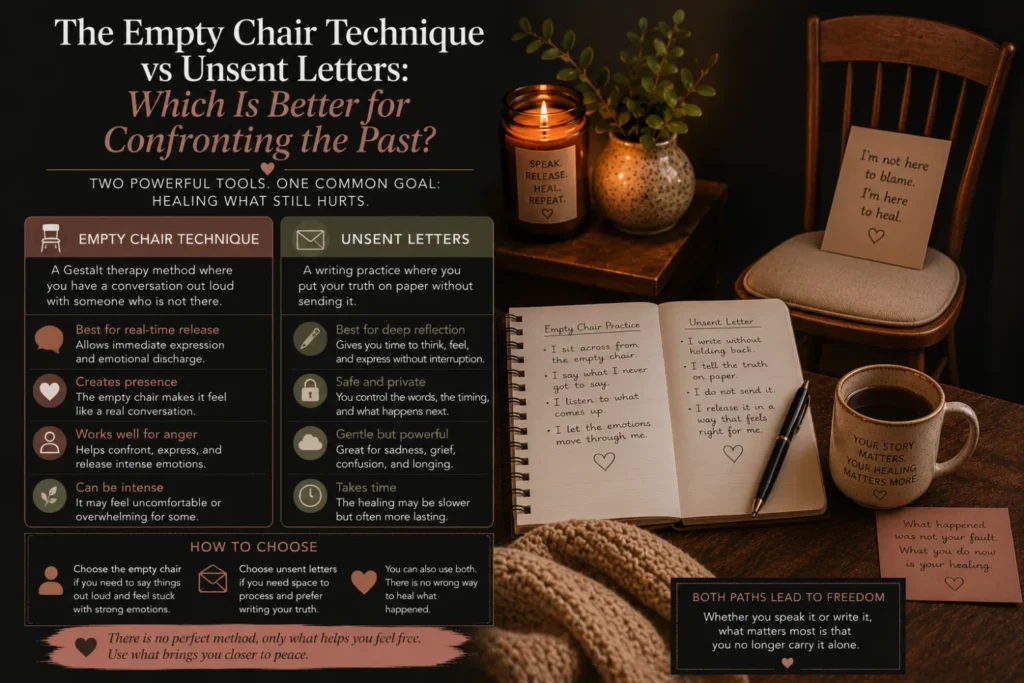
Both methods are ways to address something unresolved without contacting the actual person. That’s the shared part. You speak or write what didn’t get said, what couldn’t get said, or what you didn’t know how to say at the time.
The empty chair technique usually means sitting across from an actual empty chair and speaking to the person you associate with the pain, conflict, or unfinished feeling. Sometimes you answer back from their side too. It can feel awkward in the first minute, then strangely intense once your body starts treating the setup like a real interaction.
Unsent letters are more familiar. You write to the person, to your younger self, to a version of yourself that stayed silent, sometimes even to a situation rather than a person. You don’t send it. The point is expression, not delivery. If you’re already drawn to journaling, this often fits more naturally, especially if you’ve done any expressive writing for emotional healing before.
The difference is pace. The chair asks for immediacy. The letter gives you a buffer.
When the empty chair tends to work better
This one is stronger when the issue feels stuck in your body, not just your thoughts. If you can explain the whole story perfectly but still feel your chest tighten when you picture the person, the chair often reaches something writing doesn’t touch right away.
That’s because it creates a live exchange, even though it’s imagined. You have to say the thing out loud. You hear it. You react to it. Sometimes that breaks through the polished version you’ve been repeating to yourself for years.
It helps when you’ve edited yourself too well
Some people write beautifully and avoid the real point the whole time. The sentences are controlled. Reasonable. Very mature. Meanwhile the actual feeling is sitting in the corner with its arms crossed.
The empty chair makes that harder. You might start with the sensible version, then hear yourself say, “No, that’s not even why I’m upset,” and end up somewhere more honest.
That said, this method asks a lot from you. It can bring up fast emotion, fast defensiveness, fast shame. If you’re the kind of person who gets flooded easily, or goes blank the second a feeling gets too close, this can turn into ten miserable minutes of staring at furniture and feeling weird. Which, to be fair, is a very common outcome on the first try.
It can be useful when anger is part of the block
Anger is often easier to access in spoken form than written form. On the page, people tend to soften, explain, justify, clean up. In a chair exercise, anger shows up faster. Sometimes that matters because anger is covering grief, and sometimes because anger itself is the thing you were never allowed to have.
If your history includes being shut down, interrupted, laughed at, or made to feel dramatic, speaking into an empty chair can be surprisingly revealing. You get to hear how often you still stop yourself before you’ve finished a sentence.
When unsent letters usually work better
Unsent letters are easier to begin and easier to return to. For a lot of people, that matters more than intensity. A method doesn’t help much if you avoid it for three weeks because it sounds emotionally expensive.
Letters let you move at your own speed. You can write for eight minutes. Stop. Come back tomorrow. Cross things out. Start again. You don’t need to perform steadiness in real time.
They’re better for complicated feelings
If what you’re carrying isn’t one clean emotion, a letter gives you room for contradiction. You can be angry and loyal. Sad and relieved. Missing someone and wanting nothing to do with them. Spoken exercises sometimes push people into a dramatic one-note confrontation when the truth is messier than that.
Letters also help if you need precision. Maybe what hurt wasn’t one giant event. Maybe it was a pattern, a tone, a hundred small moments that taught you something damaging. Writing lets you name details without losing the thread.
That can blend well with other page-based methods. If you tend to freeze at the start, a few minutes of stream of consciousness writing can get you past the stiff, edited version and into something more real before you begin the letter itself.
They give you more control over the aftermath
The chair can leave people raw. Sometimes that’s productive. Sometimes it just wrecks the rest of your afternoon.
An unsent letter is easier to contain. You can set a timer, write, close the notebook, and do something grounding. You can also choose what kind of letter you’re writing. A blunt one. A grieving one. A letter that says everything. A letter that says only what you wish had been acknowledged. A letter to your younger self instead of the person who hurt you.
That flexibility matters if direct confrontation, even symbolic confrontation, feels too sharp. Some people don’t need a face-to-face simulation. They need language they can actually stay with.
What each method tends to cost you
The empty chair usually costs more emotional energy upfront. It can feel exposed even when nobody else is there. It can also trigger self-consciousness fast. Plenty of people spend the first round feeling ridiculous, and that embarrassment is not some deep symbolic truth. Sometimes it just means the exercise is awkward.
Unsent letters cost more in honesty over time. You can hide in writing if you want to. You can make the letter eloquent instead of true. You can explain your pain so neatly that you never quite touch it. That’s the quieter trap.
So the tradeoff is pretty simple. The chair is harder to fake, but harder to tolerate. The letter is easier to tolerate, but easier to dodge.
If you’re trying to choose, start with your actual sticking point
People often pick based on what sounds deeper. That’s usually the wrong filter.
Pick based on where you get blocked.
- If you intellectualize everything, try the empty chair.
- If you get overwhelmed quickly, start with an unsent letter.
- If you don’t know what you feel yet, write first.
- If you know exactly what you feel but can’t release it, speak it.
That’s the clean version. Real life is less tidy. You may start writing and realize you’re still censoring yourself. You may try the chair and discover you need the structure of sentences on paper first.
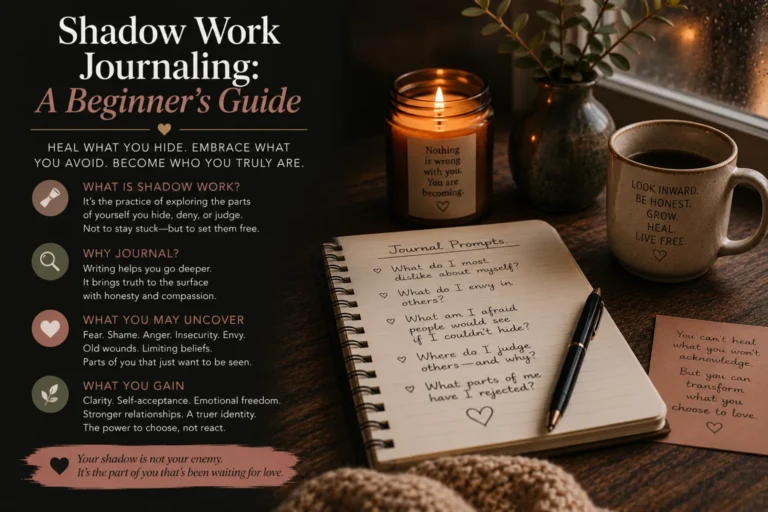
For people who already use journaling to sort through buried reactions, something like shadow work journaling can make the choice clearer because it shows you whether your block is avoidance, confusion, or fear of saying the ugly part out loud.
A simple way to test both without making it into a whole project
You don’t need to commit to one as your method forever. Try both in a controlled way and pay attention to what actually moves, not what feels more dramatic.
Try the letter first if you’re hesitant
Set a short timer. Write to the person or version of yourself involved. Don’t aim for something graceful. Aim for specific. What happened, what it cost you, what you still carry, what you wish had been different. Then stop before you’re completely drained.
Afterward, notice whether you feel clearer, flatter, angrier, calmer, or nothing at all. Nothing at all is useful information, even if it’s annoying.
Try the chair when the words feel trapped in your throat
Use one direct sentence to begin. Something plain. “I’m still angry about this.” “You don’t get to decide that it didn’t hurt me.” “I needed something from you that I never got.”
Then keep going for a few minutes. If speaking back from the other chair feels useful, do it. If that feels fake or manipulative, skip it. This isn’t a performance test.
I still think one of the least flattering but most helpful observations from reviewing these exercises is how often people choose the version that lets them stay polished. That’s a very human move. It also tends to keep the old material exactly where it is.
Sometimes the better choice is the one you’ll repeat
A single intense session can help, but repetition usually tells you more. If one exercise gives you a breakthrough once and the other helps you tell the truth five times over a month, the second one is probably doing more for you.
This is where routine matters a little. If your life has a natural writing window, the letter method may fit better than a chair exercise that requires privacy and a steadier nervous system. If you’re already comparing morning pages and evening journaling, the answer may be less about psychology and more about when you’re least defended.
There isn’t a gold medal for picking the more intense option. Sometimes the better method is just the one you don’t immediately start avoiding.
When neither one feels like a good idea
If you’re in a fragile place, very activated, or dealing with trauma that doesn’t stay contained once opened, either exercise can feel like too much without support. That doesn’t mean you’ve failed at journaling or avoided the real work. It may just mean self-guided confrontation isn’t the right tool for that part of the past.
And if your main reaction to both is “I already know what happened, I just can’t stop reliving it,” the issue may not be expression. It may be regulation, pacing, or needing a setting that feels safer than doing this alone on a Tuesday night.
So which is better? Usually, the empty chair goes deeper faster, and unsent letters let you stay longer. If you need access, use the chair. If you need room, use the letter. If you’re still unsure, start with the one that feels slightly more honest and only slightly more uncomfortable.
Not sure which method fits you right now?
If you're torn between writing it out and saying it out loud, use a guided prompt set to figure out which approach feels safer, clearer, and easier to finish.