
Sometimes emotional pain stays oddly physical. Your chest gets tight when nothing is happening. Your shoulders feel braced three hours after the hard conversation ended. You try to journal about it, and all that comes out is a neat summary of the situation while your body keeps holding the real story.
Somatic journaling can help with that. The basic shift is simple: instead of writing only about what happened, you also write from what your body is doing right now. That usually gives you access to feelings that are harder to reach through analysis alone.
You don’t need to be good at journaling, and you don’t need a dramatic breakthrough for it to work. What tends to help is slowing down enough to notice sensation, naming it without forcing meaning too fast, and letting the page hold what your body has been carrying.
What somatic journaling actually is
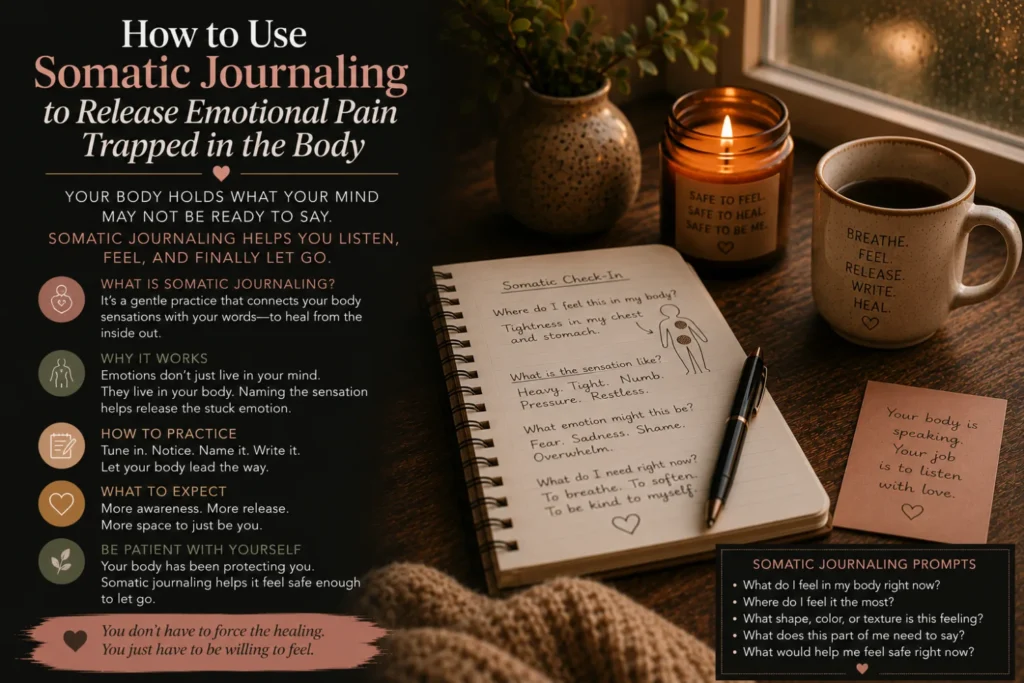
Somatic journaling is writing that stays connected to physical sensation. “Somatic” just means body-based. So instead of starting with a thought like “I’m upset because my sister ignored me,” you might start with “My throat feels thick,” or “There’s heat in my face and a heavy feeling behind my eyes.”
That sounds small, but it changes the whole process. A lot of emotional pain gets cleaned up too quickly once it becomes language. You explain it. You justify it. You turn it into something tidy. The body is usually less polite. It tells you where the strain is, whether the feeling is sharp or dull, whether it’s moving or stuck, whether it wants to curl in or push out.
This doesn’t mean every ache is a hidden emotional message, and it doesn’t mean journaling replaces therapy or medical care. If you’re dealing with trauma, panic, self-harm thoughts, or symptoms that feel intense or destabilizing, extra support matters. Somatic work can bring things close to the surface fast.
Still, for ordinary grief, anger, shame, stress, and the kind of sadness that lingers in the body long after you’ve “made sense” of it, this approach can be surprisingly direct. If regular journaling keeps turning into explanation, it may help to spend time with expressive writing for emotional healing as a broader practice and then come back to the body-focused version when you want something more immediate.
Why the body often knows before the mind does
You can understand something intellectually and still not feel done with it. That’s the frustrating part. You know the relationship ended for good reason, or you know the conflict wasn’t entirely your fault, and yet your stomach drops every time you see a name on your phone.
That gap is where somatic journaling earns its keep. The body reacts before a neat explanation is available. It holds tension patterns, protective habits, little flinches, breath changes, urges to go numb, urges to run, urges to fix everything immediately. Writing from that level gives you material that thought-based journaling often misses.
It also slows down the part of the mind that wants to get to the moral of the story. That part means well, but it can be a little overinvolved. It wants resolution on page one. Emotional pain usually does not cooperate.
How to start without making it weird
You don’t need candles, a special notebook, or a 45-minute ritual. Five or ten quiet minutes is enough.
Start by noticing one physical sensation. Just one. Maybe your jaw feels clenched. Maybe there’s pressure in your chest. Maybe your hands feel cold and restless. Then write what you notice in plain language.
It can sound like this:
- There’s a buzzing feeling in my arms.
- My stomach feels hollow and pulled inward.
- My throat feels like it’s trying not to cry.
- I keep lifting my shoulders without meaning to.
That’s enough to begin. You are not trying to sound deep. You’re trying to stay accurate.
Then keep going with sensory detail before interpretation. Is the feeling heavy, sharp, hot, numb, cramped, fluttering, shaky, flat? Is it still or moving? Does it get stronger when you think about a certain person, place, or memory?
A useful sentence stem is: “When I stay with this sensation, it seems to say…” Another is: “If this tightness had a voice, it would say…”
That may feel slightly embarrassing at first. Fairly normal. The point isn’t to pretend your ribcage is writing poetry. The point is to get around the part of you that edits too early.
What to write when you feel blank
Blankness is a body state too. So is numbness. So is “I have no idea what I feel.” You don’t have to wait until something lyrical shows up.
If nothing is obvious, write about the absence itself. “I can’t feel much except heaviness.” “Everything seems far away.” “My body feels like a room with the lights off.” Simple is fine.
Then narrow your attention. Notice your face, throat, chest, stomach, hands, back, legs. One area usually has more to say than the rest.
You can also borrow structure when your mind is scattered. Some people do better when they write in the morning, before the day crowds in, while others need distance from the day before they can hear themselves clearly. There’s a useful comparison in morning pages vs evening journaling if your timing keeps getting in the way.
A simple somatic journaling flow
You don’t need to do all of this every time, but this sequence keeps the writing from turning into pure rumination.
1. Name what your body is doing
Keep it physical. Tight chest. Heavy arms. Burning face. Knot in stomach. Tingling hands.
2. Stay there a little longer than is comfortable
Not to overwhelm yourself. Just long enough to notice whether the sensation shifts. A lot of feelings change once they’re observed without being argued with.
3. Let the sensation connect to emotion
You might write, “This pressure in my chest feels like fear,” or “The heat in my face feels like anger I’m trying to act above.” Sometimes the first emotion you name won’t be the deepest one. Keep going gently.
4. Ask what the feeling is trying to do
Does it want to hide, shout, freeze, leave, protect, collapse, reach? Emotions often come with impulse. That tells you a lot.
5. End with grounding
Look around the room. Feel your feet. Notice five ordinary things. Drink water. Write one orienting sentence like, “I’m here, and this is what I’m feeling right now.”
That last part matters more than people think. Without it, journaling can become a way to stir everything up and walk away shaky.
What release can actually look like
Release isn’t always dramatic. Sometimes it’s crying. Sometimes it’s a deep exhale you didn’t know you were holding. Sometimes your shoulders drop half an inch and that’s the whole event.
Sometimes the “release” is just finally telling the truth on paper. You stop writing the reasonable version and write the live one: “I’m angrier than I want to admit.” “I still want an apology.” “Part of me is embarrassed that this hurt so much.”
That kind of honesty can change the body more than a perfect insight does.
It also helps to know that somatic journaling is not the same as spiraling. Spiraling usually makes you feel more trapped in the story. Somatic journaling brings attention back to present-moment sensation, which tends to make the experience more specific and less endless. If your writing keeps looping around worry, what actually helps with anxiety journaling is often less about writing more and more about changing what you pay attention to.
One mistake people make right away
They try to interpret every sensation like it’s a puzzle with a correct answer.
You feel tightness in your chest and immediately decide it means unresolved abandonment, fear of intimacy, and probably something from third grade. Maybe. Maybe not. Sometimes a tight chest means grief. Sometimes it means anger you swallowed. Sometimes it means you had coffee on an empty stomach and also a stressful morning.
Let meaning emerge instead of assigning it too quickly.
This is slower than most people want. It can feel inefficient. The mildly unflattering truth is that a lot of people would rather produce a clever insight than sit with three minutes of discomfort. That urge to perform understanding shows up in journaling all the time.
Better to be plain and accurate than impressive and wrong.
When deeper material shows up
Sometimes body-based writing opens a door into older material you weren’t aiming for. A present-day conflict suddenly carries the emotional charge of something much earlier. The sensation in your throat or chest doesn’t feel new at all. It feels familiar in a way that’s hard to explain.
That can be useful, but it can also get muddy fast. If the writing starts moving toward shame, hidden resentment, or old identity patterns, you may be brushing up against work that overlaps with shadow work journaling. Go carefully there. Curiosity helps more than self-accusation.
You do not need to excavate everything in one sitting. If your body feels flooded, stop. Put both feet on the floor. Name the room you’re in. Save the page and come back later, or bring it into therapy if you have that support.
Prompts that keep you close to the body
If you want a few starting lines, keep them plain:
- Right now, the strongest sensation in my body is…
- If this tension could speak without being judged, it would say…
- The part of me that feels braced is trying to…
- When I picture this situation, my body does…
- What softens, even a little, when I tell the truth is…
Those work better than abstract prompts when you’re overwhelmed. They give your attention somewhere real to go.
How to know it’s helping
The best signs are usually subtle. You catch a feeling earlier. You stop calling yourself “fine” while your jaw is locked. A hard emotion moves through in twenty minutes instead of sitting in your back all day. You feel more honest on the page, which makes you a little more honest in the rest of your life.
And sometimes nothing dramatic happens except this: your body feels less alone in what it’s been carrying. For a lot of people, that’s where the shift begins.
If you try it and the first few sessions feel awkward, that doesn’t mean you’re doing it wrong. Body awareness is strangely hard for people who are used to living from the neck up. It gets clearer with repetition, then confusing again, then clearer in a different way. That part stays a little unresolved for most people, which is probably fine.
Let your body say what the mind keeps editing
If talking it through still leaves your chest tight or your throat locked up, a guided letter can help you put raw feeling on the page without cleaning it up too fast.