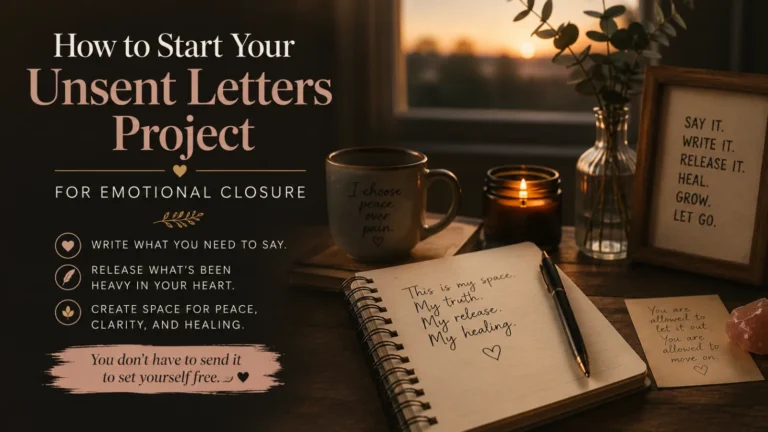


Sometimes the hardest part of grief is how much never got said. Not even dramatic things, necessarily. Just ordinary things, unfinished things, the one story you meant to tell, the apology that came too late, the anger you feel weird admitting.
An unsent letter can give those thoughts somewhere to go. It won’t fix grief, and it won’t create a neat sense of closure, but it can make the noise in your head feel a little more shaped and a little less lonely.
You do not have to make it good
That’s the first thing, honestly. A lot of people sit down to write this kind of letter and accidentally turn it into a performance. Suddenly it sounds formal, or wise, or suspiciously like something that would be read at a memorial by a person who has their life together.
You do not need that version.
An unsent letter while grieving is just a private place to say what is true right now. That might be loving. It might be confused. It might be repetitive. It might be, “I miss you and I’m angry and I hate that both things are true.” That counts.
If the phrase “unsent letter” feels a little vague, it really just means writing to someone, or sometimes to yourself, without any plan to deliver it. The point isn’t communication in the practical sense. The point is expression. If you want a broader look at how this kind of writing can help, the piece on therapeutic unsent letters for processing difficult emotions gets into that without making it feel clinical.
Start smaller than you think
People often imagine this big, cathartic page-one beginning. Dear whoever, here is the complete and coherent truth of my grief. Which would be nice. Very efficient. Usually not how grief behaves.
It often goes better if you begin with one real sentence instead of an important one.
Things like:
- I keep reaching for my phone.
- You would hate what happened with the kitchen sink.
- I still don’t know what to do with your sweater.
- I’m mad at you today.
- Nothing feels normal, and that’s getting old.
That’s enough. More than enough, actually. Grief writing tends to open once you stop trying to sound meaningful.
If you’re writing to someone who died, that can be its own strange and tender category. There’s a difference between “I’m journaling about loss” and directly addressing the person who’s gone. If that’s where you are, writing a letter to someone who died can feel a little more specific and easier to enter.
Let the letter be inconsistent
Grief is inconsistent. The letter gets to be inconsistent too.
You can miss someone and resent them. You can love someone and feel relieved they’re no longer suffering, then feel guilty for feeling relieved. You can spend three paragraphs talking about hospital rooms and then suddenly write about a grocery store cereal they used to buy. None of that is off track.
This is one of the places people get stuck, because they think the letter should have a clean emotional lane. Sad, loving, forgiving, grateful. Pick one. Stay there. Be admirable.
Turns out, no.
The mess is often the real thing. If your letter swerves, let it swerve. If it repeats itself, let it repeat. Sometimes the same sentence shows up six different ways before it finally says what it means.
If anger is in it, let it be in it
This part matters because a lot of grief gets edited for politeness. Especially if the person died. People can feel strangely disloyal for admitting they’re furious.
But anger is common in grief. Anger at what happened. Anger at what didn’t happen. Anger at doctors, family, God, timing, addiction, illness, distance, silence. Sometimes anger at the person themselves. Sometimes for leaving. Sometimes for what they did before they left. In a private letter, that anger can sit beside love and loss without needing to be cleaned up first, which is one reason an unsent letter when you were the one who walked away can feel like a place to put the truth down without editing it.
You do not have to turn that anger into a lesson by the end of the page. You also do not have to make it fair before you write it down. You can be more honest in a private letter than you can in a conversation, and that honesty is often the whole point, especially when you’re writing to someone who died.
Write like nobody will ever read it
Because ideally, nobody has to.
That sounds obvious, but plenty of people unconsciously write for an imaginary audience. A therapist. A sibling. The version of themselves that will reread this later and judge whether they did grief correctly. It makes the letter tighten up. Everything gets cleaner and less useful.
So it can help to make the privacy extremely literal. Write on paper you can fold up. Type in a document named something boring. Set a timer and promise yourself you can delete the whole thing. Some people even write by hand because it slows down the part of the brain that wants to edit every sentence into something respectable.
And yes, some people absolutely put this off for weeks because sitting down with the truth sounds awful. That’s not a character flaw. That’s grief being grief.
You don’t need to tell the whole story
There’s a quiet kind of pressure to include everything. The full history. Every regret. Every beautiful memory. Every terrible detail. As if one letter should somehow hold an entire relationship and everything that followed.
It can’t. That’s not a failure. That’s just scale.
One letter can hold one corner of it.
Maybe today’s letter is about the last conversation. Maybe it’s about what nobody in the family says out loud. Maybe it’s only about how strange mornings feel now. If that’s what is most alive for you, that’s enough material.
Actually, narrowing the focus often makes the writing more honest. Instead of saying “I miss everything,” you might end up saying, “I miss the way you made ordinary Tuesday problems seem smaller.” That lands differently. It’s specific. It has weight.
What to do when you freeze
Freezing happens for all kinds of reasons. Sometimes it’s emotion. Sometimes it’s exhaustion. Sometimes you genuinely don’t know what you feel yet, and the blank page acts like it expects clarity on demand. Rude, honestly.
If you get stuck, try one of these and keep moving:
- Write, “What I can’t stop thinking about is…”
- Start with a complaint.
- Name one object that suddenly means too much.
- Write the sentence you’re avoiding.
- Let the letter be only five minutes long.
You can also stop addressing the person directly for a minute. Write, “Here’s what this week has been like.” Then switch back if you want. There are no purity points here.
If the letter turns toward another version of you
Sometimes grief doesn’t stay pointed at the person you lost. It swings back toward you. The version of you from before. The version of you who didn’t know what was coming. The version of you who made choices you’re still replaying.
That shift can be unsettling, but it isn’t wrong. Grief changes your relationship not just with the person who’s gone, but with time, memory, identity, and self-blame. Sometimes the person you most need to speak to is your earlier self.
If that’s where the writing is trying to go, there’s something steadying about writing to your younger self with honesty and compassion instead of staying trapped in hindsight and punishment.
You can stop before it feels finished
This one is hard for people who like a resolved ending. Or people who don’t like unresolved feelings sitting around the house like damp laundry.
But a grief letter does not need a graceful final paragraph. You do not need to end with peace, forgiveness, gratitude, or “I’ll carry you with me always,” unless that is truly what you mean. You can end with something unfinished because grief is unfinished.
You can stop when you feel yourself getting tired. You can stop when the next sentence starts to feel blurry. You can stop right after the most honest line, which is often the best place to stop anyway.
Some endings are plain:
- That’s all I have today.
- I’m still angry.
- I wish you were here for this.
- I don’t know what to do with the rest of this.
Those are real endings. Maybe not satisfying ones. Real is better here.
What you do with the letter afterward matters less than you think
People get surprisingly hung up on the post-letter ritual. Keep it, burn it, tear it up, tuck it in a drawer, put it in a box, reread it later, never look at it again. There’s no hidden right answer in that list.
The writing itself is the main event.
If a ritual helps you mark the moment, fine. If it feels forced or theatrical, skip it. Not every meaningful thing needs a candle and a symbolic release into the universe. Sometimes you just close the notebook and go make tea because you’ve done enough for one day.
If your grief has you thinking less about the past and more about how to keep living inside an uncertain future, there’s a gentle shift in writing to your future self when life feels uncertain. Different kind of letter, but sometimes it meets the same ache from another angle.
When this helps, and when it doesn’t
An unsent letter can help when your thoughts feel jammed up, when conversation feels impossible, or when your grief keeps circling the same unsaid thing. It can help give shape to feelings that are too tangled to explain out loud. Sometimes it softens the pressure just enough for you to breathe differently afterward.
And sometimes it doesn’t help much that day. Sometimes it stirs everything up. Sometimes you write two sentences and feel done, or numb, or annoyed. That does not mean you failed at it. It might mean you hit a real nerve. It might mean you’re tired. It might mean this tool is useful in small doses, not long ones.
If writing leaves you feeling overwhelmed in a way that lingers, it may help to bring this into therapy or some other kind of support instead of carrying it alone. Private writing can be gentle. It can also open doors you weren’t expecting.
The letter doesn’t have to create closure to be worth writing
That word gets pushed at grieving people a lot. Closure. As if the goal is to seal something up neatly and move on with improved posture and a new understanding of life.
Usually it’s not that tidy.
What an unsent letter can do is make room. Room for the love, the rage, the guilt, the tenderness, the ordinary updates, the things you still want to say even though there’s nowhere obvious to send them. That room matters. Not because it solves grief, but because grief gets heavier when everything stays trapped inside your own head. For friendship endings, that room can hold the unsaid apologies, mixed loyalties, and quiet grief that fit an unsent letter after a friendship ends.
You’re allowed to write a clumsy letter. You’re allowed to write one sentence. You’re allowed to come back and write another one next month that contradicts the first. None of that makes it less real.
Sometimes the most honest version is just this: there are still things you need to say, and this is one way to say them.
Need help finding the words?
Use a gentle prompt to start your letter when grief has you staring at a blank page. You do not need to write something polished—just something honest.