
Some days the future feels like a hallway with the lights out. You still have to keep walking, which is rude, honestly. Writing a letter to your future self can help because it gives all that spinning uncertainty somewhere to go besides your chest.
This isn’t about predicting what happens next or writing something wise enough to impress a later version of you. It’s more like leaving a note on the kitchen table for yourself before you head into a hard season. Something steady. Something human. Something you can come back to when your own thoughts get loud and slippery.
What this kind of letter is really for
When life feels uncertain, your mind usually does one of two things. It tries to solve everything at once, or it refuses to touch any of it. The letter sits in the middle. It lets you say what’s true right now without forcing a solution.
That matters more than it sounds like it should.
A letter to your future self can hold a few different things at once: fear, hope, confusion, tiny practical reminders, the version of your values you can still reach for when everything else feels messy. It gives shape to a moment that otherwise just lives in your body as stress.
You don’t need to be profound. You don’t need a perfect tone. You’re not drafting a time capsule for a museum. You’re making contact with yourself across time, which is a strange sentence, but it’s true.
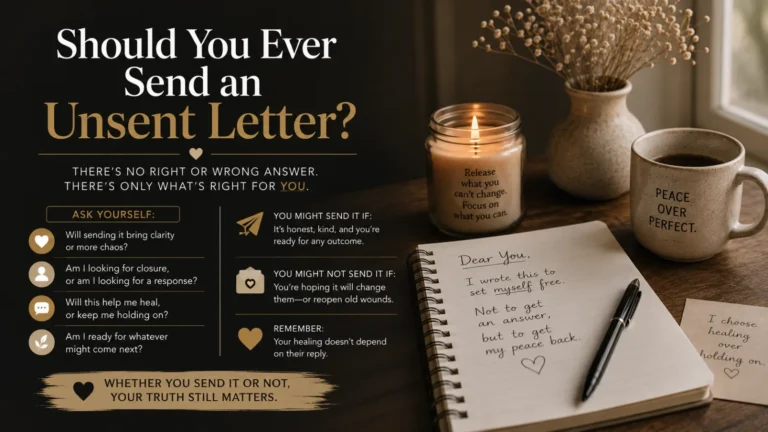
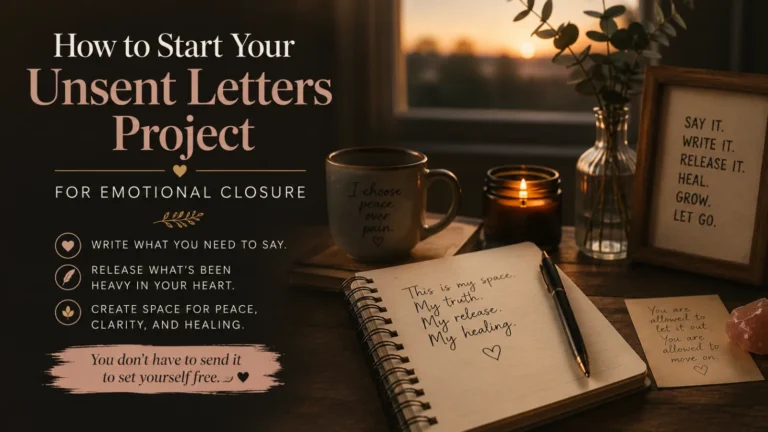
If you’ve ever found relief in writing letters you never plan to send, this can feel familiar. The difference is that this one isn’t aimed at closure with another person. It’s aimed at continuity with yourself.
Start with the version of you that exists today
The easiest mistake here is trying to sound like the person who already got through it. That usually creates a weird, stiff letter full of lines you don’t actually believe.
Write from where you are. Not from where you think you should be.
That might sound like:
- You’re scared and tired and trying not to make it everyone else’s problem.
- You keep changing your mind.
- You’re functioning fine on the outside and absolutely not fine in the private corners of the day.
- You don’t know whether this season is ending soon or just getting started.
That kind of honesty is the whole point. A useful letter doesn’t erase uncertainty. It names it in plain language so it stops leaking into everything unnamed.
If you freeze when the page is too open, start with one sentence: “Here is what life feels like right now.” Then keep going until the sentence stops pulling.
You don’t have to sound hopeful the whole time
A lot of people quietly turn this into a performance. They think the letter should be encouraging, mature, inspiring, maybe even a little poetic. Then they get stuck because what they actually feel is irritated, numb, or scared in a very unglamorous way.
You’re allowed to write the messy version.
You can say you don’t know what to do. You can say you’re angry that other people keep telling you everything happens for a reason. You can say you’re doing your best and your best currently looks like answering one email and reheating the same pasta again.
That last detail matters. Specifics make the letter real. “I’m struggling” is true, but “I keep opening my laptop and then staring at it like it personally betrayed me” is something your future self will recognize in their bones.
And if hope does show up, let it show up naturally. Don’t force it in like a motivational speaker who wasn’t invited.
What to include when you don’t know what happens next
This is the part people tend to overcomplicate. The letter doesn’t need a perfect structure, but it helps to give it a few anchors so you’re not just circling the same panic for three pages.
What is true right now
Name the reality of the moment as clearly as you can. What is uncertain? What are you waiting on? What are you grieving, fearing, hoping, avoiding?
Try to stay with actual truth rather than catastrophizing. Not because your fear is unreasonable, but because the letter becomes more useful when it’s grounded. “I don’t know whether this relationship is ending” is clearer than “everything is ruined.” “Work feels unstable and I can’t tell if I’m overreacting” gives you something to return to later.
What you want your future self to remember
This tends to be the heart of the letter.
Not goals, exactly. More like reminders. Things that are easy to lose when life gets noisy. Maybe you want your future self to remember that they were loved during this time, even if they couldn’t always feel it. Maybe you want them to remember that they kept showing up badly but sincerely. Maybe you want them to remember that they were allowed to change their mind.
This section is often simpler than people expect. A few lines can do it.
You might write:
- Please don’t mock this version of you for being scared.
- If this worked out, remember how impossible it felt from here.
- If it didn’t work out, remember that loss wasn’t proof of failure.
- You were trying. Even when it looked small from the outside.
What you need from yourself in the meantime
This isn’t a place for a 14-step life overhaul. Keep it close. Keep it doable.
You may need your future self to know that right now the job is just to get through the week. Or to keep one promise to yourself every day. Or to stop treating rest like a prize you have to earn through collapse.
Small, kind instructions tend to age better than grand declarations.
If you notice you’re writing in a punishing voice, that’s useful information too. A lot of people are far harsher with themselves on paper than they realize. If that’s happening, it may help to spend some time with using unsent letters to practice self-compassion, because the tone you use matters almost as much as the words.
The part that feels a little embarrassing is usually the real part
There’s often a moment in this kind of writing where you want to dodge the truth by sounding smarter than you feel. That’s usually the exact point to slow down.
Maybe the real thing is not “I’m navigating a transitional season with resilience.” Maybe the real thing is “You keep checking your phone for news that isn’t there.” Maybe it’s “You said you were fine three times today because explaining the actual answer felt too tiring.” Maybe it’s “Part of you wants a big dramatic sign so you don’t have to make an ordinary hard decision.”
That’s the stuff worth keeping.
Not because it’s dramatic. Because it’s honest in a way your future self will probably recognize immediately. A slightly unflattering truth can make the whole letter breathe.
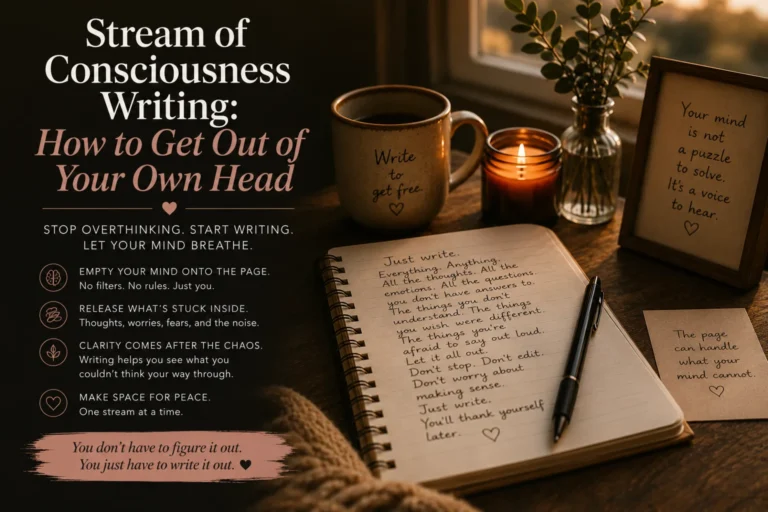
This is also why writing by hand can help, if that feels available to you. It slows down the polished voice. Not always, but often enough.
If you don’t know what to say, borrow a few sentence starters
Sometimes the page stays blank because your feelings are there, but they’re all standing on top of each other. A few simple openings can get things moving.
- Right now, the hardest part is…
- I hope when you read this, you remember…
- I need you to know that today…
- If this turned out differently than I wanted, I hope you…
- I don’t know what happens next, but I do know…
You don’t need to answer every one. One is enough. Two if the first one cracks something open.
And if writing forward feels too strange, sometimes it helps to approach it sideways. Some people find it easier to begin with the tenderness they’d offer a younger version of themselves, then carry that tone into the future-facing letter. There’s a reason writing to your younger self with honesty and compassion can unlock things that a direct self-help exercise can’t.
What to do with the letter after you write it
You’ve got options, and none of them need to be dramatic.
You can fold it and put it somewhere you’ll find it later. You can set a reminder to read it in six months. You can leave it in a journal and forget about it until a random Tuesday. You can even decide the writing was the point and never read it again.
There’s no gold star for revisiting it at the perfect moment.
If you do come back to it later, try not to read it like evidence in a trial. Read it like a message from someone who was doing their best with limited information. Because that’s what it is. Even if that version of you was spiraling. Even if they were avoiding obvious things. Even if they were weirdly fixated on one text message or one possible outcome or one conversation they replayed 40 times. Especially then.
Sometimes people worry they’ll cringe when they reread it. Maybe. A little. That’s fine. Mild embarrassment is not a sign the exercise failed. It usually means the letter was alive enough to be specific.

When this helps most
This kind of letter can be especially steadying when your uncertainty has no clean timeline. Waiting for test results. Sitting in the middle of a relationship shift. Not knowing whether to stay, leave, ask, begin, tell, try again. Grief can create this feeling too, where time keeps moving and part of you absolutely does not consent.
In those seasons, writing can become a way of staying connected to yourself instead of disappearing into reaction. Not fixing. Just staying connected.
And if part of your uncertainty is tangled up with loss, memory, or words you’ll never get to say directly, you might find yourself drifting toward other forms of letter writing too, including writing to someone who died when there’s still so much unsaid. Different letter, different purpose. Same basic human need to put feeling somewhere it can be held.
Keep it truer than it is polished
If you try this, the best version of the letter probably won’t sound impressive. It may be awkward in places. Repetitive. Uneven. A little raw around the edges. Good. That usually means it belongs to an actual moment in your life instead of a made-up wiser one.
You do not need to become certain before you write to yourself. That would defeat the point.
You just need a few honest sentences that can still be true while everything else is in motion. And maybe that’s enough for today. Or maybe it’s just the first thing that helps. Sometimes that’s all you get at first. Sometimes it’s more than it looks like.
Need help finding the words when your mind won’t settle?
Use a guided prompt to start your letter without forcing yourself to sound brave, wise, or put together. A little structure can make it easier to say what’s true right now.