
Sometimes the hardest part isn’t losing the friendship. It’s carrying around everything that never got said after. An unsent letter while grieving gives those thoughts somewhere to go, which is often the whole point.
When a friendship ends, people around you don’t always treat it like a real grief. There’s no script for it. No clean social ritual. You’re just supposed to “move on,” even if your brain keeps replaying the last conversation in the shower, in traffic, while pretending to answer emails.
That’s why writing a letter you never send can help more than a perfect text ever would. You’re not trying to reopen the friendship. You’re not building a legal case. You’re not proving who was right in paragraph four and who was emotionally unavailable in paragraph six. You’re giving your thoughts a container so they stop leaking into everything else.
What an unsent letter is actually for
An unsent letter after a friendship ends is private writing meant to say what you need to say without handing your healing over to the other person’s reaction. That matters.
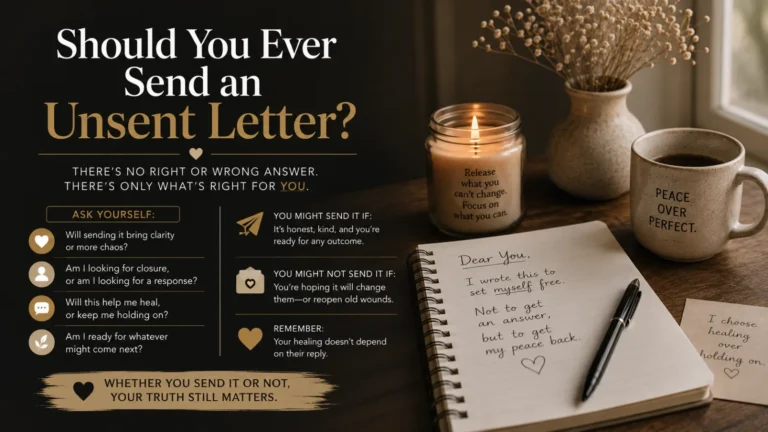
If you send the letter, the goal quietly changes. Now you’re waiting. Maybe for an apology. Maybe for understanding. Maybe just for proof that the friendship mattered as much to you as it did to them. That doesn’t make you needy. It makes you human. But it does turn the letter into a different kind of thing, which is why it helps to see how a closure letter you do not send works.Unsent letters work best when they let you tell the truth without managing someone else’s feelings in real time. You get to be honest, messy, specific, unfair for a line or two, then more honest again. You can contradict yourself. You can admit that part of you misses them and another part still feels angry.
If what you really want is peace rather than a reply, it can help to see how that shift works in a closure letter you do not send. The difference is subtle until you’re in it, and then it’s not subtle at all.
Before you write, pick the version of the truth you need
You do not need to write the definitive account of the friendship. You just need to write the version that is most alive in you right now.
That might be:
- the angry version
- the heartbroken version
- the confused version
- the version that finally sees what happened
Trying to sound balanced too early usually kills the whole thing. People do this all the time. They sit down to write something honest, then suddenly they’re drafting like a calm spokesperson for both sides. Very mature. Very emotionally useless.
You can always soften it later. The first draft is where you stop editing your own reaction long enough to hear it.
You don’t have to be noble on the first page
This is the part that tends to loosen things up.
You’re allowed to start petty. You’re allowed to write the sentence you’d never say out loud because it makes you sound twelve. You’re allowed to admit that what hurts most might not be the deepest thing. Sometimes it’s something small and ridiculous, like the fact that they still watch your stories or kept the inside jokes or acted normal in public two days after blowing up the friendship in private.
That kind of detail belongs in the letter. Not because it’s the whole truth, but because it’s often the doorway into the bigger truth.
And if you’re sitting there thinking, this feels childish, maybe. Sometimes grief is embarrassing. Sometimes your most sincere emotional breakthrough begins with a sentence that sounds like it was written by someone pacing their kitchen in unmatched socks. Still counts.
A shape that helps when your thoughts are all over the place
If the blank page makes you freeze, give the letter a loose structure. Not a rigid template. Just enough shape to keep you moving.
Start with what happened
Keep it simple. Name the break, the drift, the betrayal, the silence, the weird slow unraveling. Whatever actually ended it.
You don’t need dramatic language. “We stopped talking after that trip.” “Things changed when you kept canceling and then acted like I was overreacting.” “The friendship ended long before the final conversation, but that was the moment I had to admit it.” That’s enough.
Then say what it felt like
This is where people often rush, and it’s usually the part worth staying with.
Not just “I was sad,” in the abstract. More like: you felt stupid for not seeing it sooner. You felt replaceable. You felt relieved, which made you feel guilty. You felt angry that something so important ended in such a casual, half-finished way.
The more specific the feeling, the less the letter turns into a speech.
Say what never got said
This is usually the real center of it.
Maybe you never told them how much they hurt you because you were trying to keep the peace. Maybe you never admitted how one-sided the friendship had become. Maybe you never said thank you for what was good because the ending poisoned the memory for a while.
Put that here. Not the polished version. The actual version.
End with what you’re releasing
Not because you’re fully over it. Just because the letter needs somewhere to land.
You might be releasing the hope that they’ll suddenly explain themselves in a way that makes everything tidy. You might be releasing the role you played in that friendship. You might just be releasing the need to rehearse the same argument in your head every night.
That ending doesn’t have to sound wise. It just has to sound true.
What to write when you’re more confused than angry
Not every friendship ends with one clean offense. Some end through accumulation. Missed calls. Uneven effort. A weird shift in tone. One person grows, the other resists it, and nobody says that plainly. Then suddenly you’re grieving something you can’t even explain well to other people.
In those cases, your letter may need more questions than declarations.
You can write things like:
- I still don’t know when this started changing.
- I’m not sure whether you pulled away or I finally noticed.
- I can’t tell if we outgrew each other or just stopped being honest.
- I wish we had spoken plainly before everything got so weird.
That kind of writing can feel less satisfying at first because it doesn’t arrive at a verdict. But confusion is still real. It deserves language too.
What not to worry about while you’re writing
Grammar. Tone. Whether they would agree. Whether the timeline is perfectly fair. Whether you sound too emotional. Whether you sound not emotional enough. None of that matters yet.
The letter is not a court document. It’s not even a communication, really. It’s closer to emotional clearing.
One thing that helps is deciding ahead of time that nobody else will read the first version. Not your best friend. Not your therapist unless you want that. Definitely not the person it’s about. Once you know it doesn’t need to perform, the writing usually gets more honest fast.
If the friendship ending involved real hurt and you keep sliding into self-censorship, the language in writing to someone who hurt you without reopening the wound can help you find words that are clear without turning numb.
There’s a difference between honesty and spiraling
This part matters because writing can help, but it can also turn into emotional laps if you’re not careful.
If you notice yourself repeating the same accusation in six slightly different ways, pause. If the letter turns into a forensic reconstruction of every disappointing text exchange since 2021, pause harder. That doesn’t mean your feelings are wrong. It just means the writing may have drifted from release into rumination.
A good way back is to ask: what do you most want this person to understand, even if they never will?
That question tends to cut through the noise. It moves you away from exhibit-building and toward the actual wound.
If you still love them as a friend, say that too
Friendship endings get flattened into anger really easily, partly because anger is easier to carry around than tenderness with nowhere to go.
But if love is still in the room, let it be there.
You can miss someone and know the friendship needed to end. You can feel grateful and disappointed at the same time. You can know they were important to you without wanting them back in your life in the same way. None of that is contradictory in a bad way. It’s just what happens when the relationship was real.
This is often the part people avoid because it feels riskier than anger. It exposes more. But it’s also the part that makes the letter feel finished instead of defensive.
That same tension shows up in other kinds of endings too, especially when care and pain are tangled together. If that’s the part you’re stuck in, writing a goodbye letter to someone you still love gets at that strange mix directly.
What to do with the letter after
You do not need a meaningful ritual if that kind of thing makes you roll your eyes. You also don’t need to pretend it didn’t matter.
A few options usually feel better than just leaving it open on your laptop forever:
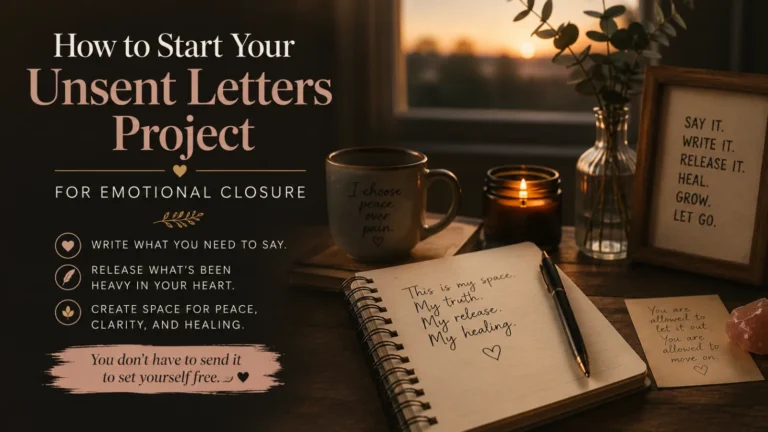
- save it in a folder and come back in a week
- handwrite it, then tear it up
- read it once out loud in private, then delete it
- keep it only long enough to write a calmer second version for yourself
The point isn’t to perform closure. It’s to mark that something moved.
And if you reread it later and cringe a little, that’s not failure. Honestly, that can be a good sign. It usually means the letter caught a feeling that was raw and real at the time, and you’re not standing in exactly the same place anymore.
When the letter makes you want to reach out
This happens a lot. You write the unsent letter, feel clearer, and suddenly you want to send a shorter, more reasonable version. Sometimes that urge means the writing helped you find your real point. Sometimes it just means the emotions got activated and now your nervous system wants contact.
Those are not the same thing.
If you feel pulled to send something, wait. Sleep on it. Read the letter the next day. Ask yourself whether contact would actually support your peace or just restart the same ache in a fresh format.
This comes up in breakup writing too, where the line between expression and reopening contact gets blurry fast. That’s why an unsent letter to an ex after a breakup can still feel surprisingly relevant here, even though friendship grief has its own flavor.
The letter doesn’t have to fix the ending
That’s probably the part worth holding onto.
You are not writing to create the perfect final word. You are writing because some endings leave too much unfinished inside you, and silence has a way of turning unfinished things into permanent background noise.
An unsent letter won’t make the friendship make sense if it didn’t. It won’t turn them into the person you needed. It may not even make you feel better immediately. Sometimes it just makes you feel more accurate, which is quieter but still useful.
And sometimes that’s enough for now.
Want help getting the words out without reopening the friendship?
Use a guided prompt to write what you actually mean, even if your thoughts feel tangled, angry, or unfinished. It can make the first draft easier when you do not know where to begin.