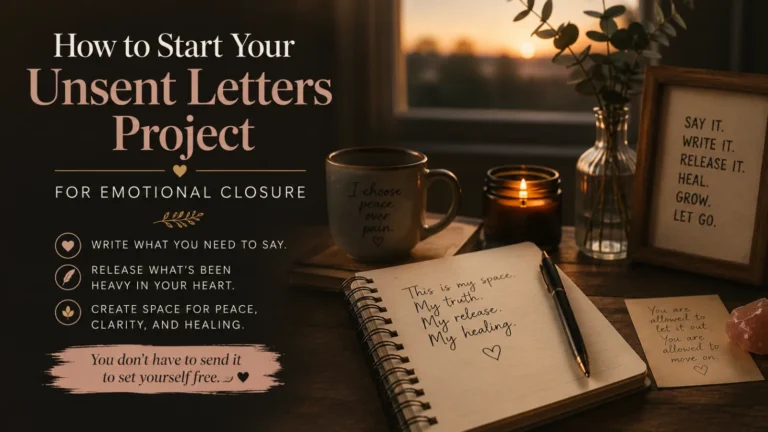


Sometimes the hardest part isn’t what happened. It’s the fact that the conversation never really ended, and your mind keeps trying to finish it anyway.
A closure letter you do not send can help with that. Not because it fixes the past, and not because it magically makes you feel okay overnight. Mostly because it gives your thoughts somewhere to go besides the same loop they’ve been running for days, months, or longer. You stop waiting for the perfect reply, the perfect apology, the perfect explanation, and you finally let yourself say the thing. Writing can be a powerful way to process feelings and find calm, as explored in Navigating Unspoken Emotions Writing as a Healing Tool.
That’s really what this kind of letter is. Not a performance. Not evidence for a trial in your own head. Not bait for a response. It’s a private place to tell the truth in full, even if nobody else ever reads it. Writing to someone who hurt you without reopening the wound requires careful phrasing and emotional boundaries, which you can explore in how to write to someone who hurt you without reopening the wound.
If you’re here, there’s a good chance part of you still wants the other person to understand. That makes sense. Most people don’t go looking for “closure” because they love vague emotional loose ends. They go looking because something was left open. Maybe the relationship ended suddenly. Maybe somebody lied, disappeared, minimized what happened, or acted like the damage didn’t count. Maybe the relationship is over, but your body and brain haven’t gotten that message yet.
And this is where people get stuck: they think closure is something another person gives them. Sometimes it is, a little. A thoughtful conversation can help. A real apology can help. Honest answers can help. But if you have to wait for somebody else to become emotionally available, self-aware, brave, accountable, or kind before you can begin healing, you may be waiting a very long time.
An unsent closure letter is a way to stop handing that person the only key.
What this letter is really for
People talk about closure like it’s one clean moment. You cry, you write, you burn the paper, you wake up glowing, the end. Usually it’s messier than that.
The real job of the letter is simpler. It helps you name what happened, what it cost you, what you wish had been different, and what you are no longer willing to carry in silence. It puts shape around an experience that may still feel blurry or unfinished.
That matters more than it sounds like it should.
When something painful stays unspoken, it can start turning into all kinds of other things. Self-blame. Rumination. Fantasies about the perfect final conversation. Imaginary courtroom speeches in the shower. Sudden waves of anger when you thought you were “over it.” A closure letter won’t erase all of that, but it often lowers the pressure.
It also gives you a place to separate your truth from their version. If they denied what happened, minimized it, or kept changing the story, that can do a real number on your sense of reality. Writing lets you put your own experience back in order.
Sometimes the letter is mostly grief. Sometimes it’s anger. Sometimes it’s a calm statement of facts. Sometimes it starts as one thing and turns into another halfway through. That’s fine. You do not need a pure emotion to write an honest letter.
Why not sending it can be the whole point
A lot of people resist the idea at first because not sending it feels pointless. If the person never reads it, what’s the point?
The point is that your nervous system may need expression more than it needs contact.
Those are not the same thing.
Contact means reopening a channel with someone who may hurt you again, dismiss you, ignore you, reply defensively, or say exactly the one thing that sets you back for three weeks. Expression means your side gets to exist without negotiation.
That difference is huge.
When you send a painful letter, the focus often shifts immediately. It stops being “what do I need to say?” and becomes “how will they take this?” Then maybe “why haven’t they answered?” Then “what did that short reply mean?” Then you’re decoding punctuation like it’s a hostage note. Not ideal.
Not sending the letter protects the original purpose. It keeps the letter about release, not reaction.
That doesn’t mean sending is always wrong. Sometimes people do choose to send something later, after they’ve written privately first and figured out what is actually theirs to say. But that is a separate decision. If what you want is peace, writing and sending do not need to be bundled together.
If you already know contact would pull you back into something harmful, the line becomes even clearer. In situations where reaching out would stir up fear, obsession, or more emotional injury, writing a final letter when contact is not healthy can help you keep the emotional truth without reopening the situation itself.
What “closure” actually looks like in real life
Closure is not always relief. Sometimes it’s just less noise.
It can look like going a whole afternoon without rehearsing what you wish you had said. It can look like not checking your phone every ten minutes. It can look like remembering the relationship without immediately rewriting yourself as the villain, the fool, or the one who should’ve somehow fixed all of it alone.
Sometimes closure looks almost boring. You still care, but the urgency drops. The fantasy conversation loses some of its shine. The person becomes more real and less central. Their silence stops feeling like a test you’re failing.
That’s one reason people often feel oddly flat after writing. They expect fireworks and get quiet instead. Quiet is not failure. Quiet is often the first sign that your mind has stopped bracing for impact.
And no, closure does not always mean forgiveness. It also doesn’t require total understanding. You do not need to fully explain another person to yourself before you can loosen your grip on what happened. Sometimes the honest ending is: this hurt me, I may never get a satisfying reason, and I’m done building my life around that missing answer.
If the open wound is specifically about being hurt and never really getting to say your side, writing to someone who hurt you without reopening the wound is often the next layer down from a general closure letter. It helps when what’s stuck isn’t just sadness, but injury.
When this kind of letter helps most
You can write an unsent closure letter any time, but it tends to help most when the emotional story in your head has become repetitive and crowded.
Usually that sounds like one of these:
- You keep replaying the last conversation.
- You have whole speeches in your head that never get said.
- You’re waiting for an apology, explanation, or acknowledgment that may never come.
- You know contacting them would make things worse, but not contacting them feels unfinished.
- You’re technically “moving on,” but your thoughts keep circling back like they missed an exit.
It can also help when the relationship itself was confusing. Not dramatic in an obvious way. Just inconsistent enough to leave you doubting your own interpretation. Those situations are hard because there isn’t always one cinematic betrayal to point to. Sometimes it was a thousand little dismissals, avoidances, broken promises, and moments where you felt yourself shrinking.
A letter can gather all that scattered material into one place. Not to prove a case. Just to stop carrying it as static.
This comes up in all kinds of relationships, too. Exes, close friends, parents, adult children, someone you dated briefly but attached to deeply, a person who ghosted you, someone you still love but can’t be with, someone who owes you an apology they’re clearly never going to give. The structure changes a little. The need underneath doesn’t.
What to do before you start writing
You do not need a perfect ritual. You just need enough steadiness to stay with yourself while you write.

That can be as simple as choosing where the letter will live. A notebook. A notes app. A document with a filename so plain nobody would ever click it. Some people like handwriting because it slows them down. Some type because their thoughts move too fast for a pen. Either is fine.
What matters more is deciding, before you begin, that this letter does not have to be fair in the way a shared conversation has to be fair. It has to be honest. Those are different things.
You’re not cross-examining yourself. You’re not writing a balanced review of the relationship. You’re not required to include every nice memory so the pain doesn’t seem too severe. If warmth belongs in the letter, it will show up on its own. You do not have to force nuance before the truth has even had a chance to speak.
It also helps to set one boundary with yourself at the start: this is not a draft for sending later. That small mental shift changes everything. It lets you stop editing for impact. You don’t need to sound calm, clever, devastating, mature, unforgettable, or impossible to argue with. You just need to say what is real.
Pick the version of the person you’re writing to
This sounds strange until you sit down to do it.
Who exactly are you addressing? The person as they were at the beginning? The person they became at the end? The version of them you kept hoping would show up? The version who hurt you? The version who never answered? The version who never apologized?
Sometimes the letter gets clearer when you quietly choose. Not because people are one-dimensional, but because your pain may be attached to a specific version of them.
If what keeps echoing is the silence after you deserved accountability, writing to someone who never apologized is its own very particular kind of closure work. The letter often sounds different when the missing thing isn’t contact, but remorse.
Decide what you need from the letter
You don’t need a polished intention statement. Just a sentence or two to orient yourself.
Maybe you need to say what happened in plain language because nobody has let you do that without interrupting.
Maybe you need to admit you’re still angry.
Maybe you need to stop idealizing someone who gave you just enough tenderness to keep you confused.
Maybe you need to let go of the part of you still auditioning for a better ending.
Maybe you need to grieve what never fully existed.
That last one catches people off guard. You can need closure from potential, not just from a finished relationship. From what almost happened. From what was promised. From who they seemed to be for a minute.
How to write the letter without turning it into a performance
This is where people often freeze. They sit down, suddenly sound weirdly formal, and end up writing something that reads like a statement prepared for a school disciplinary meeting. What to do after writing an emotionally difficult letter can help with that awkward pause after the last sentence.
You can skip all that.
Start closer to the nerve.
Not “Dear so-and-so, I hope you’re well.” Probably not. More like the sentence you’ve actually been carrying. The one that has weight in it.
Examples of honest starting lines might sound like this:
- I keep wishing this ended differently.
- You never really heard what this did to me.
- I’m tired of having this conversation with you in my head.
- What hurts most is not even the ending, it’s how small I felt near the end.
- Part of me is still waiting for something you’re probably never going to say.
None of those are literary. That’s fine. This isn’t for an audience.
One useful way to write is to let the letter move through a few natural layers:
Start with what happened
Not every detail. Just the version your body keeps reacting to.
What changed? What ended? What was said or not said? What became impossible? What moment still catches in your chest?
You are not trying to write the official history of the relationship. You are naming the part that remains emotionally unfinished.
Then write what it felt like
This is usually the part people skip because it feels vulnerable or messy.
But “you left” and “you left, and it made me feel disposable” are not the same sentence. “You lied” and “you lied, and now I question my own memory of things” are not the same sentence. The facts matter. The impact matters too.
If you’re struggling here, finish simple stems:
- What I still carry is…
- The part you never saw was…
- I felt…
- I needed…
- I wish I could stop…
That kind of sentence stem can feel a little cheesy until it unlocks something real. Then it just feels useful.
Say what you never got to say
This might be the core of the whole letter.
Maybe you swallowed your anger to keep the peace. Maybe the conversation moved too fast. Maybe they shut down, denied everything, or vanished before you could speak. Maybe you were trying to be dignified and ended up silent in ways that now bother you.
This is where the unsent format helps most. You do not need to sound regulated for their comfort. You do not need to pre-soften every sentence. You do not need to predict their objections and answer them one by one like you’re in a debate club final.
Just say it.
If the relationship you’re grieving was romantic and the attachment still has a lot of heat in it, the emotional texture can be different. an unsent letter to an ex after a breakup often needs room for love, anger, embarrassment, and longing to sit in the same paragraph without being cleaned up too soon.
Name what is over
This part matters more than people expect.
Closure often requires a sentence of recognition. Not because saying it makes it easy, but because saying it stops you from bargaining with reality for a minute.
That might be:
- I’m done waiting for you to explain this in a way that makes it hurt less.
- I can’t keep hoping the person I needed is going to appear retroactively.
- What we had is over, even if part of me still wishes it weren’t.
- I’m no longer asking you to give me the peace you interrupted.
It can feel intense to write something like that. Sometimes you write it and instantly want to soften it. You can, if softening is true. But don’t soften it just because finality makes you flinch.
End with where you’re placing your energy now
This doesn’t have to be triumphant. Please don’t force triumphant.
You do not need to end with “I release you with love” unless that is sincerely where you are, and for many people it is very much not where they are. You can end smaller and still end honestly.
Maybe you are placing your energy in rest, distance, honesty, therapy, prayer, routine, your next relationship, your own self-respect, a day without checking their page, a life that is not organized around being chosen by someone who didn’t choose well.
That counts.
What to include if your feelings are all over the place
They probably are. That doesn’t mean you’re doing it wrong.
A lot of painful relationships leave behind mixed feelings that don’t line up neatly. You can miss someone and know they were bad for you. You can love someone and be furious with them. You can be relieved it ended and still feel rejected. You can know you’re better off and still want one impossible conversation.
The letter is allowed to hold contradiction.
In fact, it usually gets more honest when it does.
So if one paragraph says, “You hurt me,” and the next says, “Part of me still misses you,” that is not weakness or confusion. That may just be reality. Human attachment is not especially tidy.
This is especially true if you’re trying to say goodbye while still carrying real love. writing a goodbye letter to someone you still love tends to require more tenderness and less pressure to pick a single clean emotion.
The part people usually avoid
There is often one truth in the middle of the letter that you keep circling without wanting to write directly.
It might be that you stayed longer than you wanted to admit. Or that part of you knew. Or that you kept accepting less because getting some version of them felt safer than facing the loss. Or that the silence after the ending triggered something older than this relationship. Or that what hurts most is how much of yourself you handed over while trying to be understood.
That is usually the sentence worth finding.
Not to blame yourself. Just to stop avoiding your own deeper stake in the story.
This is also where a slightly unflattering truth can help. Not because you need to humiliate yourself on paper. Just because honesty gets sharper when it includes the part you’d rather skip.
Maybe the truth is that you checked their social media far longer than you want to admit. Maybe you rehearsed fake calm in case they came back. Maybe you told yourself you wanted closure when you really wanted them to finally choose you properly. Maybe you kept one object, thread, voicemail, or screenshot like it was somehow going to solve the whole emotional puzzle if you stared at it long enough.
That kind of admission can change the letter. It moves you out of the role of passive recipient of pain and into something more grounded: a person telling the truth about the whole mess, including the parts that don’t flatter your ego.
And weirdly, that often makes the letter more compassionate too.
Different relationships need different closure letters
The core idea stays the same, but the emotional weight changes depending on who the letter is for.
When it’s an ex
There’s often more longing, more memory, more body-level attachment. You may be grieving habits, intimacy, future plans, sexual chemistry, shared language, all the little daily things that made the relationship feel built-in. That can make the urge to send much stronger.
It also means the letter may need to separate love from compatibility, and chemistry from safety. Those are not interchangeable, even though breakups often make them blur together.
When it’s a friend
Friendship endings can be strangely hard to validate. People around you may act like it should be easier because it “wasn’t a real breakup,” which is a ridiculous thing to say to anyone who has lost a person they told everything to. A closure letter after friendship loss may focus less on romance and more on betrayal, confusion, social fallout, or the weird grief of losing a witness to your life.
If that’s the shape of your loss, an unsent letter after a friendship ends often needs language for the kind of heartbreak people don’t always know how to name.
When it’s a parent
This can be one of the most complicated versions because the history is so long and the roles run so deep. You may not be writing about one event. You may be writing about a pattern that shaped your sense of self for years. Expectations, loyalty, guilt, grief, anger, and the wish to be loved differently can all show up at once.
That’s why an unsent letter to a parent who hurt or disappointed you usually needs more room for old pain, not just the most recent conflict.
When you were the one who left
Closure letters are not only for people who were abandoned or wronged. Sometimes you left for good reasons and still feel unresolved. Maybe you carry guilt. Maybe you still second-guess yourself. Maybe you know ending it was necessary, but the fact that it was necessary still hurts.
That kind of letter often sounds different. Less “why did you do this” and more “this is what I couldn’t keep surviving.” If that’s your situation, an unsent letter when you were the one who walked away can help sort out the guilt without rewriting the truth, especially when you already know leaving was necessary.
When they ghosted you
Ghosting creates a very specific form of unfinished business because the ending is both obvious and weirdly unconfirmed. There’s no real conversation to push against. Just absence. That can make the mind work overtime trying to invent a reason that hurts less.
In those cases, the letter often has to carry the explanation you never got. Not because you’re making things up, but because your own experience still deserves language. If that’s where you’re stuck, what to write when someone ghosted you tends to focus on the shock of silence itself.
What not to worry about while you write
A lot of people get hung up on getting the tone right. Gentle but strong. Honest but not bitter. Deep but not dramatic. That’s not your job here.
You are allowed to sound raw in a private document.
You are allowed to repeat yourself if the repetition reveals what your mind has been stuck on.
You are allowed to contradict yourself once and then find the deeper truth in the contradiction.
You are allowed to write an ugly first version full of sentences you later cross out.
You are allowed to be more hurt than you think you “should” be over something that looked brief, casual, or explainable from the outside.
You are allowed to admit you still want acknowledgment.
You are allowed to realize halfway through that the person you’re really speaking to is not only them, but also the version of you who kept enduring things quietly.
That last shift happens a lot. The letter starts outward and ends inward. Which is usually a good sign.
If you’re tempted to send it right away
Wait.
Not forever. Just long enough for the wave to pass.
The first finished draft often comes with a burst of urgency. Now they’ll finally get it. Now you can end this properly. Now they’ll understand. Maybe. But probably what’s really happening is that the writing brought emotion to the surface, and action suddenly feels like relief.
Those are not the same thing.
If there is any risk that sending the letter would pull you back into pleading, fighting, overexplaining, attachment spirals, or contact that has historically left you feeling worse, do not decide in the heat of the first draft.
Put distance between writing and sending. A day. A week. Longer if needed.
Then ask different questions:
- Do you want to send this because it would help you, or because you want to produce a reaction?
- If they never answered, would sending still feel worth it?
- If they answered badly, would you feel steadier or more undone?
- Is this letter for expression, repair, confrontation, or reconnection?
Those goals are not interchangeable. A lot of pain comes from pretending they are.
And if part of you knows the answer is really “I want them to finally give me the response I needed all along,” that is useful information, not a reason for shame. It just means the private letter may still be the safer place for this truth to land.
What to do after you’ve written it
You do not need a dramatic closing ritual unless you want one.
Some people keep the letter. Some delete it. Some print it and seal it away. Some come back weeks later and write a second version that is shorter, calmer, and somehow sadder. Some write one letter and then realize there are actually three different letters hiding inside it: one angry, one grieving, one letting go.
All normal.
What helps most afterward is noticing what changed. Not in a grand way. Just in your body, your thoughts, your level of emotional pressure.
Maybe you breathe deeper.
Maybe you cry.
Maybe you feel nothing for an hour and then suddenly feel tired in a way that tells you the tension was real.
Maybe you realize the letter is not finished because you’ve spent the whole thing talking to them and not once spoken kindly to yourself.
That’s worth noticing too.
You can also use the letter as a mirror. Read it back a day or two later and look for patterns:
- What sentence feels most true?
- What part still feels defended or edited?
- What are you still hoping they would do?
- What do you need that does not depend on them?
Those questions can show you whether the letter did what it needed to do, or whether there’s another layer underneath.
When the letter brings up more than you expected
That happens. A lot.
Sometimes you sit down to write about one person and realize the pain is plugged into something older. An old rejection. A family pattern. A long habit of shrinking to stay connected. The grief can widen fast.
If that happens, you do not need to force yourself through all of it at once. You can stop. You can come back. You can write one page that is only about the present situation and another that is about what it stirred up. You can decide the letter showed you something important and still not finish it that day.
If the writing leaves you feeling destabilized rather than relieved, more support may help. That could mean talking with someone you trust or working through the emotions with a therapist, especially if the relationship involved manipulation, coercion, abuse, trauma, or deep family wounds. A closure letter can be powerful, but it is not a replacement for support when support is needed.
If you’re writing because you were the one who caused harm
That’s a different emotional shape, but it still fits here.
Sometimes the unresolved thing is not what someone did to you, but what you did, failed to do, or understood too late. In that case, an unsent closure letter may sound more like accountability than release. Less “why did this happen” and more “this is what I see now, and this is what I can’t undo.”
That can be real closure work too, especially if contacting the person would burden them rather than help them. If that’s your situation, an apology letter you may never send can help separate genuine remorse from the urge to ease your own discomfort quickly.
The quiet shift you’re really looking for
Most people think they’re writing for a moment of finality. A clean internal click. Done, finished, healed.
Usually what they get is something softer and more useful.
You stop arguing so hard with reality.
You stop treating the missing reply like the final piece of evidence in a case that will one day explain everything.
You remember that another person’s inability to face what happened does not erase what happened.
You stop needing your pain to be co-signed before it counts.
That’s a big shift, even if it arrives quietly.
And if the letter doesn’t solve everything, that doesn’t mean it failed. It may simply mean the letter was one honest act in a longer process. Sometimes peace comes in pieces. A sentence that finally tells the truth. A night with less mental rehearsal. A morning where the urge to reach out passes instead of taking over. Not glamorous. Still real.
You may never get the reply you wanted. You may never get the version of events that makes perfect sense. You may never hear the apology in the tone your heart keeps trying to script.
But you can still have a final word, even if the only person who hears it is you.
Still carrying words you never got to say?
Use a quiet writing prompt to put the full truth on the page, without waiting for someone else to understand it first.