

Something that comes up a lot with writing and emotion is this: people sit down because they feel full, but the page stays blank anyway. Not because there’s nothing there. Usually because what’s there doesn’t have neat names yet.
That’s really the whole thing. Writing can help with emotions you can’t quite say out loud because it gives shape to what’s been living as pressure, static, loops, body tension, half-thoughts, and reactions that don’t seem to match the moment. It won’t fix everything, and it won’t turn grief tidy or anger into wisdom by Tuesday. But it can make something hidden feel visible enough to work with, and sometimes that’s the first real shift. If you want a more structured way in, structured writing techniques for complex emotions can turn those half-thoughts into something clearer.
When feelings stay unspoken, they don’t stay still
A lot of emotional pain isn’t dramatic on the outside. It looks like irritability, fog, overexplaining, snapping at someone and then feeling weirdly ashamed for hours, or going completely numb when you expected yourself to care. It can look like being “fine” in every conversation and then not sleeping well for a week.
That’s one reason writing helps. Unspoken emotion doesn’t disappear just because you manage it socially. It tends to leak into your attention, your body, your choices, your sense that something is off, even when you can’t defend that feeling with a clean explanation.
People often assume writing for healing means keeping a perfect journal and producing deep insights on command. Usually it’s less elegant than that. It’s closer to catching what’s happening before it hardens into a story you didn’t choose.
You might notice things like:
- you keep replaying one conversation
- you’re intensely annoyed by something small
- you feel tired in a way sleep doesn’t touch
- you can describe the facts of a situation but not your reaction to it
- you cry at the wrong part of the day and have no idea why
- you can say “I’m stressed,” but that word is doing far too much work
Writing creates a place where you don’t have to perform emotional clarity before you’re allowed to begin. That matters more than people realize.
What does “writing as a healing tool” actually mean?
It doesn’t mean writing beautifully. It doesn’t mean writing for an audience. And it definitely doesn’t mean every page has to end in closure.
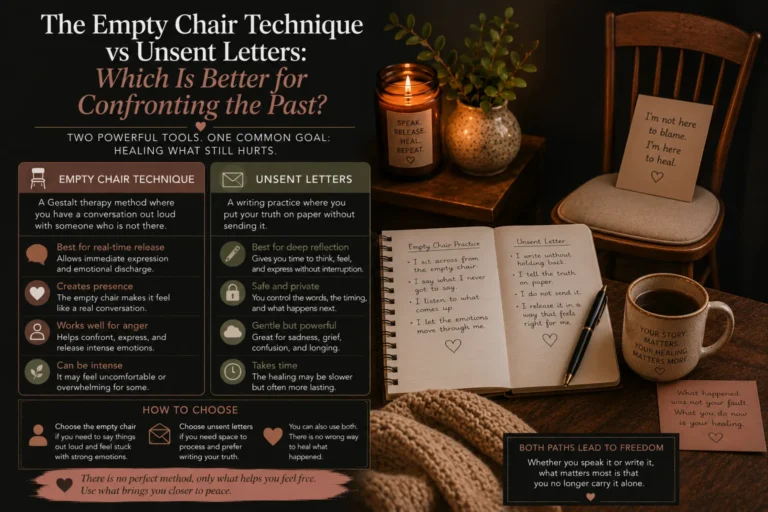
It means using written language to notice, hold, explore, and sometimes release what’s difficult to express directly. That can be private journaling, letters you never send, short fragments, poems, conversations with parts of yourself, or simple lists that start messy and get clearer as you go.
Healing is also a bigger word than it sounds. In this context, it might mean any of these:
- feeling less internally crowded
- understanding what you’re actually reacting to
- noticing grief under anger, or fear under control
- giving yourself a place to say what never felt safe to say elsewhere
- finding language for something your body has been carrying
- creating enough distance to choose a response instead of staying stuck in reaction
That’s why writing can feel strangely relieving even when what you write is painful. You’re not making the pain up. You’re giving it form.
Why is it easier to write some emotions than say them?
Because speech is social.
Even when you’re alone, spoken language often carries the pressure of imagined response. You can hear the other person in your head already. Will they think this is too much. Will they misunderstand. Will they want the shorter version. Will they make you explain why you feel that way. Will they get hurt. Will they say something well-meaning and useless.
Writing changes the conditions.
On the page, you can be contradictory. You can change your mind mid-sentence. You can write the petty version first and the wiser version later. You can admit something unflattering, like the fact that part of you wanted to be understood without having to explain anything at all. Not noble. Just true.
That privacy matters. A lot of emotion stays unspoken because the first draft of honesty isn’t socially graceful. It can be repetitive, sharp, confused, needy, unfair, embarrassed, jealous, tender, and all over the place. The page can hold that better than most conversations can.
There’s also the pacing. Talking asks for speed. Writing lets you slow down enough to notice, “Actually, I’m not angry at what happened today. I’m angry that it feels familiar.”
That sentence alone can change a week.
The page is useful because it doesn’t interrupt you
This sounds obvious until you compare it to what usually happens when you try to process emotion in your head.
Your mind skips. It edits. It protects. It starts arguing with itself. It gets distracted by logistics. It tells you to come back later. Sometimes it gets theatrical. Sometimes it gets weirdly blank.
Writing doesn’t stop any of that completely, but it gives the thought somewhere to go before it evaporates.
A sentence on a page becomes something you can see, not just something you’re trapped inside. And once you can see it, you can respond to it differently. You can ask whether it’s true, partly true, old, borrowed, exaggerated, unfinished, or attached to something deeper.
That visible distance is one of the most helpful parts of the practice. You’re still in the feeling, but not only in it.
What can writing help you uncover?
Usually not just the headline emotion.
“Upset” is often a cover word. Same with “stressed,” “off,” “fine,” and “frustrated.” Those words aren’t wrong. They’re just often the lid, not the contents.
When someone writes past the first layer, they often find:
- grief that has been disguising itself as irritation
- anger that’s really about powerlessness
- anxiety tied to uncertainty, not danger
- shame sitting underneath perfectionism
- longing hiding under criticism
- relief mixed into sadness, which can be hard to admit
- resentment built from small things that never got acknowledged
This is one reason prompts can help, but only if they’re used gently. The point isn’t to force revelation. It’s to keep going long enough to get past the polished answer. If anger tends to come out sideways for you, prompts for exploring anger through creative writing can give you a more focused place to start without turning the whole thing into a performance.
Do you need to know exactly what you feel before you start?
No. Honestly, that requirement would stop most people.
A better place to begin is with what you notice:
- “My chest got tight when that happened.”
- “I keep thinking about the way they said it.”
- “I’m avoiding this for a reason.”
- “I don’t want to write about this, which is probably information.”
- “The part I keep skipping is…”
That’s enough. More than enough.
People sometimes wait for insight before they write, when writing is often how insight arrives. Not every time. Some days it’s just a page of repetition and annoyance. But even that has value. Repetition usually points toward the part that still has charge.
There isn’t one right way to do this, which is annoying but true
It would be nice if emotional writing came with a clean formula. Sit down, write for twelve minutes, emerge wiser and softer. Sometimes that happens. A lot of the time, it doesn’t.
Some people need freewriting because structure makes them self-conscious. Some need a tight prompt because a blank page feels like being asked to invent oxygen. Some need letters. Some need poems because plain language feels too exposed. Some need lists because paragraphs make everything feel bigger.

That’s why it helps to think less in terms of “the best method” and more in terms of “what lets you tell the truth today.”
A few common forms work well for different reasons.
Freewriting when you need to stop filtering
Freewriting is useful when your inner editor is the main problem. You set a short time, keep your hand moving or your fingers typing, and don’t stop to correct, organize, or make it sound intelligent.
This can look messy fast. That’s normal.
The value isn’t elegance. It’s momentum. When you don’t stop every sentence to manage how it sounds, something less controlled tends to show up. Sometimes that’s insight. Sometimes it’s raw material. Sometimes it’s just the first honest line of the day. The 3-Letter Sequence: Raw, Refined, Reflective is a useful bridge if you want some direction without losing that unfiltered momentum.
Letters when the feeling is relational
A lot of unspoken emotion exists in relationship, even when the other person isn’t available, safe, or alive. Letters can help because they give your emotion somewhere to land. You’re not just circling inside your own mind. You’re addressing someone, something, or some version of yourself.
That might be:
- a letter to a parent who hurt or disappointed you
- a letter to someone you miss
- a letter to the version of you who went through something hard
- a letter from your current self to your younger or future self
- a letter to fear, shame, illness, ambition, exhaustion, or grief
This format can loosen things that regular journaling doesn’t reach, especially when the feeling has been stuck in conversation form for years. And if the hard part is addressing something that isn’t a person at all, writing to abstract concepts like anxiety, loss, or dreams gives that strange but useful practice a clearer shape.
Writing for grief when there was no clean ending
Grief has a way of scattering language. Even when you know what happened, your emotional reality often refuses the tidy version.
That’s one reason writing can be especially helpful with loss. It doesn’t demand a linear process. You can be numb on one page, furious on the next, weirdly funny the page after that. Grief allows for contradiction whether anybody approves or not.
Some people find that direct journaling is enough. Others need a more specific frame, especially when they’re carrying words that never got said. If grief is close to the surface for you, a few journaling techniques for processing unexpressed grief may help you find a steadier entry point. And when the pain is tied to a goodbye you never got to say, writing letters to people you never got to say goodbye to can be a gentler next step than trying to process everything at once.
What if writing makes the feeling stronger at first?
Sometimes it does.
That doesn’t automatically mean you’re doing it wrong. It often means you’ve stopped skimming over something that was already there.
There’s a difference, though, between healthy emotional activation and feeling flooded.
A manageable writing session might leave you sad, wrung out, thoughtful, or unexpectedly tired. You may need a walk, water, a shower, a break from your phone, or ten quiet minutes staring out a window like a person in a movie who just figured something out.
Flooding feels different. Your body may feel panicked, disoriented, shaky, trapped, or unable to settle after you stop. You may feel pulled toward spiraling rather than expressing. The writing doesn’t open anything; it drops you into it with no edges.
That’s important to notice. Writing is a tool, not a test of endurance.
A few signs it’s time to pause: you can’t stay oriented to where you are, the page is escalating you rather than helping you express, you feel compelled to keep going even though you’re getting more distressed, you finish and feel less grounded than when you started, every time, or the writing moves from honest into punishing.
If that happens, scaling back is often wiser than pushing through. Shorter sessions help. So does changing the prompt, using more structure, writing from a slight distance, or ending with something concrete and present-tense: what you see, hear, smell, or need right now.
For some people, especially around trauma, writing is best done with support or with clear boundaries. That’s not weakness. That’s good judgment. If you want a plain-language look at why putting words to experience affects more than mood, this piece on expressive writing and stress and pain management is worth a look. Not as a promise. Just as context.
What makes a writing practice feel safe enough to be honest?
Safety is less decorative than people think. It’s not candles and the perfect notebook, unless those actually help you. Mostly it’s about whether your nervous system believes you can tell the truth without being interrupted, exposed, or rushed.
That can mean practical things: writing where nobody will read over your shoulder, knowing where you’ll keep the pages, deciding in advance whether you’re keeping or destroying what you write, setting a time limit so the work has edges, or having a ritual that tells your mind when you’re done.
And sometimes the obstacle is embarrassingly basic. Shared housing. Thin walls. Kids. A partner who means well and asks, “Whatcha writing?” at exactly the worst moment. If privacy is the part that keeps derailing you, creating a safe writing environment in shared spaces is a practical place to start. A lot of emotional honesty disappears the second you feel observed.
Handwritten or digital? This matters more than people pretend
There isn’t a morally superior format here, despite the weird reverence people sometimes have about notebooks.
Handwriting slows you down. That can be useful when your thoughts move faster than your understanding. It can help you feel your sentences more fully, and some people find it easier to access emotion when the process is physical and private.
Digital writing is faster, easier to edit, easier to hide, and often more realistic if you’re tired, restless, or writing in brief windows. It can also help if your hand cramps, your thoughts outrun your pen, or your emotional honesty depends on being able to delete a line without staring at it scratched out on paper.
The useful question isn’t “which one is better.” It’s “which one makes you more truthful.” If you’re genuinely split, the tradeoffs between handwritten and digital writing are worth a closer look.
What if you hate rereading what you wrote?
You don’t have to reread everything.
That surprises people because they assume the value is in analyzing the page later. Sometimes it is. Sometimes rereading helps you catch patterns, repeated fears, old narratives, or moments where your language suddenly gets honest.
But sometimes rereading too soon just triggers self-consciousness. You start judging tone, grammar, exaggeration, neediness, drama, pettiness. In other words, you stop listening and start managing.
You’re allowed to write for release, then close the notebook. You’re also allowed to come back later with a different purpose. Not to grade yourself. Just to notice what words repeat, what you keep avoiding, what voice enters when you’re trying not to feel something, or where your writing shifts from reporting into truth.
Some people benefit from a delayed reread. A day later. A week later. Long enough that you can see the page as information instead of evidence against your character.
The hardest part is often telling the truth in plain language
A lot of people can write around a feeling forever. Beautifully, even. Cleverly. Symbolically. Very moving, if somebody else were reading. Meanwhile the one sentence that would actually matter stays unwritten.
Usually it’s a plain sentence.
“I wanted them to choose me.” “I’m angrier than this situation alone explains.” “I don’t think I’m only sad. I think I’m ashamed.” “I keep calling this stress because grief feels too permanent.” “I wanted an apology I’m probably never getting.” “I miss who I was before this.” “I’m relieved, and I feel bad about being relieved.”
Those aren’t polished sentences. They don’t need to be. They just need to be true enough that your body recognizes them.
That’s one reason writing can work when talking doesn’t. Talking often pulls people toward explanation. Writing can let you say the sentence before you justify it.
What if you don’t trust your emotions?
That’s a real barrier, and usually not a random one.
Maybe you were told you were too sensitive. Maybe your environment rewarded composure and punished emotional mess. Maybe your feelings have surprised you before, and now you approach them like they’re suspicious witnesses. Maybe you’ve spent so long minimizing your reactions that direct emotional language feels melodramatic, even in private.
If that’s you, try treating writing as observation before confession. You don’t have to begin with “I feel abandoned” or “I’m devastated” if those sentences make you recoil. You can begin with what happened in your body, attention, and behavior.
“After that text, it was hard to focus for two hours.” “I kept reopening the message.” “I started cleaning the kitchen instead of answering.” “I felt a drop in my stomach when I saw their name.” “I told myself it wasn’t a big deal, then I was awake at 2 a.m.”
That kind of writing builds trust because it starts with evidence you can actually observe. Emotion often becomes clearer once it has somewhere concrete to stand.
You do not have to produce wisdom from every page
This one helps people exhale a little.
Not every writing session turns into insight. Some pages are repetitive. Some are flat. Some sound like a person circling the same drain with slightly different punctuation. Some are all heat and no clarity. Some just prove that you are, in fact, upset.
Still useful.
The pressure to make writing meaningful can kill the honesty that makes it healing. If you sit down trying to produce a breakthrough, you’ll often end up performing one. The page gets smarter. You get less true.
Sometimes the useful session is the one where you realize you’re more hurt than angry. Or more tired than hurt. Or that the situation you can’t stop writing about isn’t the main thing at all. It’s just the thing that knocked against an older bruise.
And sometimes the only result is relief. That counts too.
A simple way to begin when you don’t know where to start
You don’t need a complex ritual. A few sentences are enough.
Try one of these openings and keep going without editing for ten minutes:
- “What I’m not saying is…”
- “The part that keeps repeating is…”
- “If I stop trying to sound reasonable, what I mean is…”
- “What hurt more than I expected was…”
- “I keep telling myself ___, but my body seems to think…”
- “The sentence I don’t want to write is…”
That last one can be especially revealing. Also annoying. Usually a sign it’s working.
If you need a bit more structure after the first spill, move into three layers: what happened, what you felt, what it might be connected to. Not as a rule. Just as a handrail.
Writing can show you patterns you can’t see in real time
In the middle of a difficult season, everything feels immediate and singular. This fight. This loss. This deadline. This reaction. This one bad week that somehow turned into four months.
Writing creates a record, and records are clarifying.
Over time, you may start to notice the same emotional trigger in different relationships, certain phrases you use when you’re hiding from yourself, how often exhaustion gets mislabeled as failure, that your anger tends to show up three days after the actual hurt, that you become “productive” when you feel powerless, that anniversaries affect you even when you think they don’t, or how often your clearest writing begins after you stop trying to be fair to everybody at once.
That kind of pattern recognition can be deeply grounding. Not because it solves everything, but because it turns confusion into something you can work with.
It also helps you separate present pain from accumulated pain. That distinction matters. If your reaction feels bigger than the moment, the page may show you that the moment is carrying company.
Does writing need to stay private to help?
Not always. But privacy usually comes first.
The healing part tends to happen in the uncensored draft, not the version you shape for somebody else to understand. Sharing can be meaningful later, especially in therapy, trusted friendship, support groups, or creative spaces where being witnessed matters. But if you start by imagining the audience, you may write around the truth instead of toward it.
That doesn’t mean privacy has to be absolute. Some people share selected pieces. Some write privately, then pull out one paragraph that names the real issue. Some never show anyone anything and still find the practice transformative.
You don’t owe publication to your pain. You don’t owe eloquence to your feelings either.
When writing helps, it often helps quietly
This is maybe the least glamorous thing about it.
People expect a dramatic emotional release. Sometimes that happens. More often, the changes are smaller and steadier. You feel less scrambled. You understand your reaction sooner. You stop picking the same fight in your head. You become a little kinder in how you name what hurts. You realize you’ve been grieving, not failing.
That’s not nothing.
Writing is often useful precisely because it lets your internal life become more legible to you. And once something is legible, you’re not at its mercy in quite the same way.
Not immune. Not finished. Just less lost inside it.
There’s no clean finish to this kind of practice, which is probably part of why it’s real. Some things get clearer fast. Some stay murky for a long time. Sometimes the page gives you the sentence you needed. Sometimes it just keeps you company while you circle it. Both count.
Write what you never got to say
If there’s a conversation still living in your chest, put it somewhere safe. Use a private space to write the words you’ve been carrying without worrying about how they’ll land.