

Most people start expressive writing because something in them is too loud to ignore or too hard to explain. And the simple version is this: putting honest words on a page can help you process emotions that keep circling when they stay unspoken.
Not in a magical, fixed-forever way. More in a real, human way. The page gives your feelings somewhere to go. It slows down the mental pileup. It lets you notice what hurts, what repeats, what you’re avoiding, and sometimes what you already know but haven’t let yourself say.
That’s the heart of expressive writing for emotional healing. Not pretty journaling. Not a productivity habit with nice stationery. Just honest writing that helps you feel, sort, release, and understand what’s happening inside you.
If you’ve ever sat down to write and immediately thought, “I don’t know where to start,” that’s normal. If you’ve started and then felt worse for a minute, also normal. If you’ve avoided it because you’re worried you’ll open something you can’t close, that makes sense too. A lot of people want emotional relief but don’t want to accidentally flood themselves in the process. Fair concern.
This guide is here to make the whole thing less vague. You’ll see what expressive writing actually is, why it can help, what to write about, how to do it safely, what tends to go wrong, and how to shape it into something that supports you instead of draining you.
What expressive writing actually is
Expressive writing is writing for emotional processing, not for performance. You’re not trying to sound smart, polished, spiritual, insightful, or even coherent. You’re trying to tell the truth on paper closely enough that your nervous system stops carrying all of it alone.
Sometimes that truth comes out as full sentences. Sometimes it’s jagged notes, repeated phrases, scraps of memory, anger, grief, confusion, or a half-finished thought you can barely stand to look at. It still counts.
The point isn’t literary quality. The point is emotional honesty.
That matters because a lot of people think journaling and expressive writing are the same thing. They overlap, but they’re not identical.
Regular journaling can be about anything: what happened that day, what you need to do tomorrow, a nice conversation, a plan, a list, a habit tracker, a brain dump. Expressive writing is narrower and deeper. It’s what you reach for when there’s emotional material that needs processing.
That emotional material might be obvious. A breakup. Grief. Burnout. A conflict you can’t stop replaying. Shame about something old that still has claws in it.
Or it might be harder to name. Irritability that won’t go away. A flat feeling you keep trying to outwork. The weird heaviness that shows up every Sunday night. The sense that you’re overreacting to small things because the small things aren’t actually the issue.
Expressive writing gives shape to that.
Why writing can help when thinking doesn’t
You can think about a problem for weeks and still feel stuck inside it. That’s partly because thinking often turns into looping. The same argument, the same memory, the same self-blame, the same imaginary conversation where you finally say the perfect thing and everyone claps. Very satisfying in theory. Not especially healing.
Writing changes the experience because it externalizes what’s happening. Instead of carrying the whole thing in your head, you put it somewhere visible. Once it’s visible, you can relate to it differently.
You may notice:
- what emotion is actually underneath the obvious one
- where your story jumps or gets fuzzy
- which details you keep returning to
- what you’re trying to control
- what you still need to grieve, say, forgive, or admit
That shift can be surprisingly practical. A page can show you that what sounded like anger is mostly hurt. Or that what felt like sadness is tangled up with embarrassment. Or that what keeps bothering you isn’t the event itself so much as what it seemed to say about your worth.
And sometimes the writing does something even simpler: it interrupts emotional pressure. You stop holding every feeling in a clenched, wordless form.
That doesn’t mean writing solves everything. It doesn’t replace therapy, medical care, crisis support, or real-world changes that need to happen. If you’re dealing with trauma symptoms, severe depression, panic, self-harm thoughts, or anything that makes writing feel destabilizing, you may need more support than a notebook can give. That’s not failure. That’s good judgment.
But for a lot of people, expressive writing is one of the first ways emotions become workable instead of just overwhelming.
What emotional healing through writing really looks like
“Healing” can sound bigger and cleaner than it usually is.
Most of the time, emotional healing through writing looks less like a breakthrough montage and more like a gradual change in your relationship to what hurts. The memory may still be sad. The loss may still be a loss. The anger may still make sense. But the emotional charge can shift. The story gets less sticky. Your body doesn’t brace as hard. You stop rehearsing the same pain every day.
Sometimes you get clarity. Sometimes relief. Sometimes language. Sometimes just a little more room to breathe.
That counts.
It can also look uneven. You might write three times and feel lighter, then hit a session that leaves you raw and tired. You might think you’re writing about one thing and realize the real subject is something older. You might have a strong session and then avoid the page for a week because, honestly, your own honesty was a bit much.
That unevenness doesn’t mean you’re doing it wrong. It usually means you’re touching real material.
What expressive writing is not
It helps to clear out a few common misunderstandings before you start.
It’s not forced positivity
If you try to turn every painful thing into a gratitude lesson too early, the writing often gets thin and fake. There’s a place for perspective. There’s also a place for “this hurt and I’m still mad about it.” You don’t need to rush yourself into wisdom.
It’s not the same as rumination
This matters a lot. Expressive writing can become rumination if you keep writing the same pain in the same way without movement, reflection, or containment. If every session leaves you more agitated and less grounded, something needs adjusting.
Usually that means shortening the session, adding structure, writing with more distance, or ending with a calming step instead of closing the notebook in emotional free fall.
It’s not a performance of depth
You do not need to sound profound. Some of the most useful writing is blunt and almost boring on the surface.
“I’m angry that they got to move on like nothing happened.”
“I keep pretending this doesn’t matter and it obviously does.”
“Part of me still wants an apology I’m never getting.”
That kind of sentence can do more than a whole page of elegant abstraction.
It’s not always about writing the full story
Some people do well with detailed narrative writing. Some don’t, especially at first. You might need fragments, lists, sentence starters, or body-based noticing before you can write a clean story. That’s fine. You don’t have to earn the right to process your emotions by being organized.
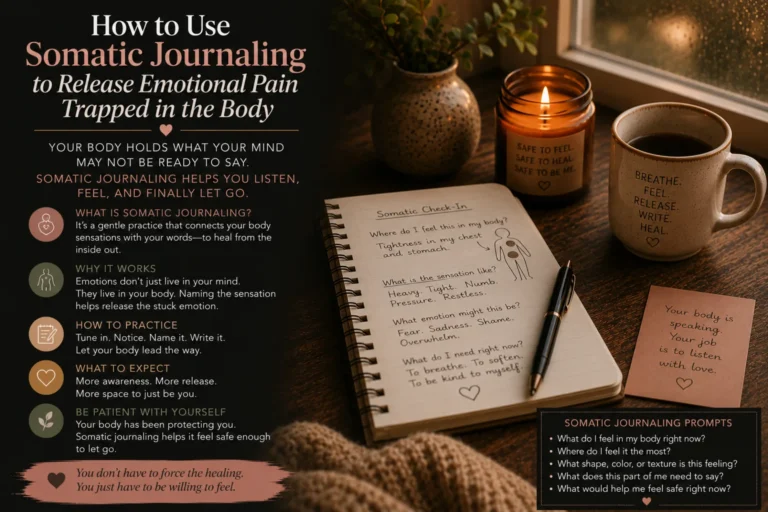
And if you notice your emotions show up physically before they show up in language, somatic journaling may fit better than trying to force insight out of your head alone.
When expressive writing tends to help most
This kind of writing is especially useful when you know something is bothering you but the feeling hasn’t fully formed into language yet. The page can help you catch it before it hardens into avoidance, numbness, or a constant low-grade mental buzz.
It also tends to help when:
- you keep replaying a conversation or memory
- you feel emotionally backed up
- you need a private place to say what you can’t say out loud
- you’re trying to understand a strong reaction
- you’re moving through grief, transition, shame, heartbreak, or identity shifts
- you want to make sense of a painful experience without immediately turning it into a lesson
That last part matters. A lot of people try to “figure out the meaning” of something before they’ve even let themselves feel it. Writing can help you slow that down.
You don’t need to extract wisdom from pain on demand. Sometimes the first useful step is just being accurate.
How to start without making it a whole production
The best setup is the one you’ll actually use.
You do not need the perfect journal, the ideal candle, the exact playlist, or a beautifully protected morning routine. Those things can be nice. They can also become a very efficient way to delay writing.
A simple place to write is enough. Paper, notes app, laptop, whatever feels private and low-friction.
What matters more is giving the writing a small container.
Use a time boundary
Try ten to twenty minutes. Long enough to get past the polite layer, short enough that you don’t feel trapped in it.
If you’re emotionally tender, start smaller. Seven minutes is still real writing.
Pick one thing
Not your whole life. One knot.
The conversation that’s still sitting wrong. The thing you can’t stop thinking about at 2 a.m. The situation you keep minimizing and then crying over in the grocery store parking lot. Specific is usually better than sprawling.
Write past the obvious sentence
A lot of sessions begin with the clean, socially acceptable version.
“I’m frustrated.”
Fine. Keep going.
Frustrated about what, exactly? What feels unfair? What are you afraid this means? What are you pretending doesn’t matter? What do you wish you could say if you didn’t have to be reasonable?
That second layer is often where the real writing starts.
Stop before you’re wrung out
This is one of the more underrated parts of expressive writing. You do not need to excavate every feeling to prove the session counted. Ending when you’ve touched something real but still have enough steadiness to re-enter your day is often the better move.
Especially if you’re new to this.
What to write about when you don’t know where to begin
A blank page can make even very strong feelings go weirdly silent. Sometimes you need a doorway.
Here are a few that tend to work.
Write the uncensored version
This is the page for what you’re not saying out loud because it sounds petty, mean, needy, scared, confused, dramatic, or contradictory. The part you usually edit for other people is often the part that most needs somewhere to exist.
You’re not writing to be correct. You’re writing to be honest enough that the emotional truth shows up.
Write what happened, then write what it meant to you
These are not the same thing.
What happened is the event. What it meant is the story your mind attached to it.
For example:
- What happened: they didn’t call back
- What it meant: you felt disposable, foolish, easy to forget
That distinction can change everything. A lot of pain lives in the meaning layer.
Write to someone you’re not sending it to
This is one of the cleanest ways to access real feeling. You can write to a parent, partner, ex, friend, boss, younger self, future self, grief itself, fear itself, even a version of you that got stuck somewhere.
The point isn’t whether the letter is fair. The point is whether it lets you say what’s been trapped.
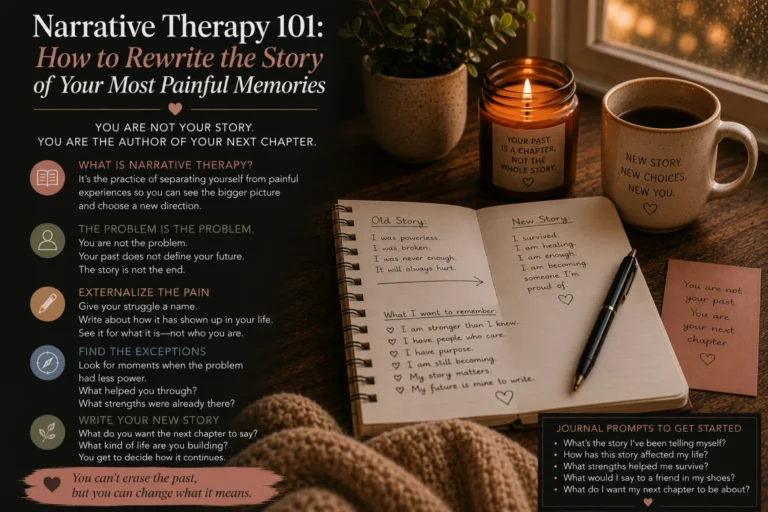
If that format opens something useful, you may eventually want to explore rewriting the story of painful memories in a more structured way, especially when the same events keep shaping how you see yourself.
Write from the body, not just the mind
Sometimes the clearest entry point is physical.
Where do you feel this? Tight chest. Jaw. Stomach. Throat. Heavy arms. Buzzing skin. Numbness. Heat.
Then describe it without trying to fix it. Let the body have words before the intellect starts cleaning everything up.
This can be especially useful if your emotions are hard to name but very easy to feel physically.
Write the sentence you keep avoiding
You probably know the one.
The sentence that makes you stare at the page for a while. The one that feels too true, too embarrassing, too disloyal, too sad, too angry, too inconvenient.
Start there if you can.
Not always. Some days that’s too much. But when it’s available, it’s usually where the energy is.
A few forms of expressive writing that work differently
Not all emotional writing works the same way. It helps to know the difference so you’re not forcing yourself into a method that doesn’t fit your brain or your current state.
Free writing
This is the most open-ended version. You write continuously for a set amount of time without stopping to edit, organize, or fix yourself. Good for bypassing the inner manager who wants every feeling to be articulate before it’s allowed to exist.
If your brain gets tangled in overthinking, stream of consciousness writing can help you get out of your own way and uncover what’s underneath the noise.
Prompt-based writing
Useful when blank pages make you freeze or drift. A prompt gives you direction without over-controlling the process.
Examples:
- What am I actually upset about?
- What part of this still hurts?
- What do I wish someone had understood?
- What am I carrying that isn’t mine?
Prompt-based writing is often gentler for people who want emotional access but need some rails.
Narrative writing
This means writing the story of an event or period in a more connected way. Not to make it pretty. To make it legible.
When painful experiences stay fragmented, they can keep popping up as intense emotion without context. Narrative writing can help you place events in time, see cause and effect, notice missing pieces, and separate what happened from what you came to believe about yourself because of it.
Dialogues
This can sound slightly awkward until you try it. You write a back-and-forth between two parts of yourself, or between you and an emotion, or you and someone absent.
For example:
- the part of you that wants to move on and the part that doesn’t
- you and your anger
- you and your inner critic
- you now and you at sixteen
It can surface conflicts that stay hidden when everything is mushed together in one voice.
Reflective writing after a hard event
This is less about raw discharge and more about processing. What happened, how it affected you, what you needed, what you learned, what still feels unfinished.
That kind of reflection can be especially helpful if your emotions spike around stress and uncertainty. In those moments, a more specific approach like journaling for anxiety may feel steadier than broad emotional excavation.
How to make expressive writing emotionally safe enough to be useful
This is the part people skip, then wonder why writing either does nothing or leaves them feeling wrecked.
The goal is not to stay comfortable. You’re writing to touch something real. But you do want enough safety and containment that the writing helps you process instead of just re-experience.
Choose a level of closeness you can handle
You do not always have to write from the center of the wound.
If direct writing feels too intense, try one step back:
- write about the edges of the event instead of the core
- write about what changed afterward
- write about what you wish had happened
- write in third person for a bit of distance
Distance is not avoidance when it helps you stay present.
Have a clear ending ritual
This doesn’t need to be elaborate. It just needs to tell your body the session is over.
You might:
- close the notebook and put it away
- stand up and drink water
- wash your hands
- step outside for two minutes
- write one grounding sentence about where you are now
Without some kind of closing move, it’s easy to carry the rawness into the rest of the day.
Notice your signs of overload
If you become disoriented, numb in a scary way, panicky, unable to stop, or emotionally flooded long after writing ends, pull back. Shorter sessions. More structure. More support. Possibly a different approach entirely.
There’s no prize for blasting past your capacity.
Don’t force insight while you’re activated
When emotion is hot, your job may simply be to name it and let it move. Interpretation can come later.
Trying to turn raw pain into immediate wisdom is like trying to fold laundry in the middle of a thunderstorm. Bad timing.
What people often get wrong
A lot of expressive writing advice sounds simple until you actually try to do it while sad, angry, ashamed, or exhausted. Then the common mistakes show up fast.
Trying to do it “right”
The need to be good at writing is one of the stranger obstacles here. People sit down to be honest and somehow end up sounding like they’re drafting a respectable email to their own emotions.
That version usually stays on the surface.
If your writing becomes polished very quickly, there’s a chance you’ve switched from feeling to managing the appearance of feeling.
Turning every session into a deep dive
Not every page needs to be a full emotional excavation. Sometimes a short check-in is enough. Sometimes the kindest move is ten minutes, one true paragraph, and done.
Intensity is not the same as usefulness.
Using writing to prove your pain is valid
You do not need the perfect explanation for why something hurt. You also do not need to build a courtroom case for your own emotions.
A lot of suffering gets prolonged because people keep trying to justify what they feel instead of letting themselves feel it.
Expecting immediate relief every time
Some sessions feel relieving. Some feel clarifying. Some feel messy. Some seem useless and then make sense two days later.
The effect is not always instant, and it’s not always obvious while you’re in it.
Writing only when things are unbearable
That’s understandable, but it can make the page feel like an emergency room. If you only write at emotional crisis level, you miss the quieter sessions where patterns become visible before they explode.
This is also where timing matters more than people think. Some people do better when they write before the day crowds in. Others need the distance of night. If your schedule keeps fighting your writing, it may help to sort out whether mornings or evenings fit you better instead of forcing a routine that makes you resent the notebook.
What to do after you write
The minutes after expressive writing matter almost as much as the writing itself.
You’ve just opened something. Don’t immediately slam yourself back into email, errands, group chats, or doomscrolling if you can help it.
Give yourself a small transition.
Read it back only if it helps
Some people learn a lot by rereading. Others just start judging themselves. You’re allowed to decide session by session.
If you do reread, look for emotional patterns rather than polished insight. Repeated themes, repeated fears, repeated names, repeated bodily reactions. That’s often where the real information is.
Pull out one sentence
Not a lesson. Just a sentence that feels true.
Maybe:
- I’m angrier than I’ve been admitting.
- This brought up something older.
- I want closure from someone who can’t give it.
- I’m more hurt than confused.
One honest sentence can be enough to carry forward.
Do something ordinary
This sounds almost too simple, but ordinary actions help. Tea. A shower. A short walk. Folding laundry. Petting the dog. Wiping the counter. Human, boring, grounding things.
You don’t always need a grand integration ritual. Sometimes you need to remind your body that the world is still the world.
How expressive writing changes over time
At first, most people write very close to the pain. The page is a place to vent, confess, unravel, name, discharge.
Later, the writing often gets more layered.
You start noticing pattern instead of just episode. You become more curious about what triggers you, what soothes you, what stories keep repeating. You may begin to recognize that a current conflict is dragging three older conflicts behind it. Annoying, honestly, but useful.
You may also notice your voice changing. Less apologizing. Less self-cross-examination. More directness. More precision. More ability to say, “This hurt,” without immediately arguing yourself out of it.
That shift is part of healing too.
When deeper themes start showing up
Once you get past surface stress, expressive writing often starts brushing up against identity, family roles, old shame, unmet needs, and parts of yourself you’d rather not claim.
This is where the work can get especially useful and especially uncomfortable.
You may notice jealousy that doesn’t fit your self-image. Resentment where you wanted to feel compassion. A strong need for approval you thought you’d outgrown. A version of yourself that is not nearly as evolved as your public persona would prefer. Very human. Still inconvenient.
That’s one reason some people eventually move toward shadow work journaling when ordinary reflection starts revealing the parts they usually hide, reject, or explain away.
You don’t have to go there immediately. But if your writing keeps circling the same charged reactions, there may be more under the surface than the current situation alone.
How to tell whether it’s helping
The signs are usually subtle before they’re dramatic.
You may notice you recover faster after triggers. You understand your reactions sooner. You stop rehearsing the same conversation for hours. You become less afraid of your own feelings because you’ve had repeated experiences of surviving them on the page.
You may also notice more honesty in daily life. Not reckless honesty. Just less internal editing.
Sometimes the clearest sign is that your writing gets simpler. Less circling, less explaining, less trying to make your pain acceptable. More direct contact with what’s true.
And sometimes the sign is that you realize a particular kind of writing is not helping, which is also useful information. If every session leaves you spun up, ashamed, or stuck in the same grooves, that’s not a moral issue. It just means the method, timing, intensity, or support level needs to change.
If you’re afraid of what might come out
That fear makes sense.
A lot of people avoid expressive writing because they suspect they’re carrying more than they want to meet all at once. They’re probably right. Most people are.
But writing does not require you to open every locked room in one sitting. You can crack a window. You can name the hallway. You can describe the door without going through it.
You can also decide that some material belongs with a therapist, a support group, or another form of care. Private writing is powerful, but it is not your only option and not always the best one for every layer of pain.
The point is not to force bravery. The point is to build enough trust with yourself that the page becomes a place you can visit honestly.
Making this a practice instead of a last resort
There’s a difference between using expressive writing occasionally and letting it become part of how you care for your inner life.
That doesn’t mean writing every day forever. It just means the page becomes a place you know how to return to when something needs attention.
You might write once a week. Three times during a hard month. Briefly after conflict. More regularly during grief. Less during stable periods. There isn’t one respectable schedule.
What matters is that you stop treating your emotions like they only deserve space when they become impossible to ignore.
That alone changes things.
When the page starts telling the truth faster than you do
This is one of the stranger, better parts of expressive writing. Over time, your page may become the place where your real feelings show up before your social self catches up.
You write “it’s fine” and then immediately write three paragraphs that make it extremely clear that it is not, in fact, fine.
Useful. Slightly rude. Very common.
That kind of mismatch is not something to be embarrassed about. It’s information. It shows you where you’re split between what you feel and what you’re ready to admit.
And once you can see the split, you’re not trapped in it in quite the same way.
You do not have to be eloquent for this to work
This may be the part worth keeping closest: emotional healing through writing does not depend on being a beautiful writer. It depends on being honest enough, often enough, that your inner world stops staying vague even to you.
Some days that honesty comes out as a full page. Some days it’s six ugly lines and one sentence you almost didn’t write. Sometimes that’s the session that matters most.
You’re not trying to create a perfect record of your pain. You’re trying to make contact with yourself in a way that leaves a little more room, a little more truth, and maybe a little less carrying-it-all-alone.
That’s a real thing, even when it’s quiet. And it usually starts smaller than people expect.
Need help finding the words?
If your feelings are clear but the page still goes blank, guided prompts can make the first sentence easier. Start with a tool designed for honest, unfiltered writing.