

You can tell pretty quickly when journaling is making anxiety louder instead of calmer. The page starts feeling like a courtroom, or a spiral, or a place where every small worry suddenly gets a full monologue. What actually helps is simpler than that: writing in a way that gives your mind somewhere to put the noise without handing it a microphone for an hour.
If journaling helps your anxiety, it usually does one of three things. It slows down a loop, makes a vague feeling more specific, or gives you a next step that feels small enough to do. If it leaves you more activated, you probably need a different structure, less time, or a gentler prompt.
Journaling is not automatically calming
This sounds obvious until you sit down with a notebook and somehow end up feeling worse. That happens all the time. Writing is a tool, not magic, and anxiety is very good at turning tools into extra work.
A blank page can become a place to rehearse every awful possibility. You might start with “I’m stressed about tomorrow” and twenty minutes later you’re six layers deep into imagined disasters, reading your own handwriting like it’s evidence. That isn’t failure. It just means the kind of journaling you picked gave anxiety too much room to roam.
The useful shift is moving from open-ended venting to contained writing. Not forced positivity. Not pretending you’re fine. Just enough structure that your thoughts stop multiplying on contact.
What actually helps most people
The best journaling for anxiety tends to be boring in a good way. Repeatable. Clear. A little grounding. It gives your mind edges.
Name the feeling before you explain it
Anxiety likes speed. It rushes straight into analysis before you’ve even figured out what’s happening. So it often helps to begin with a short sentence you can actually stand behind: “I feel keyed up.” “I’m bracing for something.” “My chest feels tight and my thoughts are jumping.”
That may seem small, but it changes the tone of the whole page. You’re describing your state instead of instantly arguing with it.
If “anxious” feels too broad, get more specific. Are you overwhelmed, scared, ashamed, restless, irritated, panicky, mentally crowded, physically tense? A lot of relief comes from getting the feeling one notch more accurate.
Write what is true right now, not what might happen in six hours
This is one of the better filters for anxious writing. Stay close to the present. Right now, what is actually happening?
Maybe the true thing is: “I have an email I don’t want to open.” Or, “I’m worried I said something weird.” Or, “I haven’t made the dentist appointment and now it feels absurdly loaded.” Those are workable sentences. They give you something real to hold.
Future-tripping usually sounds different. “This is going to turn into a disaster.” “Everyone’s upset with me.” “If I mess this up once, everything unravels.” Anxiety loves those giant jumps. Your journal doesn’t have to follow.
Use a container
Open pages can be too loose when your nervous system is already revved up. A container helps. That can mean a time limit, a prompt, or a set number of lines.
Ten minutes is often enough. So is one page. So is finishing these three sentences:
- What feels hard right now:
- What I know for sure:
- What would help in the next hour:
You’re not trying to produce insight worthy of framing. You’re trying to reduce the mental pileup.
The kinds of prompts that usually work better
Some prompts are basically traps for anxious people. “What’s bothering you?” can become a tunnel with no exit. A better prompt gives you a lane.
Try prompts that narrow the field
These tend to work better because they interrupt mental sprawl:
- What am I assuming right now?
- What part of this is real, and what part is prediction?
- What am I responsible for today?
- What feels urgent but probably isn’t?
- What would make tonight 10% easier?
That last one is especially useful on rough days. Anxiety often wants a full life solution by 4:30 p.m. Sometimes the real assignment is just figuring out dinner, sending one text, and not reading too much into the tone of a Slack message.
Use two-column writing when your thoughts get loud
Split the page down the middle. On one side, write the anxious thought exactly as it shows up. On the other, answer it more carefully.
For example:
“I’m behind on everything.”
“Some things are behind. Everything is not behind.”
“They haven’t replied, so I probably messed this up.”
“There are other reasons people don’t reply quickly. I don’t know yet.”
“If I rest, I’m being lazy.”
“You’re fried. Rest is part of functioning.”
This works because it doesn’t demand that you become wildly optimistic. It just asks for a voice that is less dramatic and more accurate.
What to avoid if journaling keeps making you spin out
If you finish writing and feel shaky, flooded, or more convinced that every fear is true, pay attention to the pattern. The answer may not be “journal more.” It may be “journal differently.”
Be careful with endless venting
There’s nothing wrong with unloading sometimes. The problem is staying there too long. If every entry becomes five pages of raw panic with no slowing down, your journal can start training your brain to rehearse distress instead of process it.
That’s one reason some people do better with more structured expressive writing rather than fully unfiltered dumping. Structure doesn’t make the writing fake. It just keeps it from running you over.
Don’t force insight when you need regulation
There are days for deep reflection and days for drinking water and sitting on the floor for a minute. If you’re highly activated, a big excavating prompt can be too much. You may be better off writing three concrete observations, then stopping.
Something like this:
- My jaw is tight.
- I’m worried about tomorrow morning.
- I need to charge my phone and set out my keys.
That may not look profound. It can still be the most useful thing on the page.
Watch for self-interrogation dressed up as journaling
This one sneaks in. You start writing, and suddenly the page sounds like an aggressive cross-examination. Why are you like this. Why can’t you handle normal things. Why did you wait so long to deal with this.
That voice is not especially clarifying. It’s just mean.
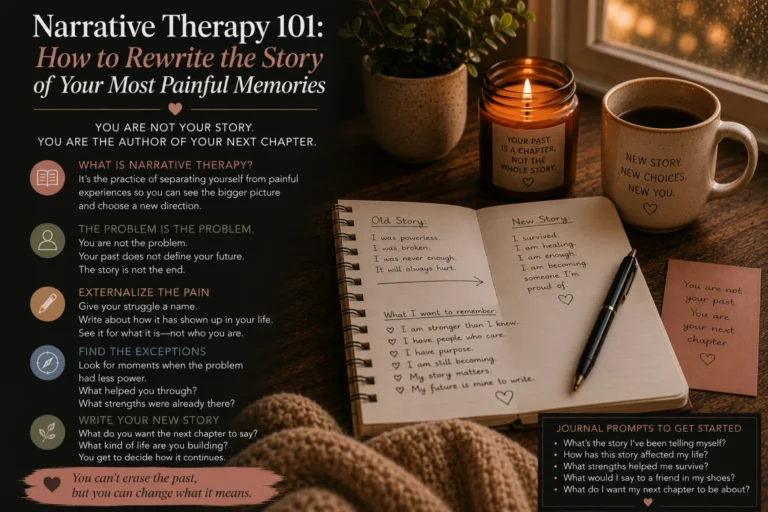
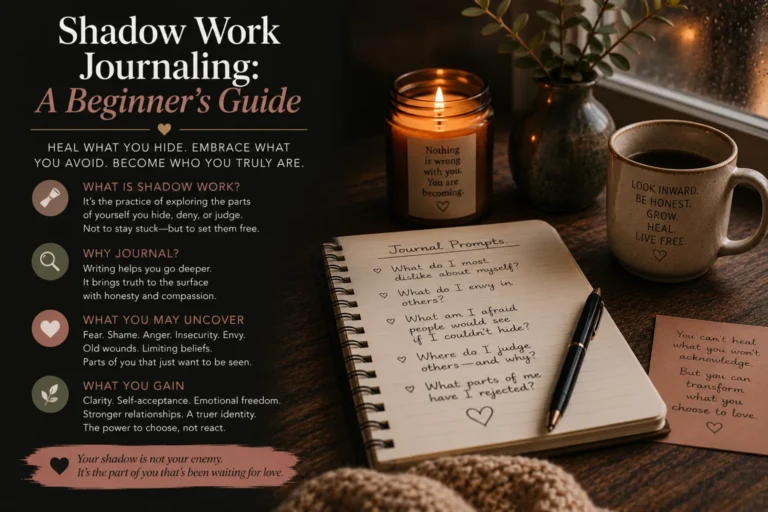
If your journaling keeps turning into self-criticism, switch formats. Write as if you’re talking to a younger version of yourself, or a tired friend you don’t want to scare. If that feels hard, shadow work journaling can be useful later, but anxiety spikes are usually not the best moment to go digging for every hidden wound in your personality.
Timing matters more than people admit
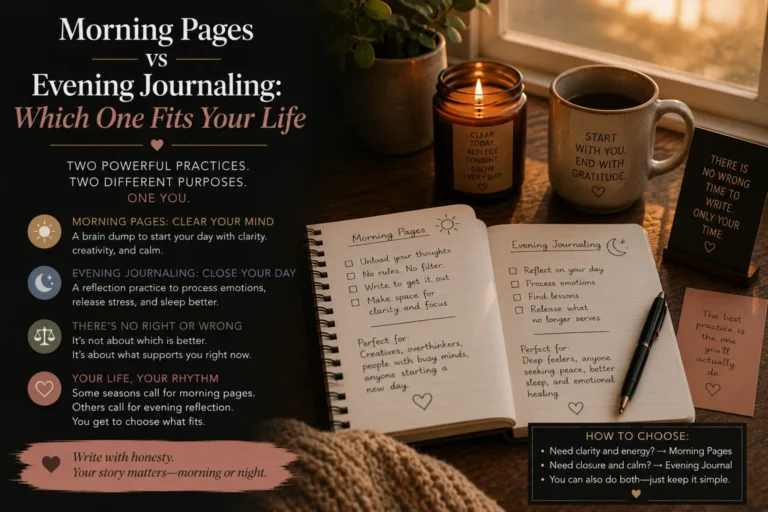
Some people do better writing in the morning, before the day gets noisy. Others need to empty their head at night so they’re not carrying five unfinished emotional tabs into bed. The annoying answer is that it depends, and if you’re curious about body-based approaches, somatic journaling can be a useful next format when regular freewriting starts to feel stuck.
If your anxiety tends to show up as morning dread, try journaling before looking at your phone. Even five minutes can help you notice what your mind is already doing before outside input piles on. If your hardest time is bedtime, evening writing may work better, especially if you keep it contained and don’t turn it into a midnight excavation project.
The difference between morning pages and evening journaling is less about rules and more about the shape of your anxiety. You’re looking for the time when writing helps clear static, not create more of it.
Sometimes anxiety lives in the body first
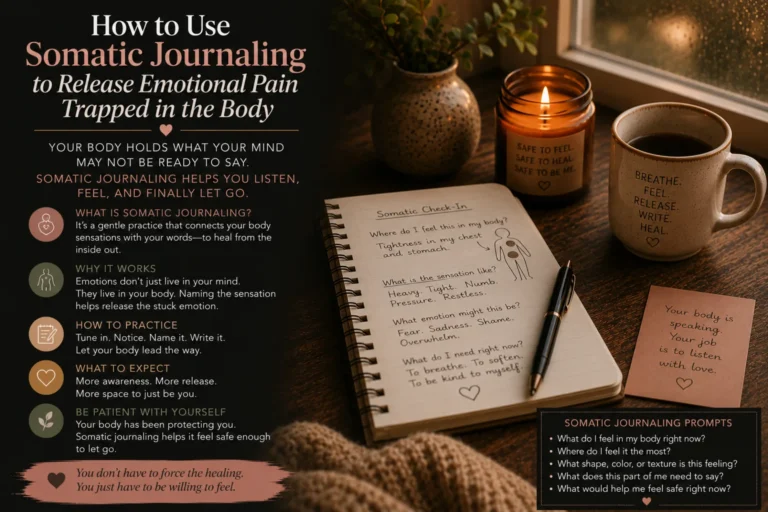
This is the part people miss when they keep trying to out-think their nervous system. If your hands are buzzing, your stomach is clenched, or your shoulders are up by your ears, you may need to write from the body instead of from the story.
Start with physical facts. “My chest feels pressed down.” “My legs feel twitchy.” “My breathing is shallow.” Then see what changes when you stay there for a minute instead of rushing to explain why.
This kind of writing can be surprisingly steadying because it interrupts the habit of turning every sensation into a theory. Sometimes a body-based approach works better than thought-based journaling, especially if your anxiety gets very physical. That’s where somatic journaling can make more sense than another page of overthinking.
A simple journaling rhythm you can actually use
If you want something practical, keep it plain. You do not need a beautiful notebook, a perfect routine, or a special pen that makes you feel like the sort of person who has their life together. That fantasy has taken out many good intentions.
A basic rhythm looks like this:
- Write down what’s happening right now.
- Name the feeling as specifically as you can.
- Separate facts from predictions.
- Write one kind response to yourself.
- Choose one next step for the next hour.
That’s enough for a full entry. On some days, it’s more than enough.
One slightly embarrassing but very common problem: people use journaling to avoid the actual task. You can spend twenty thoughtful minutes unpacking your dread about sending an email instead of sending the email. The writing still has value, but if the page becomes a holding pattern, it helps to end with something concrete and mildly boring. Open the message. Put the subject line in. Find the number. Fill the water bottle. Anxiety hates ordinary next steps because they work more often than drama does.
If it stops helping, that means something
You don’t have to make journaling your personality for it to be useful. If it helps three times a week and feels awful the other four, that matters. If every entry turns into rumination, shorten it. If night writing ramps you up, move it earlier. If words keep failing you, try body-focused notes, or stop and come back later.
And if writing consistently stirs up panic, dread, or memories that feel too big to handle alone, it may be worth bringing that into therapy or another kind of support. A journal can hold a lot, but it doesn’t have to hold everything.
The version that helps is usually the one that asks less of you. A few honest lines. A smaller question. A page that helps you come back to the moment you’re actually in, instead of the ten imaginary ones your anxiety already built for you.
When your thoughts won’t slow down, write to something real
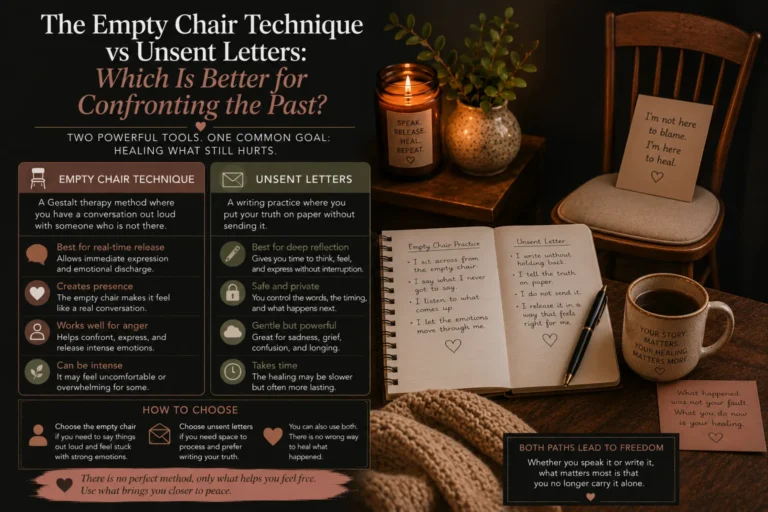
If open-ended journaling keeps turning into spiraling, Unsent Letters gives you a more focused way to get the pressure out. Put the feeling somewhere specific instead of letting it run the page.