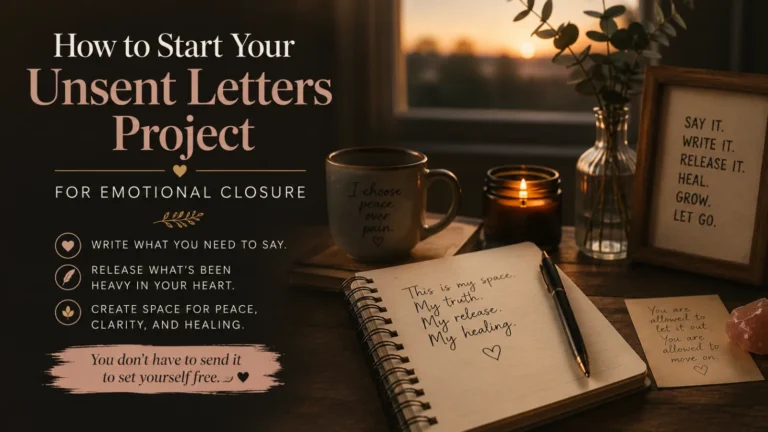


Sometimes the hardest part isn’t knowing what you feel. It’s having nowhere safe to put it. That’s where an unsent letter can help more than people expect.
Therapeutic letter writing is exactly what it sounds like: writing a letter you do not plan to send, so you can say the thing as honestly as it exists inside you. Not the polished version. Not the reasonable version. The version that keeps circling at 2 a.m., or shows up as tension in your shoulders, or leaks out sideways in conversations that were never really about that person in the first place.
You’re not writing to be fair. You’re not writing to win. You’re not even necessarily writing to understand everything right away. You’re writing to make the emotional mess more visible, more nameable, and a little less trapped inside your body.
And yes, it can feel oddly intense for “just writing.” That tends to be the point.
What an unsent letter is actually doing
An unsent letter gives your mind a container. That matters more than it sounds.
When emotion stays vague, it tends to spread. It shows up in places that have nothing to do with the original hurt. You get sharper than you meant to. Or numb. Or weirdly obsessed with replaying one conversation from six years ago while you’re trying to answer emails. A letter narrows the beam. It says: this is who this is about, this is what happened, this is what still hurts, this is what never got said.
That focus can be a relief.
It can also be uncomfortable, because writing makes things harder to dodge. A thought you can outrun in your head starts looking a lot more real once it’s sitting in front of you in a paragraph. Still, that’s often where the shift begins. Not because the letter fixes everything, but because it stops the constant low-grade effort of holding everything in place.
People use therapeutic letters for all kinds of situations:
- anger toward someone who hurt you
- grief after a death or major loss
- resentment in relationships
- things you wish you’d said during a breakup
- complicated family dynamics
- shame about something you did or didn’t do
- regret, apology, forgiveness, or closure that never came
- trying to reconnect with a part of yourself you abandoned for a while
The letter becomes a place where you can stop performing emotional moderation. You do not need to sound mature. You do not need to sound healed. You do not need to make the other person look understandable. Sometimes people get stuck because they think healing writing has to be insightful from the first line. Usually it doesn’t. Usually it starts messy.
If you want a broader outside perspective on why this practice can be powerful, this piece on the emotional power of the unsent letter captures that first release really well.
Why this can help when talking doesn’t
Talking helps a lot of people. It also has limits.
Conversation is live. It moves fast. Another person reacts. Their face changes. They interrupt, defend themselves, apologize too soon, cry, deny it, explain it away, or suddenly need comfort from you while you’re in the middle of saying what happened. Even a good conversation can pull you away from your own thoughts before you’ve finished having them.
A letter doesn’t do that.
It waits.
You can write the same sentence three times until it says what you mean. You can contradict yourself. You can realize halfway through that the real issue was not the comment they made but the fact that it confirmed something you’d feared for years. You can be kinder in one paragraph and furious in the next. Real emotional processing is rarely neat enough to sound good out loud on the first try.
There’s also something different about direct address. Writing “I’m angry that you left” lands differently in your nervous system than writing “I have abandonment issues related to this situation.” One is alive. The other is a report.
This is part of why unsent letters can work even for people who journal regularly. A journal entry can stay diffuse. A letter has a recipient, even if that recipient never sees it. That creates focus, pressure, honesty.
Who these letters are for
Probably more people than the phrase “therapeutic letter writing” suggests.
You do not need to be good at writing. You do not need a dramatic backstory. You do not need to know exactly what you feel before you begin. In fact, not knowing is often the reason to try.
This can help if you’re carrying emotions that feel unfinished. That unfinished feeling has a certain texture. It’s the conversation you keep editing in your head. The apology you never got. The explanation you still want even though you know it may never come. The version of yourself that can function perfectly fine all day and then gets sideswiped by one song, one anniversary, one throwaway comment, one photo.
It can also help if you’re the kind of person who turns feeling into analysis very quickly. Plenty of people can explain their own pain beautifully and still not feel like they’ve actually touched it. A letter can pull you out of interpretation and back into contact.
And sometimes it helps people who are embarrassed by how much they still care. That one matters. A lot of pain gets prolonged because people decide they should be over it by now. So they avoid it, minimize it, joke about it, or stay “busy.” The emotions remain exactly where they were. Just less visible.
What therapeutic letter writing is not
It’s not a legal document. Not a debate brief. Not a perfect summary of events.
It’s also not a magic closure machine. You can write a devastatingly honest letter and still wake up sad tomorrow. That does not mean it failed. Sometimes the real result is smaller and more useful than that. A little more clarity. A little less pressure. A better understanding of what kind of pain this actually is. Relief that lasts an hour, then comes back, then eases again over time.
It’s also worth saying that an unsent letter is not always the same thing as forgiveness. People get those tangled up. You do not need to excuse someone in order to write truthfully about them. You do not need to reach compassion on schedule. Some letters are mostly grief. Some are mostly anger. Some are just a plain record of what happened because nobody ever acknowledged it clearly.
And it is definitely not the same thing as preparing a message to send. Those are different tasks with different goals.
An unsent letter is for honesty. A sent letter is for communication, and communication has consequences.
Why “unsent” matters so much
This part changes everything.
The minute you believe there’s a chance the other person might read it, your voice starts adjusting. Even if you don’t mean to. You become strategic. You leave out the ugliest sentence. You make yourself sound calmer. You start arguing your case instead of revealing your experience. You shape it for impact. Or safety. Or image.
That makes sense. It’s also why many people can’t get to the heart of things while they’re still writing with an audience in mind.
Unsent means you get to be fully honest without also managing someone else’s reaction. It removes the pressure to be persuasive, diplomatic, or morally impressive. You can say the terrible, unflattering, confusing things that would never belong in an actual message.
Like:
- I wanted you to notice without me asking.
- I’m angrier than this seems to justify.
- Part of me still wants an apology, which is annoying.
- I hate that this still matters to me.
- I wanted you to choose me.
Those sentences are useful because they are not polished.
One of the more quietly difficult parts of this practice is admitting feelings that make you look less generous, less evolved, less in control. That’s often where the real material is. People will spend four paragraphs explaining the other person’s behavior and one half-sentence admitting their own heartbreak. That ratio usually tells you something.
What happens in your mind when you write this way
Not in a grand, mystical sense. Just in a very practical one.
When you write a direct, emotionally honest letter, you start organizing experience. A memory that felt like one giant blur begins to separate into parts. What happened. What it meant to you. What you needed then. What you still wish had happened instead. What was actually about them and what brushed up against older pain.
That separation matters because suffering gets stickier when everything is fused together.
You may also notice that writing slows emotional avoidance. In your head, it’s easy to jump tracks. You get close to the hard part, then think about dinner, then remember an email, then start explaining the situation to yourself in abstract terms. On paper or on screen, there’s more continuity. The sentence you were about to avoid is still right there waiting for you.
That can bring up strong feelings. Tears, anger, shakiness, exhaustion, even a weird blankness. None of that automatically means you’re doing something wrong. It may mean you’ve touched something real.
Still, there’s a difference between honest emotional contact and flooding. If you feel so activated that you cannot think, breathe steadily, or come back to the present, stop. Ground yourself. Drink water. Stand up. Look around the room. Put the letter away for now. This kind of writing can be supportive, but it is not a substitute for professional mental health care when the emotions are overwhelming, traumatic, or unsafe to manage alone. For a calmer overview of the practice, unsent letters anonymous explains how unsent writing gives feelings somewhere to go without demanding that you send them.
When this works especially well
There are certain situations where unsent letters tend to be especially useful.
When the conversation is impossible
The person died. You no longer speak. Contact would reopen harm. They are incapable of hearing you. The relationship ended years ago. Or maybe the issue is too old and strange to explain in a way that would lead anywhere good. A letter gives you somewhere to place words that still need a destination.
That’s part of why so many people turn to writing a letter to someone who died when grief feels unfinished. The point isn’t pretending the person can answer. It’s making room for what is still living in you.
When your feelings are more complicated than one conversation can hold
You can love someone and resent them. Miss them and feel relieved they’re gone. Understand why they acted the way they did and still feel deeply hurt by it. Letters are good containers for mixed feelings because they don’t require emotional consistency to count as valid, and unsent letter prompts can help when the feelings are hard to separate at first.
When anger is real but not yet organized
Anger can be clarifying. It can also turn into a fast-moving wall of words that leaves you feeling more charged than before. If that’s where you are, it can help to get more deliberate about how to write about anger without letting it take over so the letter stays honest without becoming one long emotional wildfire, especially when it’s part of writing a goodbye letter to someone you still love.
When you keep trying to “be fine” instead of actually processing
This one is common. You function. You smile. You answer texts. You make the appointment. You say you’re okay because nothing dramatic is happening today. Meanwhile your body is carrying something your schedule keeps outrunning.
An unsent letter can interrupt that. Not gracefully, usually. But effectively.
What to write about if you don’t know where to start
A lot of people get stuck before the first sentence because they think they need the right opening. You don’t. You need a true opening.
Usually that means starting closer to the actual emotional pressure point than feels elegant.
You can begin with one plain line:
- This is what I never got to say.
- I’m still upset about this.
- I wish this didn’t still hurt.
- What I needed from you was…
- What I can’t seem to let go of is…
- I keep replaying this one moment.
If even that feels too direct, start by naming the scene. The hallway. The phone call. The hospital room. The kitchen table. The text message. The day you packed the box. Specificity helps because emotion often arrives attached to moments, not concepts.
You also do not have to start with the biggest thing. Sometimes people unlock more by starting with the smaller, pettier, more embarrassing truth. The moment you felt ignored. The card they forgot to send. The exact sentence you still hear in their voice. Those details can open the door to larger grief or anger that your mind has been skirting.
Different kinds of unsent letters, depending on what hurts
Not every letter is trying to do the same job. It helps to know which kind you’re actually writing.
The letter that says what happened
This one is useful when your experience still feels foggy or minimized. You’re not trying to be poetic. You’re putting events in order and naming their impact. Often this matters when you were dismissed, gaslit, interrupted, or trained to doubt your own reality.
The writing might sound simple:
You said this. Then this happened. I felt myself shut down. I told myself it wasn’t a big deal, but it was.
Plain language can do a lot here.
The letter that says what you needed
This one often carries grief under the surface. It’s about the care, protection, honesty, repair, or presence that never arrived. These letters can be surprisingly emotional because they move you from complaint into longing, and longing is often the softer center people have been defending against.
The letter that says what you’re angry about
Not the socially acceptable version. The real one. The part that feels unfair, childish, repetitive, or intense. This can be deeply clarifying, especially if anger has been showing up in your life as irritability, numbness, or constant mental arguments.
The letter that says goodbye
Sometimes the relationship is over, the season is over, the role is over, the version of you tied to that chapter is over. The letter isn’t trying to resolve history. It’s marking an ending your nervous system hasn’t fully caught up with.
The letter that reconnects you to yourself
Not every therapeutic letter is addressed outward. Some of the most meaningful ones are to a younger version of you, a future version of you, or the version of you that went quiet while trying to survive something hard. If that’s the direction your writing naturally wants to go, writing to your younger self with honesty and compassion can open a very different kind of reflection than a conflict-based letter.
How to write the first draft without editing yourself to death
This is the part where people accidentally turn a raw practice into a performance.
You do not need the right notebook. You do not need candlelight. You do not need a moving soundtrack unless that genuinely helps and does not turn the whole thing into a private emotional awards show. You just need enough privacy that you can stop managing your own image for a while.
A few things tend to help:
- Write fast enough that your inner editor can’t fully catch up.
- Address the person or version of yourself directly.
- Let repetition happen for a while instead of deleting it immediately.
- Stay concrete when you can. Scenes. Words. actions. silences.
- Keep going a little past the point where you think you’re done.
That last one matters. A lot of people stop right after the part that sounds coherent. Then, if they keep going for five more minutes, the real material shows up. The line that embarrasses them. The grief beneath the anger. The sentence that finally admits, I wanted something from you that you were never going to give.
That’s often where the letter starts doing actual work.
One slightly unflattering thing people do here: they spend twenty minutes choosing whether to write by hand or type because that feels more manageable than actually beginning. Very normal. Still avoidance.
If the letter turns into a rant, that’s not automatically a problem
Early drafts are allowed to be messy.
If the whole first page is basically emotional static, that may still be useful. Sometimes you need to clear the reactive layer before anything deeper can emerge. The mistake is assuming that because the first version was chaotic, the exercise has nothing to offer.
The better move is to let the rant happen, then read back through and notice what keeps repeating.
Usually one of these starts standing out:
- a sentence about betrayal
- a moment of humiliation
- a wish that wasn’t met
- a fear the event confirmed
- a part of you that still wants recognition
That repeating line is often the real letter hiding inside the first one.
So yes, let yourself write the dramatic version first if that’s what comes. You can always write another letter tomorrow that is quieter, sadder, more precise.
What if you start crying, go blank, or feel ridiculous
All very common. None especially elegant.
Crying can mean release. It can also mean you hit something tender before you had language for it. Going blank can mean your mind is protecting you from moving too fast. Feeling ridiculous usually means you’ve brushed up against vulnerability and your defenses are trying to save face.
You do not need to push through every reaction.
If you cry, pause if you need to. If you go blank, write exactly that: I don’t know what to say next. Then wait and see what follows. If you feel silly, keep the letter private and lower the stakes. A lot of useful emotional work feels corny from the inside while it’s happening.
The question is not whether it feels polished. The question is whether it helps you get more honest.
Some letters are about grief, and grief has its own rhythm
Grief can make letter writing feel both natural and impossible.
Natural, because grief is full of ongoing conversation. Things you still want to say. News you still want to share. Anger, love, guilt, relief, confusion, longing, all taking turns at the wheel. Impossible, because even starting can make the loss feel newly real.
If your letter is connected to bereavement, it may help to approach it more gently than a conflict letter. Less pressure to “get it all out.” More permission to write in fragments, memories, questions, updates, apologies, or ordinary details. A grief letter does not need a big emotional arc to matter.
For some people, writing an unsent letter while grieving works best when it stays small and specific instead of trying to carry the full weight of the loss all at once.

You do not have to choose between honesty and compassion
This is where people often get confused.
They think a healing letter must either be raw and furious or wise and forgiving. Usually it’s both, just not at the same time.
You might write one letter that is pure accusation. Another that names what you miss. Another that says what the other person may never have been able to give. Another that admits the ways you also contributed, if that is true and if you’re at a point where that reflection does not turn into self-erasure.
Compassion is useful when it opens space. It is not useful when it becomes a way to skip your own pain.
That’s especially true for people who are quick to understand everyone else. If that’s you, watch for the moment when empathy becomes escape. The letter stops being about what happened to you and becomes a well-written explanation of why the other person was probably struggling. Maybe they were. That may even matter later. But not before your own experience has been fully named.
What to do after you’ve written one
This part deserves more thought than people give it.
You may feel lighter right away. You may also feel wrung out, agitated, oddly exposed, or tempted to send the letter immediately because now it seems incredibly important that the other person know exactly how badly they handled things. That impulse tends to arrive hot and convincing. What to do after writing an emotionally difficult letter matters because the moment after the draft can feel just as intense as the writing itself. It is not always trustworthy.
After writing, it helps to create a little space between expression and action. Even ten minutes matters. Longer is often better.
You might:
- put the letter away and come back tomorrow
- go outside and let your body settle
- underline the lines that feel most true
- notice whether the letter changed what you actually want
- decide that the writing itself was the point
If you’re unsure what to do with the emotional aftermath, what to do after writing an emotionally difficult letter is often the more useful next question than whether the letter was “good.”
Should you ever send it?
Sometimes. Often, no.
Whether to send any part of an unsent letter depends on your goal, the relationship, the likely consequences, and your emotional state once the initial charge has passed. A letter written for processing is usually too raw, too total, or too internally focused to function well as communication.
That does not mean it was badly written. It means it was doing a different job.
If you are considering sending something, it helps to ask:
- Do you want understanding, repair, release, or impact?
- Is this person capable of receiving what you’re saying?
- Will sending this protect your dignity or hand them fresh access to you?
- Are you hoping for a response that history suggests is unlikely?
- Would a shorter, steadier message serve you better than the raw letter?
There’s no universal answer here. Some people do send a revised version later. Some never do. Some realize the whole desire to send it was really the desire to be witnessed, which is not the same thing.
And some letters become clear only when addressed to a future self instead of the person who caused the pain. If you’re in a season where nothing feels stable and you’re trying to hold onto yourself through uncertainty, writing to your future self when life feels uncertain can be surprisingly grounding.
When this practice may not be enough on its own
Letter writing can open things. It can soothe things. It can clarify things. It can also uncover more than you expected.
If writing triggers panic, dissociation, urges to harm yourself, traumatic flashbacks, or a level of emotional overwhelm that feels unmanageable, please treat that seriously. Stop the exercise and reach for support that matches the intensity of what’s coming up. That might mean a therapist, grief counselor, trusted clinician, crisis support, or another qualified mental health professional depending on your situation.
There is nothing failed or weak about needing more support than a notebook can offer. Some material needs company.
This also applies if you notice yourself using letter writing to stay in a loop without actually moving. Rewriting the same grievance every night for months may mean there’s more to work through, but it may also mean you need help processing the injury in a different way.
How to know the letter actually helped
Not by whether you produced something beautiful.
Usually the signs are quieter than that.
You understand your own reaction better. You feel a little less scrambled. One part of the story stops repeating quite so loudly. You can tell the difference between what you wish had happened and what is actually possible now. You feel sad instead of just vaguely bad, which is a rough trade in the moment but often a real step forward. You stop rehearsing a confrontation every time you’re in the shower.
Sometimes the help is simply this: the feeling now exists somewhere outside your body too.
That may not sound dramatic. It can still be a relief.
If you want to keep going with it
You do not need to turn this into a daily ritual unless that genuinely serves you. Some people write one unforgettable letter and that’s enough for a while. Others find that different kinds of letters surface at different stages.
You might eventually write:
- the raw letter
- the letter underneath the raw letter
- the version that speaks to your younger self
- the version that marks an ending
- the version that says what you want now
That last one can matter more than people expect. Once the pressure of the past is on paper, the next honest question is often not “why did this happen” but “what do you need now?” Safety, distance, apology, ritual, rest, boundaries, witness, time. Sometimes the letter clears enough room for that answer to become visible.
You do not have to force closure. You do not have to make the writing noble. You just have to let it be true enough to loosen whatever has been clenched inside you.
And if the first letter feels awkward, overwritten, angry, flat, or unfinished, that doesn’t mean you missed it. It may just mean you found the edge of something real. Sometimes that’s the whole beginning.
Need a safe place to say what you can’t say out loud?
Use an unsent letter to put anger, grief, regret, or resentment somewhere real without having to send it to anyone. Start writing while the feelings are still close enough to name.