
Most unsent letters get too long when they’re trying to do three jobs at once. If you’re wondering how long it should be, the honest answer is: long enough to say the true thing, short enough that you don’t disappear inside it. For a lot of people, that lands somewhere between one page and three. Not because there’s a rule. Just because after that, you’re usually repeating yourself, circling, or finally getting to the part you meant to say from the start.
An unsent letter is strange that way. It doesn’t have to persuade anybody. It doesn’t have to sound fair. It doesn’t have to be tidy. But it does need some kind of shape, or it turns into emotional wallpaper. A lot of words on a page. Not much relief.
If you’re writing one, you probably already know that.
What the letter is trying to do matters more than the page count
The length depends a lot on what you’re using it for.
If you’re writing because you’re angry and need somewhere to put the anger that isn’t a text message you regret in ten minutes, the first draft might be messy and long. That’s fine. It’s doing containment. It’s holding the spill. If the letter keeps growing because you are trying to capture every detail, it may help to get clearer on which parts actually belong in the letter.
If you’re writing because something ended and you never got to say your part, shorter is often stronger. Not always softer. Just clearer. A letter that says, “This hurt, and I needed more than you gave,” can do more for you than four pages of reliving every conversation.
If you’re writing to understand what you feel, not just express it, you may need more room. That kind of letter usually starts in one place and ends somewhere else. The first paragraph says one thing. The middle tells the truth. By the end, you realize what the letter was actually about.
If you need more structure than a single page gives you, a simple way to shape the letter from beginning to end can keep the writing focused without making it stiff.
So the better question usually isn’t “How many words?” It’s “What needs to happen for you when this is done?”
That answer changes the length.
One page is often enough
Not in a rigid, minimalist way. Just in a human way.
One page gives you enough room to name what happened, say what it cost you, and put down the thing you keep rehearsing in your head. It keeps you close to the center. It also makes it harder to drift into courtroom mode, where suddenly you’re documenting six years of disappointment like you’re building a case file.
That mode feels productive. Sometimes it even feels powerful. But a lot of the time, it’s a stall. You’re still in the argument. Still trying to be understood by someone who isn’t here, or isn’t capable of understanding it the way you need.
A one-page letter can interrupt that. It asks for the real sentence.
Something like:
You embarrassed me, and I acted like it didn’t matter because I didn’t know what else to do.
Or:
I kept waiting for an apology that never came, and I’m tired of organizing my healing around your timing.
That’s a letter. It counts.
When it gets longer, that doesn’t automatically mean it’s better
Some letters need space. Especially if the relationship was long, confusing, or full of contradictions. You may need room to say, “I loved you,” and “you hurt me,” and “I still don’t fully understand what happened,” without forcing those things to cancel each other out.
But length can also be a way of hiding.
Not always on purpose. Just quietly.
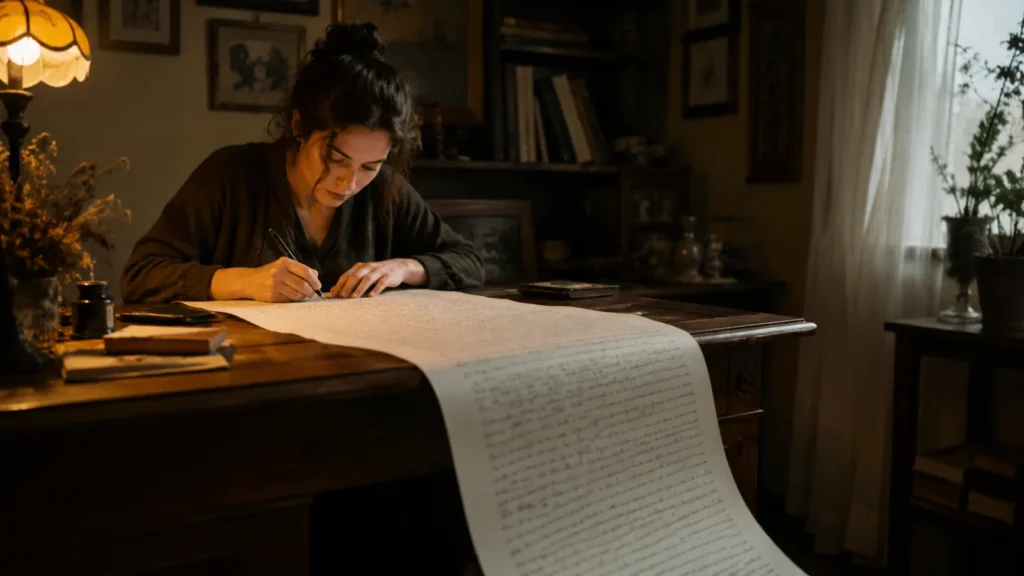
A very long unsent letter sometimes means you’re trying to write until the feeling resolves. And sometimes it won’t. You can write seven pages and still end up with the same ache, just with hand cramps.
There’s also the part nobody likes admitting: once a letter gets long enough, some people start performing for the imaginary reader. The tone sharpens. The paragraphs get more polished. You can almost feel the ghost audience in the room.
That doesn’t make the letter useless. It just means you may want to stop and ask whether you’re still expressing something, or whether you’ve shifted into writing a speech for a person who is never going to hear it.
A good stopping point is usually repetition
You don’t need a perfect ending. Most unsent letters don’t have one.
What you’re looking for is the point where the letter starts saying the same pain in slightly different clothes.
That’s often the signal to stop.
It might sound like:
- re-explaining the same incident three different ways
- adding examples that don’t change the meaning
- sliding into old arguments you already know by heart
- writing to prove you were right instead of writing what was true
If you notice that shift, you don’t have to force more. You can end the letter right after the clearest sentence. Even if it feels abrupt. Sometimes abrupt is honest.
Some people stop because they’ve said everything. Others stop because they’ve finally said the one thing they were avoiding. Those are both real endings.
If you can’t stop writing, split the letter
This helps more than people expect.
If what’s coming out is long, tangled, and emotionally all over the place, the problem may not be the length. It may be that there are actually several letters jammed together.
You may have:
- the angry letter
- the grieving letter
- the letter that says what you wish had happened
- the letter that admits what you miss
Those do not need to live in the same document.
In fact, they often work better apart. Otherwise the whole thing starts lurching around. One paragraph is fury, the next is tenderness, then bargaining, then sarcasm, then a very calm explanation of boundaries as if you’re somehow above all this. It gets crowded fast.
Separate letters give each feeling some air. They also make it easier to notice which part actually needed to be written, and which part was just momentum.
The draft can be long. The letter you keep might be short.
That distinction matters.
Your first version does not need restraint. If you need six pages, write six pages. If the whole thing comes out in a rush and half of it is not especially elegant, that’s fine. Unsent letters are allowed to be ugly before they become useful.
But once the draft exists, you can come back and ask a calmer question: what part of this is alive?
Not the cleverest part. Not the most devastating line. The part that still feels true when the temperature drops a little.
Sometimes that leaves you with a page and a half from an original five. Sometimes it leaves you with three lines.
Three honest lines can do a surprising amount of work.
You were not who I needed you to be.
I kept hoping that would change.
I’m done waiting inside that hope.
That’s enough, sometimes. More than enough.
What to do if you keep making it longer because you’re scared to be direct
This happens a lot.
People often add detail when they’re getting close to the sentence that actually scares them. More context. More explanation. More qualification. Suddenly the letter is twice as long, and somehow the main point is harder to find.

If that sounds familiar, it may help to ask: what would this letter say if you weren’t trying to be fair, impressive, reasonable, or impossible to misread?
Not cruel. Just direct.
The answer is usually shorter than expected.
Maybe it’s: I wanted you to choose me clearly, and you didn’t.
Maybe it’s: I’m angrier than I’ve let myself admit.
Maybe it’s: I still want an apology, which is inconvenient and a little embarrassing, but there it is.
That last kind of sentence tends to change the whole letter. Because now you’re not writing around the truth. You’re in it.
If the letter is for closure, shorter usually hits harder
Closure is one of those words that sounds cleaner than it feels.
But if your goal is to mark an ending for yourself, a shorter letter often works better than a sprawling one. Not because your feelings should be compact. Just because endings usually need firmness more than elaboration.
A shorter letter can sound like a line being drawn, even if nobody else ever sees it.
It can hold things like:
- what you now understand
- what you’re no longer asking for
- what you’re carrying forward, or refusing to
That kind of letter doesn’t need every detail in the record. It just needs enough truth that your body believes you wrote it.
If you finish and feel a little quiet after, that’s usually a better sign than feeling brilliantly eloquent.
There’s no prize for writing the most complete version
This part is easy to forget, especially if you’re a thorough person, or if the whole situation left you feeling misunderstood.
You do not have to include every example to justify your pain.
You do not have to write the definitive account.
You do not have to pre-answer objections from a person who isn’t even reading.
That urge makes sense. It really does. But it can turn the letter into a defense brief instead of a release.
And the weird thing is, the more complete people try to make an unsent letter, the less breathable it can become. Everything is in there except the pulse.
Better to leave some things unsaid than to bury the live wire under too much explanation.
A simple way to know you’re done
You read it back, and there’s a sentence that feels like it let some air into the room.
Not a perfect sentence. Not a dramatic one. Just one that makes your shoulders drop a little because, finally, there it is.
When you find that sentence, you may not need much after it.
You can stop there. Or write one more line. Or date it and put it away.
If you’re still unsure, try this: take a break, come back later, and cut anything that explains what the strongest sentence already says. That tends to reveal the real length pretty fast.
And if it’s still long, that doesn’t mean you did it wrong. It may just mean the thing you’re carrying is still unfolding. Some letters are a single sitting. Some are a stack of drafts over time. Both count.
The useful question isn’t whether the letter is technically short or long. It’s whether it sounds more honest the longer it gets.
If yes, keep going.
If not, you might already be done.
Stuck between one page and five?
Use a guided tool to sort out what belongs in the letter, what’s repetition, and what you’re really trying to release before you keep writing.