Most people don’t need the “best” format. You need the one that lets you say the thing honestly enough that you can actually finish it. That’s usually the real problem.
What should you understand first about message format?
Message format is the container you choose for what you need to say, and it changes the tone before the first sentence even lands. In practice, it affects pace, pressure, readability, and how exposed or composed the message feels to you and the person reading it.
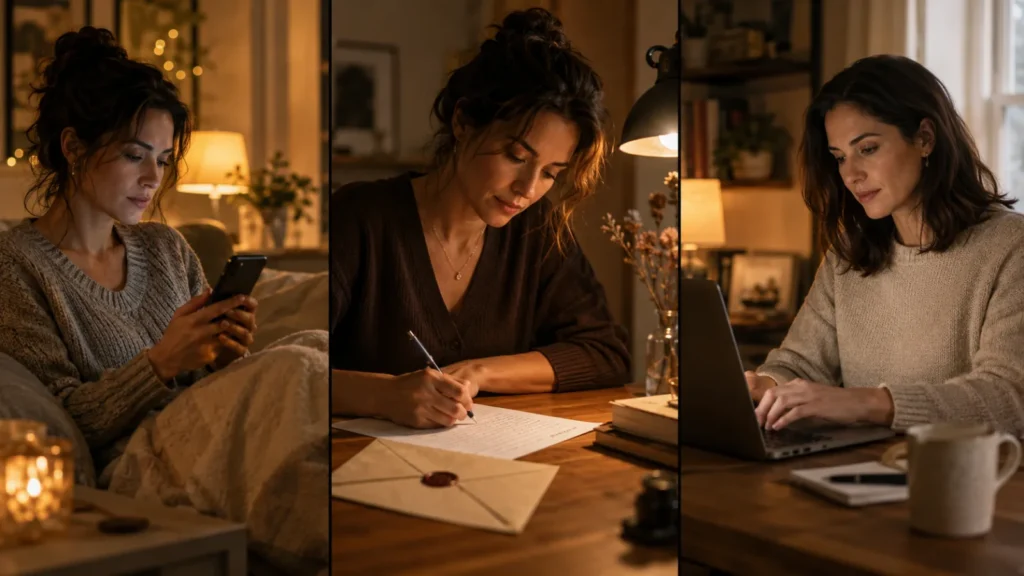
A handwritten letter feels intimate. A typed letter gives you room to think. An unsent text is fast, raw, and sometimes exactly right when you need to get words out before they harden into something heavier. None of them is automatically deeper or braver than the others. They just do different jobs.
If you’re stuck choosing, it usually helps to stop asking which one looks the most meaningful and ask a less glamorous question: what are you actually trying to do here?
Start with the job the message needs to do
Format changes tone before the person even reads a word. That’s why this decision matters more than it seems.
If you’re trying to create closeness, mark a moment, or say something that deserves a little weight, handwritten often fits. If you need clarity, structure, or enough distance to not spiral halfway through, typed usually helps. If the point is release, immediacy, or catching a feeling while it’s still honest, an unsent letter can be the cleanest option.
You’re not just choosing paper versus screen. You’re choosing pace, pressure, and emotional temperature.
That sounds dramatic. It’s still true.
When handwritten makes the most sense
Handwritten letters slow everything down. That’s part of their power and part of their problem.

They tend to feel more personal because they carry evidence of effort. The crossed-out line. The uneven spacing. The fact that someone had to sit there and stay with the thought long enough to move a pen across a page. If the message is about love, grief, apology, memory, gratitude, or goodbye, that physical quality can matter.
It can also make the message feel more vulnerable than you intended.
What handwritten does well
It gives emotional weight without needing dramatic language. A simple sentence on paper can land harder than a polished paragraph on a screen.
It also works well when you want the message to feel singular. Not dashed off between errands. Not copied from notes. Not easy to delete. Just there.
This can be especially right if you’re writing something someone might keep. A note for a partner. A letter to a parent. A message connected to loss. Something ceremonial without being stiff.
Where handwritten gets tricky
It’s hard to edit without making a mess. That matters if your thoughts are tangled or emotionally loaded.
It can also create pressure. People sometimes choose handwritten because it feels more meaningful, then freeze because every sentence suddenly seems permanent. The blank page starts acting like a judge. Not ideal.
And if your handwriting is hard to read, or writing by hand makes you physically uncomfortable, the romance of it fades pretty fast.
There’s also this slightly unflattering thing people do: choosing handwritten because it looks sincere, while avoiding the harder work of being clear. Beautiful stationery can’t rescue a vague message.
Choose handwritten if you want presence more than polish
If what matters most is warmth, tenderness, or the feeling that a real human sat with these words, handwritten is probably your format.
Not because it’s better. Because it leaves your fingerprints on the message, literally and emotionally.
If you want help with the actual mechanics, this complete guide to writing an unsent letter is useful for getting unstuck without making the whole thing sound formal.
When typed is the better call
Typed letters are underrated because they don’t get the same emotional credit. They should.
Sometimes the kindest thing you can do for yourself and the reader is make the message readable, organized, and easier to revise. That’s not less heartfelt. It’s often more responsible.
Typed gives you room to think
If you’re writing about something complicated, typed usually helps you say what you actually mean. You can move paragraphs around. Cut the part that sounded sharper in your head. Add the sentence that explains context instead of assuming the other person already knows it.
This matters a lot for apologies, difficult family dynamics, boundary-setting, or any message where tone can go sideways fast.
Typed also helps if you’re someone who starts strong and then loses the thread halfway through. You can pause, come back, and still read what you were trying to say.
It creates useful distance
Distance isn’t always avoidance. Sometimes it’s what keeps the message from becoming a live emotional spill.
A typed letter can hold warmth and thoughtfulness while giving you just enough separation to stay coherent. That’s a good trade when the topic is charged.
It’s also practical if the message is longer, if you want to save a copy, or if there’s any chance the recipient may need to revisit what you wrote carefully.
Typed can feel cold if you hide behind it
This is the catch. Typed letters can become overly managed. So polished they stop sounding human.
If every sentence starts sounding like it belongs in a workplace email, you’ve probably drifted too far from the actual feeling. Clean is good. Bloodless isn’t.
You don’t need to strip out every rough edge. Sometimes one plain sentence does more than five carefully balanced ones. “I didn’t know how to say this out loud.” “I’m trying to be clearer than I’ve been.” “You may not want to hear from me, and I understand that.” Those lines don’t need decoration.
When an unsent text is exactly the right move
This one gets dismissed because it sounds casual. Sometimes casual is the whole point.
An unsent text isn’t really about the platform. It’s about immediacy without consequence. You write as if you’re sending it, but you don’t. That changes what comes out.
For a lot of people, this is the format that gets past self-editing fastest.
Why unsent texts work
They lower the stakes. You’re not composing a letter for posterity. You’re catching a thought while it’s still alive.
That can be incredibly useful if you’re angry, grieving, ashamed, confused, or stuck in a loop of things you wish you’d said. The text format lets the language stay natural. Short lines. Half-finished thoughts. The exact phrasing you’d probably use if you were speaking without overthinking.
And because you’re not sending it, you don’t have to shape it for someone else’s comfort right away.
That last part matters more than people admit.
What it won’t do
An unsent text is great for release. It’s not always great for reflection.
If you stop there, you may end up with something emotionally honest but not especially clear. Useful, yes. Finished, maybe not.
It can also keep you in reaction mode. If what you really need is a considered message, the text draft may be step one, not the final form.
There’s a reason some people write the angry version in Notes first. Not because they’re manipulative. Because sending the first version is how situations get worse before breakfast.
Use an unsent text when speed matters more than structure
If you need to say the truest thing quickly, before you tidy it up into something less honest, start there.
You can always turn it into a typed or handwritten letter later. A surprising number of strong letters begin as something messy and unpresentable.
The real decision is emotional, not aesthetic
It’s easy to get distracted by the vibe of each format. Handwritten feels heartfelt. Typed feels mature. Text feels modern and raw. Fine. But the better question is what each one lets you access.
If handwriting makes you more sincere, use it. If it makes you self-conscious and weirdly performative, don’t.
If typing helps you stay kind and specific, that’s useful. If it turns you into a tiny corporate spokesperson for your own feelings, maybe back up.
If the unsent text gets to the truth in thirty seconds, great. If it just lets you rehearse arguments you don’t actually want to have, maybe don’t confuse intensity with clarity.
You’re looking for the format that makes honesty possible, not the one that looks the most meaningful from the outside.
If you’re still torn, try this in order
You probably don’t need a big decision. You may just need a sequence.
- Start with the unsent text if the feeling is loud and messy.
- Move to typed if you need shape, context, or restraint.
- Switch to handwritten if the final message deserves intimacy or permanence.
That order works because it follows the way emotion usually settles. First the spill, then the sense-making, then the offering.
Not always. But often enough.
A few quiet signs you’ve picked the wrong format
Sometimes you can tell by how you’re behaving around the draft.
If you keep restarting a handwritten letter because it doesn’t look beautiful enough, the format may be making you self-conscious.
If you’re editing a typed message for the fifteenth time and somehow saying less each round, you may be protecting yourself too much.
If your unsent text keeps getting longer and meaner and more theatrical, it may be helping you vent without helping you understand.
And if you’ve been “deciding on the format” for days when the real issue is that you don’t want to write the message at all, well. That happens. More than people like to admit.
Sometimes choosing between pen, keyboard, and phone is just a very respectable-looking form of procrastination.
What the recipient needs matters too
If this message is eventually being shared, think a little about how the other person is likely to receive it.
A handwritten note can feel deeply caring to one person and emotionally intense to another. A typed letter can feel thoughtful or distant. A text can feel natural or too casual, depending on the relationship and the subject.
You can’t control their reaction, obviously. But you can avoid choosing a format that fights the message.
If you’re saying something tender to someone who values keepsakes, handwritten may feel right. If you’re discussing something complicated with someone who needs clarity, typed might serve both of you better. If the message is mostly for your own processing, unsent may be enough.
That’s the part people skip. Not every honest message is meant to be delivered. Some are meant to be discovered, written down, and left there. Deciding whether you should ever send it is a separate question from writing it well.
So which one is right for you?
The short version is this: handwritten for closeness, typed for clarity, unsent text for release.
But even that’s a little too neat.
The right format is the one that helps you tell the truth without collapsing into performance, vagueness, or damage control. The one that gets you past the blank page and into the actual thing you need to say.
Sometimes that will be the version with folded paper and a real envelope. Sometimes it’ll be a document on your laptop with six bad opening lines deleted. Sometimes it’ll be a text you never send and still feel better having written.
You don’t have to make it meaningful in the most visible way. You just have to make it honest enough to exist.
Need help choosing the right format before you write?
Use a simple guided tool to sort out whether your message needs closeness, clarity, or private release first. It can make the next step feel much less loaded.