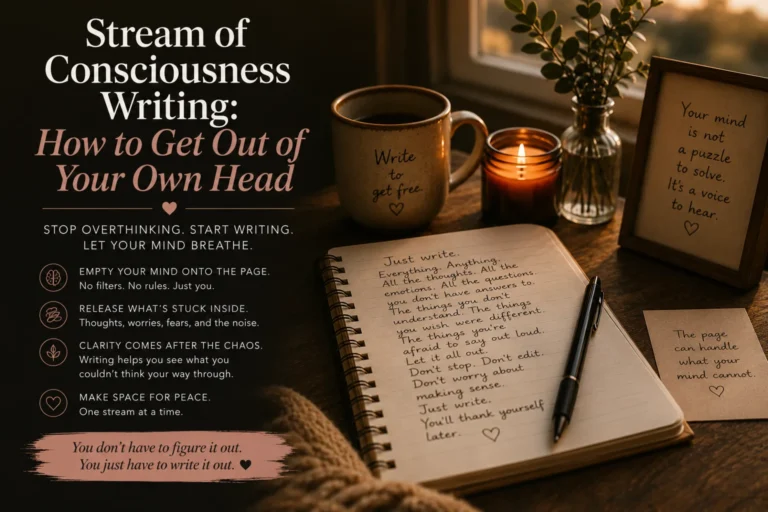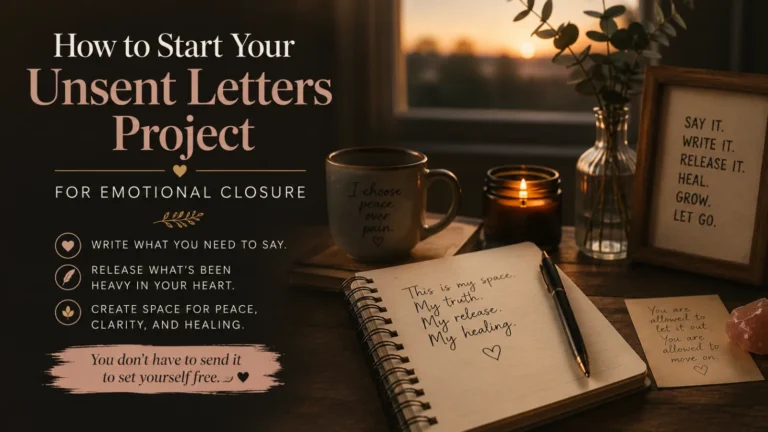

It usually starts smaller than people expect. Not with a dramatic need to “heal” or “express yourself,” but with one moment where you sit down to write and realize your body is acting like the page is dangerous.
That’s the real thing to work with here: if writing feels exposed, your private sanctuary isn’t a pretty desk setup. It’s a set of conditions that helps your mind stop bracing long enough to tell the truth.
Why does writing feel risky in the first place?
If you’ve ever opened a notebook and instantly wanted to clean the kitchen instead, that’s not laziness. That’s information.
Writing without fear sounds simple until you notice what writing actually asks of you. It asks you to be alone with your own thoughts. It asks you to choose words for things you’ve managed to keep blurry. It asks you to leave some kind of trace. Even if nobody else will ever read it, you will know it’s there.
For a lot of people, that’s the hard part.
Sometimes the fear is obvious. You’re afraid someone will find your pages. You’re afraid of being judged. You’re afraid what comes out will be “too much,” or messy, or childish, or not meaningful enough to justify the emotion behind it.
Sometimes it’s quieter than that. You sit down and feel restless. You scroll. You suddenly remember an email. You decide you need a different pen. You reorganize your notes into a system so elaborate that actual writing never happens. That last one is more common than anyone likes to admit.
A writing sanctuary matters because fear rarely announces itself as fear. It shows up as delay, fussiness, numbness, perfectionism, and the very convincing belief that you should wait until you feel more ready.
Usually, you don’t become ready first. Usually, you build conditions that make readiness more possible.
So what is a private writing sanctuary, really?
Not a cabin in the woods. Not necessarily a whole room with candles and a velvet chair and rain sounds playing in the background, though if you have that, good for you.
A private writing sanctuary is any space, routine, and boundary system that helps you write honestly with less self-protection.

That’s the useful definition. Not luxury. Not aesthetics. Safety.
And safety here doesn’t mean perfectly calm or deeply inspired. It means your environment is giving you enough support that your nervous system isn’t spending all its energy scanning for interruption, exposure, or pressure.
That support can come from a lot of places:
- physical privacy
- emotional permission
- a writing ritual that tells your brain what’s happening
- tools that feel easy, not loaded
- limits around time, noise, and other people
- a way to store or destroy your writing that makes you feel safe
- realistic expectations for what “good” writing even means in private
That last part matters more than people think. If you secretly treat every journal entry like it should be beautiful, wise, and coherent, you’re not creating sanctuary. You’re bringing an audience into the room.
What makes a space feel safe enough to tell the truth?
This is where people often get distracted by appearance.
A cozy corner can help. Soft light can help. A notebook you actually want to touch can help. But none of that matters much if you still feel watched, rushed, or internally graded.
A safe writing space usually gives you three things:
Privacy
This is the most obvious one, but it has layers.
Physical privacy is simple: can someone walk in, read over your shoulder, ask what you’re doing, comment on how long you’ve been sitting there, or pick up your notebook later?
If the answer is yes, your writing may stay shallow for good reason.
Emotional privacy is trickier. You can be alone and still feel observed. Maybe you grew up around people who mocked journaling, dismissed feelings, or treated private thoughts as community property. Maybe you were taught to explain yourself neatly and avoid sounding dramatic. Maybe you still hear an imaginary reader in your head every time you start a sentence.
That invisible audience changes what gets written.
A sanctuary reduces both forms of exposure. It doesn’t just shut the door. It helps you stop performing.
Permission
Some people don’t need help getting words out. They need help believing they’re allowed to say what’s true before they’ve organized it into something reasonable.
Permission sounds soft, but it’s practical. It means you don’t require your writing to be balanced, generous, evolved, poetic, productive, or “the full story” right away.
You’re allowed to write the first layer first.
That might be anger before nuance. Confusion before insight. Complaint before compassion. Fragments before coherence.
A lot of private writing dies because the writer tries to become the editor too early.
Containment
This is the part people skip and then wonder why writing leaves them raw for the rest of the day.
Containment means the writing has edges. A beginning. An end. A place to go. A way to stop.
If you know you can open something difficult and then close it with care, you’re more likely to begin. If writing feels like falling into a hole with no ladder out, your mind will resist it.
Containment can be as simple as a timer, a closing ritual, a glass of water afterward, a walk around the block, or a rule that says “when the timer ends, I write one final line and stop.”
That’s not restrictive. It’s merciful.
Do you need a perfect room to do this?
No. Honestly, waiting for ideal conditions can become its own form of avoidance.
A real sanctuary can exist in a full house, a tiny apartment, a parked car, a corner of the bed, a notes app, a cheap notebook hidden in a winter coat pocket, or ten minutes at the library before you go home.
The goal isn’t perfect conditions. It’s repeatable conditions.
You need something you can return to. Something that tells your body, “this is where we do the real writing.”
For some people, that’s a place. For others, it’s a sequence.
Sit down. Put phone face down. Open the same notebook. Make tea. Set a 15-minute timer. Begin with the same sentence stem. Write until the timer ends. Fold the page. Put it away.
That can be a sanctuary.
It doesn’t look glamorous, which is probably why it works.
Start with the part that actually scares you
This matters more than choosing the right pen or lighting. Before you build your space, get honest about the specific threat your mind is reacting to.
Not in a big dramatic way. Just plainly.
Maybe it’s one of these:
- Someone might read it.
- You might discover you’re angrier than you want to be.
- You might confirm something you’ve been trying not to know.
- You might write badly and feel embarrassed, even in private.
- You might start crying and not know how to get back to normal.
- You might not feel anything at all, which can be its own kind of fear.
- You might uncover memories or grief you don’t feel ready to handle.
- You might say something on the page that feels disloyal.
Different fears need different kinds of sanctuary.
If privacy is the issue, you need stronger boundaries and safer storage. If intensity is the issue, you need better containment. If perfectionism is the issue, you need looser rules. If you freeze because the page feels too open, structure may help more than freedom.
This is why generic advice about “just write whatever comes” can feel so useless. For some people, openness is freeing. For others, it’s the exact thing that makes the mind bolt.
What should your space protect you from?
Not every discomfort is a problem. Some writing is uncomfortable because it’s honest. That’s different from a setup that makes honesty harder than it needs to be.
A useful private sanctuary protects you from preventable friction.
Interruption
There’s the obvious kind, where somebody literally walks in. Then there’s interruption by anticipation, which can be just as disruptive. If part of your attention is always listening for footsteps, waiting to answer a text, or bracing for someone to ask what you’re doing, your writing won’t go very deep.
If you live with other people, this is where practical boundaries matter more than idealism. A closed door if you have one. Headphones if you don’t. A phrase everyone in the house understands. A time of day when fewer people need things from you. A seat that doesn’t leave your page visible from the hallway.
If shared-space writing is your reality, creating a safe writing environment in shared spaces can help you build privacy out of less-than-private conditions.
Evaluation
This one sneaks in.
Maybe nobody is actually grading your journal entry. But if your tools, timing, and setup make the session feel like a performance, you may start writing for an imaginary audience. Suddenly you’re choosing lines that sound insightful instead of lines that are true.
Sanctuary protects you from unnecessary evaluation. That might mean handwriting instead of typing because typing feels too polished. Or the opposite, if handwriting feels slow and loaded and digital writing lets you move faster than your inner critic.
If you’re not sure which medium gives you more freedom, hand-written vs digital: choosing your medium is worth reading before you overcomplicate the choice.
Exposure after the fact
A lot of people can write honestly only until they imagine the written thing continuing to exist.
That matters.
If the fear isn’t the writing itself but the record it creates, give yourself options. Lock the notebook. Use password-protected files. Write on loose pages and destroy them. Keep one notebook for material you want to revisit and another for writing that exists only to be released.
You do not need to archive every private truth.
Too much openness
This may sound backwards, but some spaces feel so open-ended that they stop being safe. A blank page, no time limit, no prompt, no ending, no structure. For some minds, that feels expansive. For others, it feels like standing at the edge of a dark field.
Structure can make honesty easier.
A prompt helps. A repeated opening line helps. A specific format helps. Even having phases helps. Some writers do better when they separate raw outpouring from sense-making. If that sounds like you, the 3-letter sequence: raw, refined, reflective gives you a way to move through emotional writing without forcing every part to happen at once.
How do you make writing feel private when your life isn’t?
This is the question underneath a lot of stalled writing.
You may not have a room of your own. You may live with a partner, children, parents, roommates, or anyone else with a talent for appearing exactly when you’ve finally touched a real thought. You may have a job that keeps your brain noisy. You may have a body that doesn’t relax on command. So the answer can’t be “just create a peaceful atmosphere.”
It has to be more practical than that.
Build layers, not one magical solution
Most private writing setups work because they combine several small protections.
For example:
- a specific time when interruption is less likely
- a seat that faces away from the room
- headphones or white noise
- a notebook that closes
- a rule that private writing gets put away immediately
- a short ritual that marks the start
- a timer that marks the end
None of those things is dramatic. Together, they tell your mind that this space is handled.
That matters because uncertainty is exhausting. If you sit down already negotiating ten risks at once, you’ll spend half the session trying to manage them instead of writing.
Decide what privacy means to you
Privacy is not one-size-fits-all.
For one person, privacy means total secrecy. Nobody knows they journal. Nobody touches the notebook. The pages get hidden or destroyed.
For someone else, privacy means nobody reads the words, but other people know the practice exists. “I write at 9. Please don’t interrupt unless it’s urgent.” That’s still privacy.
For someone else, privacy means emotional distance from real-life consequences. They can write candidly because they use initials, code words, or symbolic language that feels less exposing.
You’re allowed to choose the level that makes honest writing possible.
You’re also allowed to change it later.
The space itself matters, but not in the way social media says it does
A writing sanctuary does not need to look meaningful. It needs to remove resistance.
That’s a less photogenic goal, but it’s the useful one.
Ask practical questions:
- Can you sit there without adjusting yourself every 40 seconds?
- Is the light good enough that your body doesn’t get annoyed?
- Is the writing tool easy to reach?
- Can you start within a minute or two, or do you need to set up a whole production first?
- Will you feel exposed if someone walks past?
- Can you leave and come back without losing the thread?
If your setup is beautiful but inconvenient, you may avoid it. If it’s plain but easy, you’ll probably use it.
There’s a reason some of the most honest writing happens in ugly notebooks with bad pens and a door half-closed against the rest of the house.
Aesthetics can help you arrive. They can’t do the emotional work for you.
That said, atmosphere does matter when it helps your body unclench. Dimmer light. A blanket. A familiar mug. A certain chair. A lamp instead of overhead lighting. The same playlist every time. A surface that feels stable. The point isn’t to be precious about it. The point is to make the space recognizable.
If you want ideas for the physical side of this without turning it into a shopping project, this piece on creating your writer’s sanctuary is a helpful outside read.
What should you keep nearby, and what should go away?
This is one of those boring questions that ends up mattering a lot.
Keep nearby:
- the tool you actually write with
- water or tea if that helps you stay put
- tissues if emotional writing tends to go there
- one grounding object if you need one
- a simple prompt list if blank pages freeze you
- something soft or steadying if your body gets tense
Move away:
- your phone, if it turns into an escape hatch
- extra notebooks that make you second-guess which one is “right”
- open tabs, if you’re writing digitally
- anything visually noisy enough to keep catching your attention
- anything tied to work, productivity, or household management
The goal is not minimalism for its own sake. The goal is reducing decisions.
Every extra choice is a small chance to drift away from the reason you sat down.
What kind of writing actually belongs in a sanctuary like this?
Not just journaling, and not only dramatic emotional release.
A private writing sanctuary is useful for any kind of writing that asks for honesty before polish.
That includes:
- journaling when you don’t yet know what you think
- letters you’ll never send
- grief writing
- anger writing
- reflective writing after conflict
- writing to a younger self or future self
- writing to feelings, memories, places, or abstract ideas
- drafting something creative that feels too tender to expose early
- note-form truth-telling that may never become anything else
Some forms of writing especially benefit from a strong sense of privacy because they lower your usual defenses.
Letters are a good example. They can get straight to the point in a way normal journaling doesn’t. If that format opens something useful for you, writing letters to your younger or future self offers a gentle place to start, and how to write to abstract concepts: anxiety, loss, dreams can help if direct self-address feels awkward.
For grief, privacy often matters even more because grief writing can feel exposed in ways that are hard to predict. Some days it’s quiet. Some days one sentence hits and everything after that is different. If that’s part of why you’re here, journaling techniques for processing unexpressed grief and writing letters to people you never got to say goodbye to both fit naturally inside this larger practice.
And if anger is what keeps getting blocked, that deserves its own kind of container. Anger often gets edited out before it even reaches the page. Prompts for exploring anger through creative writing can give that feeling a shape without making it run the whole room.
What if the problem isn’t the room, but the inner critic?
Sometimes the physical setup is fine. The door is closed, the notebook is open, the time is there, and still the writing comes out stiff, careful, oddly polite.
That’s usually the inner critic arriving in advance.
Not the useful editing voice that helps later. The one that reacts to a half-formed sentence as if it’s evidence in a trial.
A lot of people try to defeat that voice by arguing with it. That can work sometimes, but often it just makes the whole session feel crowded. It’s usually easier to sidestep it.
Lower the stakes on purpose
The critic tends to get loud when the writing feels important.
So make it temporarily unimportant.
Use a throwaway notebook. Write in fragments. Set a ten-minute timer. Tell yourself this page doesn’t need to be kept. Start with “this is probably not the real thing, but…” or “what I’m not saying is…” or “the version I’d say out loud is…”
Those openings are useful because they bypass the formal voice. They make room for the sentence underneath the acceptable sentence.
You can also narrow the assignment. Don’t “journal about your feelings.” That’s too broad and weirdly formal. Write about the exact moment your chest tightened during a conversation. Write the sentence you wanted to say but didn’t. Write what you’re rehearsing in the shower. Write what you keep editing in your head.
Specificity gives the critic less room to posture.
Let the first pass be untrustworthy-looking
This helps more than people expect.
Private writing does not need to look respectable. In fact, a page that looks a little rough can feel safer. Messy lines. Arrows. Half-sentences. Repetition. Contradictions. Underlining something three times because apparently that’s the mood.
That kind of page signals that nobody is being graded here.
If you tend to shut down when asked to “write clearly,” it may help to separate expression from reflection. Raw first. Meaning later. Not because one stage is better, but because they ask for different muscles.
What if you’re afraid of what will come out?
That fear deserves respect.
People say “just let it out” too casually sometimes, as if every truth becomes manageable once written down. Not always. Writing can clarify, relieve, soften, and reveal. It can also flood you if you open more than you can hold in that moment.
So no, you do not have to force yourself to go all the way to the center of the hardest thing every time you write.
A sanctuary should make honesty possible, not compulsory.
Stay near the edge if that’s what’s honest today
There’s a strange kind of pressure around emotional writing where anything less than full catharsis can feel like failure. It isn’t.
Sometimes the most honest thing you can write is not the deepest thing. Sometimes it’s simply: “There’s something here I’m not ready to name.” That counts. Sometimes writing around the feeling is the safe and useful move.
You can circle a difficult subject by writing:
- what happened before it
- what your body does when you think about it
- what you keep avoiding
- what you wish were not true
- what you’d say if nobody interrupted
- what you don’t want anyone to minimize
That’s still real writing. It’s not lesser because it has edges.
Give difficult writing an exit ramp
If there’s any chance writing will stir up more than you want to carry around all day, end with something grounding. Not fake positivity. Just orientation.
A few options:
- name five ordinary things you can see
- write one sentence about where you are right now
- put both feet on the floor before you close the notebook
- drink water
- step outside
- write one final line that belongs to the present, not the memory
This is especially helpful if your writing touches grief, fear, anger, or old experiences that leave you feeling dislocated.
And if you know certain topics consistently overwhelm you, it may be better to approach them gently, or with support outside the page. Writing can be powerful, but it isn’t a substitute for professional care when something feels unmanageable.
How do you know your sanctuary is working?
Not because every session feels profound.
Usually the first sign is smaller than that. You stop delaying as much. You get to the real thing faster. Your sentences sound less public. You don’t spend the whole session arranging yourself into someone admirable.
You may also notice that the page becomes less “performatively reflective.” Less polished insight, more actual thought. Fewer summary statements. More lines that surprise you a little.
That’s a good sign.
Another sign is that you recover better after writing. You may still feel stirred up, but not shredded. There’s enough containment that your day isn’t derailed every time you touch something tender.
And maybe the clearest sign: you start trusting the space. You sit down and your body recognizes what this is for.
That takes time.
What tends to break the sanctuary?
Usually, it’s not one huge failure. It’s drift.
You start checking your phone mid-session. You begin using the same notebook for grocery lists and emotionally loaded writing. You tell someone where you keep your journal and they make one annoying joke about reading it. You start rereading old entries every time instead of writing new ones. You decide every session has to produce insight. You move the practice to a time of day when you’re already depleted and resentful.
None of that means you’ve failed. It just means the container needs repair.
Sometimes the repair is practical. New notebook. Better storage. Different time. Headphones. Shorter sessions.
Sometimes it’s emotional. You need to remind yourself that private writing is not a performance review, and it does not owe anybody coherence.
Sometimes it’s a boundary problem. Someone has gotten too close to a thing that needed to stay yours.
That’s worth taking seriously.
If you’ve been waiting to “deserve” a private practice, stop there
This comes up more than it should.
People act like private writing needs to be earned through discipline, depth, or a level of suffering that justifies the quiet. As if ordinary confusion doesn’t count. As if you need a dramatic reason to close the door and hear yourself think.
You don’t.
You can build a sanctuary simply because your inner life needs somewhere to go.
You can build one because you’re tired of only hearing your own thoughts in rushed, interrupted fragments.
You can build one because there are things you can’t say cleanly out loud yet.
That’s enough.
When should you change the method instead of forcing it?
If you keep avoiding the same setup, that’s useful information. Not a character flaw.
Maybe the notebook feels too permanent. Maybe typing makes you too editorial. Maybe prompts help. Maybe prompts make you feel trapped. Maybe nighttime writing opens more truth. Maybe it also wrecks your sleep. Maybe mornings are quieter but emotionally flatter. Maybe you need movement first. Maybe sitting still is the problem.
A sanctuary is not a moral system. It’s an experiment in honesty.
Change what isn’t helping.
If one form keeps producing locked-up, careful writing, try another. A letter instead of an entry. Fragments instead of paragraphs. Timed writing instead of open-ended writing. Raw notes now, reflection tomorrow. A page you keep, and a page you tear up.
You’re not cheating if you make it easier.
Common Questions
How private does writing need to be to feel safe?
Private enough that you stop self-censoring. For some people that means total secrecy; for others it just means nobody reads the words. If you’re still mentally writing for an audience, the setup probably needs stronger boundaries.
Is it better to handwrite or type?
Whichever one makes you more honest. Handwriting can slow you down in a good way, but it can also make some people feel too exposed. Typing can feel freer or more polished, depending on your habits. Test both and notice which one makes you less guarded.
What if you freeze every time you face a blank page?
Use structure. A prompt, a timer, a repeated first sentence, or a letter format can help a lot. The problem usually isn’t that you have nothing to say; it’s that total openness gives your mind nowhere to step first.
Should you reread what you write?
Not always. Sometimes rereading helps you notice patterns or continue a thread. Sometimes it makes you edit yourself too early or get stuck in self-analysis. If rereading kills momentum, leave a gap before you go back.
What if someone might find your writing?
Build for that risk directly instead of trying to ignore it. Use password protection, a hidden notebook, coded language, loose pages you can destroy, or a separate place to store sensitive writing. If the fear is real, the solution needs to be practical.
Can writing ever make things feel worse?
Yes, sometimes. Honest writing can stir up grief, anger, fear, or memories you weren’t ready to hold that day. That doesn’t mean writing is bad; it means containment matters, and some topics may need a gentler approach or support beyond the page.
How long should a writing session be?
Long enough to get past the polite version, short enough that you don’t dread starting. For many people, that’s somewhere around 10 to 20 minutes at first. If you end while you still feel steady, you’re more likely to come back tomorrow.
There’s no perfect version of this. Just the one where your body stops acting like the page is a threat, at least enough for a few honest lines. That’s usually where it begins.
Write what you can’t say out loud
If the page only feels safe when nobody else will ever see it, start there. Give your unspoken words a private place to land.