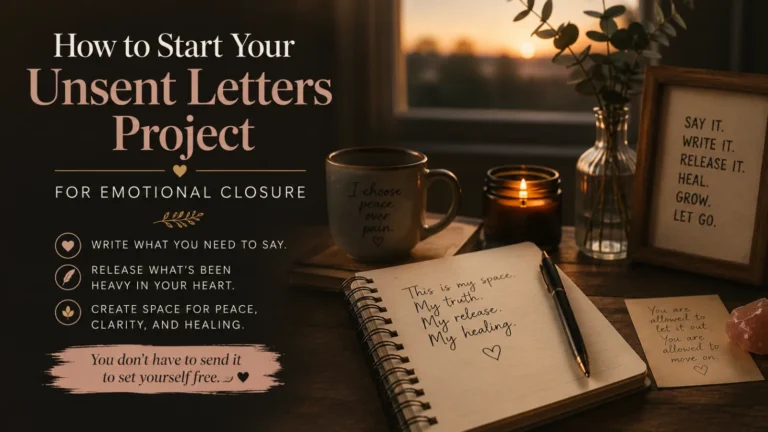


Sometimes the hardest part isn’t deciding to say goodbye. It’s trying to say goodbye when the love didn’t actually shut off. That’s what makes this kind of letter so brutal, and also why it can help more than you expect.
A goodbye letter to someone you still love usually isn’t about proving anything or getting the perfect final word. It’s about saying what’s true without pretending you’re over it, and without leaving yourself trapped in the loop of one more message, one more explanation, one more chance they may never take.
You do not have to sound healed to be honest
People often get stuck before they even start because they think the letter has to sound calm, wise, detached, maybe even gracious in a very polished way. It doesn’t. It just has to be honest enough that you recognize yourself in it.
You can still love someone and know you need to stop reaching for them. Those two things can sit in the same letter. Actually, they usually should.
This is not the place to perform indifference. If you still love them, writing “I’m completely at peace and wishing you the best” when that isn’t true will make the whole thing feel fake by the third sentence. You don’t need to be dramatic, but you do need to be real.
Real can sound like this:
You mattered to me. You probably still do. I didn’t want this to end like this, and I’m not writing because my feelings vanished. I’m writing because I can’t keep living inside what this has become.
That kind of honesty tends to land harder than anything polished.
What the letter is really for
If you secretly hope the letter will make them come back transformed, say exactly the right thing, or finally understand your value, that hope is worth noticing before you write another line. Not because it makes you foolish. Just because it changes what kind of letter you’re writing.
A goodbye letter can do a few different jobs, and they are not all compatible.
If you want closure, write toward release
If this letter is mainly for your own closure, the goal is not persuasion. It’s clarity. You’re naming what happened, what it cost you, what you’re accepting, and what you’re putting down now. That kind of letter often becomes much clearer once you stop imagining their rebuttal. If that’s the version you need, it may help to look at how to write a closure letter you do not send, because sometimes the most honest goodbye is one that never has to survive their response.
If you plan to send it, write with consequences in mind
A sent goodbye letter lives in the real world. It can be ignored, misunderstood, answered badly, answered tenderly, screenshotted, reread, or used to reopen something you were trying to end. That doesn’t mean don’t send it. It just means the letter needs to serve you even if the reply is disappointing or there is no reply at all.
That’s the part people skip. They write for the fantasy response and forget to write for the actual risk.
What to include when love is still in the room
This is where a lot of letters either become too vague or completely unravel. The simplest structure is usually enough.
You can include four things:
- what was real for you
- what is no longer workable
- what you’re choosing now
- what boundary, if any, comes next
That’s it. Not your whole history. Not every contradiction. Not a cross-examination.
What was real for you might be the love itself, or the hope, or the way the relationship changed you. What is no longer workable is the part that keeps breaking you open: inconsistency, silence, betrayal, waiting, half-commitment, emotional confusion, being kept near but never fully chosen.
Then comes the choice. This is the real goodbye. Not “I guess this is it” floating at the end of a page full of longing. An actual decision in words.
You might say you’re stepping back. You’re not contacting them anymore. You’re not available for an almost-relationship. You’re not continuing a pattern that keeps asking your heart to survive on scraps and call it love.
That last part may sound a little sharp, but sometimes sharp is accurate.
What to leave out, even if you’re tempted
Some things feel satisfying in the draft and awful later.
One is the hidden test. That’s when the letter says goodbye on the surface but is really designed to see whether they’ll fight for you. If the whole letter is leaning toward “unless you stop me,” it probably isn’t a goodbye yet. It’s a last attempt. Which, to be fair, happens. But naming it matters.
Another is overexplaining. When someone has already shown you they can’t meet you where you are, adding six more paragraphs usually doesn’t create understanding. It just exposes more of you to someone who may not know what to do with that tenderness.
And then there’s the part that gets a little humiliating later: trying to sound untouched. That cool, distant tone. The “I’m thriving and barely thinking about this” voice. It rarely protects your dignity the way people hope it will. It usually just makes the letter sound like it was written for an audience.
A better kind of dignity is saying less, but meaning it.

The line between loving someone and abandoning yourself
This is usually the center of the whole thing.
You can love someone deeply and still need to leave. Not because the love was fake. Because love is not the only thing that decides whether a relationship is livable.
That can be hard to accept when part of you still wants to defend them. Maybe they were overwhelmed. Maybe they were scared. Maybe they cared but couldn’t show it well. Maybe they did love you in the only way they knew how. All of that may be true.
It still may not have been enough to build a life on.
Your letter does not need to put them on trial to justify your goodbye. It just has to tell the truth about the impact. If you keep minimizing what happened because you understand their reasons, the letter will start slipping away from you.
Sometimes the most honest sentence is not the most poetic one. It’s something plain: I love you, and this is hurting me too much to keep doing.
That’s a whole letter, honestly.
If they hurt you, the goodbye may need more protection
Not every goodbye letter to someone you still love is about mutual sadness. Sometimes love is still there, but so is anger, confusion, betrayal, or the weird ache of never getting a clean ending.
In those cases, the letter needs less emotional openness than you may think. Not because your feelings don’t matter. Because not every person has earned full access to them.
If you’re writing to someone who caused real harm, it may help to think more carefully about how to write to someone who hurt you without reopening the wound. A goodbye should not become another opportunity for them to twist your words, deny your reality, or pull you back into the same pattern wearing different clothes.
And if what’s haunting you is the lack of accountability, that very specific ache of being deeply affected by something they’ll probably never fully admit, there’s a reason writing to someone who never apologized feels like its own kind of impossible. You’re not just ending contact. You’re giving up the fantasy of the apology that would finally make the story make sense.
You probably need a draft nobody else sees
The first version is rarely the letter.
The first version is where all the extra blood comes out. The blaming, the bargaining, the paragraphs you’d deny writing tomorrow, the sentence that is technically true but maybe a little too crafted to make them feel your absence forever. Normal. Very human. Not the final.
If you skip that draft, the “clean” version often comes out too restrained, and then the real feeling leaks sideways in odd places. A formal line here, a guilt-loaded sentence there, one little stab disguised as sincerity.
Better to let the mess happen in private.
Then come back and ask:
- What am I actually trying to say?
- What part is true but unnecessary?
- What part is written to get a reaction?
- What would I regret if they showed this to someone else?
That last question isn’t about shame. It’s about whether the letter protects what is still tender in you.
When the ending was silence, the letter feels different
Goodbye letters are hard enough when there was at least a conversation. When there was ghosting, disappearing, half-answers, or some vague fade-out that left you talking to a locked door, the whole thing gets stranger.
Because you’re not only grieving the person. You’re grieving the lack of an ending that made any sense.
That kind of letter often carries a different temptation: to finally make them explain themselves. And maybe they should. But a letter usually can’t force that moment into existence. If the silence is the wound, figuring out what to write when someone ghosted you can help you separate what needs to be said from what still longs to be answered.
That distinction matters. One gives you ground to stand on. The other can keep you pacing.
There is no perfect tone for this
This is the part that trips people up more than wording, more than structure, more than whether to send it.
You may want the letter to sound loving but not weak, firm but not cruel, openhearted but not available, final but not cold. Which is understandable. It’s also a nearly impossible emotional gymnastics routine.
So it helps to stop aiming for a perfect tone and aim for a steady one.
Steady sounds like yourself on your clearest day. Not your angriest day. Not your most hopeful day. Not the day you miss them so much you’d agree to anything just to hear their voice again.
If you can, write it. Leave it alone. Read it the next day. If one sentence makes you wince because it sounds like a trap, take it out. If one sentence makes you tear up because it finally says the truth simply, keep that one.
And yes, people do sometimes spend forty minutes changing one line and then realize the original line was fine. Not noble. Just common.
What a real goodbye often sounds like
Not elegant. Not cinematic. Usually just clean.
It might sound like this in spirit:
You can love them and still say this relationship is costing too much.
You can admit you wanted it to be different.
You can say you’re grateful for what was real without pretending the ending didn’t hurt.
You can stop asking them to become someone else in the final paragraph.
You can leave the door closed without slamming it.
That’s usually enough.
The strangest part is that writing a goodbye letter to someone you still love may not make you feel instantly free. Sometimes it just makes things quieter. Which doesn’t sound dramatic, but quiet can be a mercy when your head has been arguing with your heart for weeks.
If you write one, and it doesn’t solve everything, that doesn’t mean you did it wrong. It may have only done one job. It may have helped you stop saying the same unsaid thing over and over in your mind. Sometimes that’s the first real sign that the ending has started, even if your feelings haven’t caught up yet, which is why writing a letter to yourself after a mistake you cannot undo can matter even when it doesn’t feel tidy.
And if you’re still sitting there with a half-written draft because part of you doesn’t want to let go of the version where they finally understand and come back different, that part probably deserves some kindness too. It’s not ridiculous. It’s just not always a good editor.
Need help saying what you still feel without reopening the wound?
Use a guided unsent letter prompt to put love, grief, and goodbye in the same place without turning it into another message you regret sending.