

Something shifts once you stop trying to “write well” about anger and just give it somewhere to go. That’s really the point of these prompts. Not to make your anger prettier. Just more sayable.
Anger can be loud, but on the page it often shows up weirdly quiet at first. You sit down thinking you’re going to pour out everything, and instead you write three stiff sentences that sound like an email to a manager. Very common. Anger tends to wear disguises. It comes out as sarcasm, blankness, overexplaining, fake calm, or a sudden need to clean the kitchen instead of write anything at all.
So if you’re trying to explore anger through creative writing, it helps to stop expecting one perfect cathartic monologue. Usually, you get further with prompts that come at the feeling from the side, including unsent letters.
If you want a wider frame for how writing helps with emotions that don’t come out cleanly, Navigating Unspoken Emotions: Writing as a Healing Tool gives you the bigger picture. This piece is narrower. Just anger, and ways to get it moving.
Why is anger so hard to write about?
Partly because anger is rarely just anger.
A lot of the time it’s anger with humiliation attached. Or grief. Or fear. Or that particular sharp feeling of being dismissed and then expected to act normal five minutes later. When you try to write it straight, the whole thing can feel either too hot or completely flat.
That’s why creative prompts help. They give your mind a shape to push against. Instead of “write about what made you angry,” which can feel impossible, you get a smaller door to walk through.
And smaller is usually better here.
Not because your anger is small. Because it’s easier to tell the truth in pieces.
What kind of writing actually helps?
Usually, the kind that makes you less performative.
Anger has a strange way of making people write for an imaginary audience. Suddenly the page becomes a courtroom, or a closing argument, or a speech you wish you’d given. That can be useful for a minute. But if every sentence is trying to prove your case, you may end up circling the same point without learning much.
Helpful anger writing often does one of three things:
- lets you say the unsaid thing
- helps you notice what’s under the anger
- gives the feeling an image, voice, or scene instead of forcing a neat explanation
If structure helps you feel safer on the page, Using Structured Writing Techniques for Complex Emotions can make this easier. But if structure makes you tighten up, the prompts below work well in a looser way too.
When you don’t know where to start
Start with the least elegant version.
Not the wise version. Not the fair version. Not the version you’d be comfortable rereading tomorrow. Just the version that has heat in it.
Here are a few prompts that tend to get past the polite layer.
1. Write the sentence you were not allowed to say
Begin with: “What I actually wanted to say was…”
Then keep going without correcting tone, softening language, or trying to sound reasonable. The point isn’t to be cruel on the page. The point is to stop editing the emotional reality before it even appears.
If that opens something up, follow it with: “And what made it worse was…”
That second line is often where the real material is.
2. Describe anger as a place
Not a fire. Not a storm. Those metaphors are a little tired unless they genuinely fit.
Instead, ask yourself: if your anger were a room, street, waiting area, staircase, parking lot, kitchen, field, what would it be? What’s the lighting like? What’s broken? What sound is always there? What should be in the room but isn’t?
This works because anger often becomes easier to approach once it’s not trapped inside abstract feeling words.
3. Write from the moment before the anger
This one matters more than people expect.
Pick the ten seconds before you got angry. Or the hour before. What was happening in your body? What were you hoping for? What were you trying to ignore? What had already been building?
Sometimes anger makes more sense once you write the lead-up instead of the explosion.
4. Let the anger speak for itself
Try writing a monologue that begins:
“I am the part of you that…” or “I showed up when…”
Give anger a voice. Not because anger is always right. It isn’t. But it usually thinks it has a job. Protection, interruption, defense, exposure, refusal. Let it explain itself.
A lot of surprising things come out when anger gets to speak without being either glorified or shoved out of the room.
What if your anger feels messy or irrational?
Then you’re probably close to something real.
One of the more frustrating things about anger is how quickly people sort it into “valid” and “overreaction,” as if human feelings arrive clean and documented. They don’t. Sometimes your anger is about what happened yesterday. Sometimes it’s about yesterday landing on top of something much older. Sometimes both.
That doesn’t make the writing less useful. It makes it more honest.
Try prompts that leave room for contradiction.
5. Write two versions of the same moment
In the first version, write it as if your anger is completely justified.
In the second, write it as if your anger is covering a more vulnerable feeling.
Don’t force yourself to choose which version is correct. Just see what changes between them. Often the details tell you something before your conclusions do.
6. Finish these lines without stopping
- “What anger has been protecting me from is…”
- “If I stopped being angry for one minute, I might feel…”
- “The part I keep skipping over is…”
- “What still feels unfair is…”
These are simple, but simple is sometimes what gets through. The mind loves complexity when it wants to avoid a sentence it already knows.
7. Write the most petty version
Honestly, this can be weirdly useful.
Write the small, undignified, unimpressive part of the anger. The part that’s not noble at all. The part that wanted a text back, wanted an apology in the exact right tone, wanted someone to notice the effort, wanted not to be interrupted for once.
That kind of writing can feel a little embarrassing, which is usually a sign you’ve left the performance layer. Anger often has a very polished public face and a much less flattering private one.
How do you make anger creative without watering it down?
By giving it form, not a filter.
Creative writing doesn’t mean turning anger into something delicate or poetic unless that’s honestly where it goes. It means using shape, image, voice, scene, rhythm, and point of view so the feeling can move.

Here are a few ways to do that.
8. Write a scene with no explanation
Put the anger in a scene. Just actions, dialogue, objects, movement. No commentary. No “you felt.” No explaining motives.
What got slammed down on the table? What went unsaid? What was everyone pretending not to notice?
Scenes often reveal power more clearly than reflection does.
9. Turn your anger into an object
Make it specific.
A cracked mug. A car idling outside. A sweater stretched out of shape. A shopping cart with one bad wheel. A phone with the brightness turned all the way down.
Then write about the object for a page without announcing what it stands for. Let the connection emerge on its own.
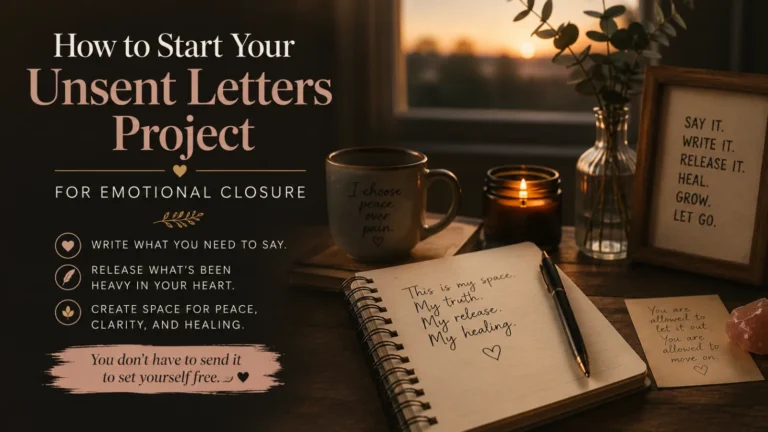
10. Write a letter you will not send
Yes, this one is obvious. It’s also useful for a reason.
The trick is to make the letter less formal than you think it should be. Most unsent letters fail because they start sounding like official statements. What you want is the sentence you wouldn’t want interrupted.
You can also write two letters: one to the person, one to the version of yourself who is still arguing with them in your head.
The second one is often sharper.
11. Write anger as dialogue between two voices
Let one voice be furious. Let the other voice be tired, scared, detached, practical, or ashamed.
You don’t need to decide which one is the “real” you. Most people are not one clean voice when they’re hurt. Writing both sides can stop the page from turning into one long emotional glare.
What if the page goes blank?
Then the prompt may be too broad, or too direct.
Blankness is not always resistance. Sometimes it’s self-protection. Sometimes it just means your mind needs a narrower task.
Try one of these:
- Describe only your hands during the angry moment.
- Write what the room looked like after the argument.
- Start with, “The ridiculous part is…”
- List five things that felt minor but were not minor.
- Write the version you’d deny if someone read it aloud.
That last one has some bite to it.
If you tend to freeze when emotions get layered or hard to name, Using Structured Writing Techniques for Complex Emotions can help you hold the thread without flattening what you feel.
Do you have to understand your anger while you write?
No. That pressure makes people lie on the page.
You do not need a takeaway while you’re in the middle of it. You do not need to end in forgiveness, clarity, balance, or grace. Sometimes the most honest page is one that simply says, in different ways, this still burns and I don’t know what to do with it yet.
That’s not failed writing. That’s writing that hasn’t been forced into a moral too early.
It can help to separate two kinds of sessions:
One where you let the anger speak. One where you come back later and ask what it was trying to say.
Those are different jobs. Doing both at once can make the writing stiff.
If you want prompts that go a little deeper
These are useful when you’ve already written the obvious version and you can tell there’s more underneath it.
12. What did the anger interrupt?
Sometimes anger stops something. Compliance. Hope. Waiting. Begging. Performing okay-ness.
Write about what your anger ended, even briefly. There’s often power in that.
13. What does your anger refuse?
Start with: “My anger refuses…”
Let the answer be repetitive if it needs to be. Repetition has its place here. Refuses to be spoken over. Refuses to make this sound smaller. Refuses to carry the whole thing quietly.
14. Write from the body, not the argument
Forget the story for a minute.
Where does the anger sit? Jaw, throat, chest, gut, hands? Is it hot, electric, pressurized, restless, heavy, brittle? Does it make you want to pace, clench, scrub, drive, sleep, disappear?
This is often where the writing gets less polished and more true.
15. Ask anger one good question
Not twenty. One.
Try: “What are you pointing at?” “What are you tired of?” “What came before you?” “What would ease you, even a little?” “What do you need me to stop pretending about?”
Then answer without trying to sound insightful. Insight usually arrives sideways anyway.
Common Questions
Is it better to write about anger right away or wait until you’ve calmed down?
Either can work. Writing right away can capture heat and honesty, but waiting can give you more range. If the page turns into pure looping, step back and come back later.
What if the writing gets too intense?
Stop before you feel flooded. You can switch to describing objects in the room, your breathing, or the physical setting of the moment. The goal is expression, not pushing yourself past what feels manageable.
Do these prompts work if you’re angry at yourself?
Yes, though that version can get harsh fast. It helps to notice when self-anger is sliding into punishment. If it does, switch from accusation to curiosity for a few lines.
Should you keep what you write, or throw it away?
Either is fine. Some pages are worth revisiting because they show you something real. Some were only useful in the moment. You don’t owe every honest page an archive.
What if everything you write sounds dramatic or fake?
That usually means you’re still writing for an imagined reader. Make the prompt smaller. Focus on one sentence, one object, one gesture, one interruption. Specificity tends to drain the fake tone out.
Can creative writing actually help with anger, or does it just stir it up more?
It can do both. Sometimes writing brings the feeling closer before it loosens it. That doesn’t mean it’s failing. It may just mean you’ve stopped skimming the surface, which is not always comfortable.
Write the angry version first
If your thoughts keep turning into edited, polite sentences, start with a space that doesn’t ask you to be reasonable. Use a private guided letter to say what you’re actually mad about, even if you never send it.