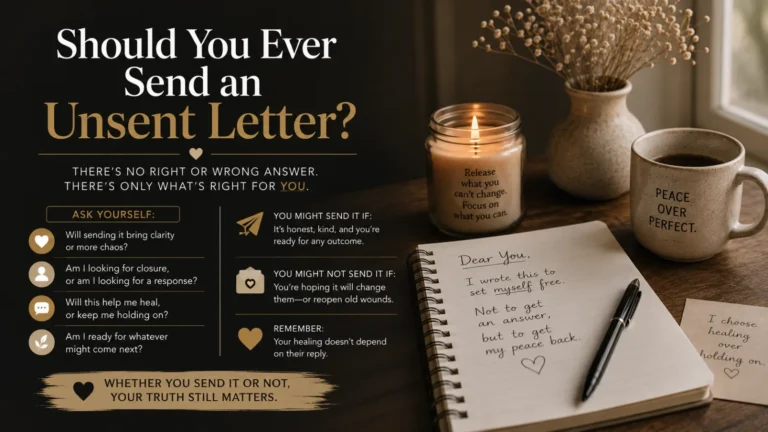


Sometimes the hardest part isn’t knowing what you feel. It’s finding a way to let those feelings exist somewhere outside your body without sending them somewhere they can do more damage. That’s where unsent letter prompts can help. Not because they magically fix anything, but because they give your thoughts somewhere to go.
What are unsent letter prompts?
They are simple sentence starters that help you begin a private letter when your thoughts feel tangled, delayed, or difficult to say plainly.
An unsent letter is exactly what it sounds like: a letter you write without any plan to mail, text, email, or hand it over. It can be to a person, a version of yourself, a relationship, a grief, a memory, even a question that never got answered. The point isn’t performance. It’s honesty with a little privacy around it. If you want a clearer picture of what counts and what doesn’t, this breakdown of what an unsent letter is and why people write one lays it out simply.
If you’ve been holding a lot inside, prompts can make starting easier. Blank pages can get weirdly confrontational. A sentence stem is gentler. It gives you a door instead of a wall.
When you don’t know where to begin
You do not need the full story before you start. You just need one true sentence. Usually the real letter begins a few lines after the polite version runs out.
These prompts are good if you feel jammed up, numb, scattered, or too flooded to write in a straight line:
- I keep pretending I’m fine with this, but I’m not fine with…
- The part I haven’t said out loud is…
- If I stopped trying to be fair for one minute, I would say…
- What still bothers me is…
- I didn’t know this was still living in me until…
- The truth is, I wanted…
- What I wish you understood is…
- I keep replaying…
- I don’t even know if this makes sense, but…
That last one is especially useful. A lot of real writing starts messy. You’re not drafting testimony. You’re letting the guarded part of your mind realize it doesn’t have to sound impressive. If the first line is still the part that keeps stopping you, ways to start when you do not know what to say yet can make the page feel less hostile.
Prompts for things you never got to say in the moment
Some feelings don’t show up on time. They arrive three days later in the grocery store. Or in the shower. Or when you’re trying to answer an email and your brain suddenly drags up an argument from two years ago with suspicious clarity.
If the words came late, these can help:
- At the time, I said nothing, but what I meant was…
- I wish I had told you…
- The moment I went quiet was the moment…
- I needed more time to understand that…
- What I should have protected then was…
- I thought staying calm meant staying silent, but…
This kind of prompt can be strangely relieving because it lets you finish an emotional sentence your body has been trying to complete. Not to rewrite history. Just to stop carrying around the unfinished version.
When the letter is full of anger
Anger on the page can look sharper than anger in your head, and that can be unnerving. Sometimes people stop writing right when it gets useful because they’re afraid of what the words reveal. But an unsent letter is one of the safer places for anger to be honest.
You’re allowed to let the ugly first draft exist. You’re also allowed to not trust it as your final truth. Both things can be true at once.
Prompts that let anger say its piece
- I am angry because…
- What this cost me was…
- You do not get to decide that this was small because…
- The part that felt cruel was…
- I keep minimizing this, but it hurt when…
- If I stopped trying to be the bigger person, I would say…
- You crossed a line when…
One small caution here: if you’re writing while very activated, it can help to give the letter a container. Set a timer. Write by hand. Stop when your body starts revving higher instead of settling. Sometimes the page helps release anger. Sometimes it feeds the spiral a little. You’ll know which one it is by how you feel afterward: clearer, heavier, shakier, steadier. Pay attention to that.
When what’s stuck is grief
Grief letters can be for someone who died, but not only that. You can grieve a friendship that changed, a home you left, a future you thought you’d have, a version of your family that never existed the way you needed it to. A lot of people dismiss that kind of grief because it feels less legitimate. It usually isn’t less real.
These prompts can help when the ache is hard to name:
- I miss…
- What I never got back was…
- I keep reaching for you in these moments…
- I didn’t just lose you. I lost…
- The ordinary thing I miss most is…
- I’m still trying to make sense of…
- I wish I could tell you what happened after…
The line about ordinary things matters more than it seems. Big grief often hides in small details. The chair nobody sits in now. The person you still almost text. The recipe you avoid. The weird joke no one else would get. That’s usually where the letter becomes real.
Prompts for the apology you won’t receive
This one is rough, honestly. Waiting for accountability can keep a wound open far longer than the original event. Sometimes the apology never comes. Sometimes it comes in a form so thin and self-protective that it somehow makes things worse. “I’m sorry you felt that way” has done a lot of damage.
An unsent letter can’t make someone take responsibility. But it can help you stop organizing your inner life around their potential change of heart.
- What I needed you to admit was…
- The apology I deserved would have sounded like…
- I wanted you to understand that…
- What made this harder was that you never…
- I keep waiting for something you may never say, and that something is…
- Even without your apology, the truth is still…
That last prompt can shift something. Not all at once. But enough to remind you that truth does not become false just because someone refuses to say it with you in the room.
When the letter is really to yourself
These are often the hardest ones to write without slipping into either fake positivity or total demolition. A lot of people are much crueler to themselves on paper than they realize. Then they try to fix it by forcing compassion so fast it doesn’t feel believable. Neither extreme helps much.
It can work better to write to yourself like someone who knows the full story and isn’t trying to win an argument.
Prompts that feel a little more honest
- You were doing the best you could with what you knew then, and also…
- I’m sorry for how hard you were trying to survive…
- You keep blaming yourself for…
- What nobody saw about that season was…
- You did not fail just because…
- I need you to stop calling this weakness when it was…
- The part of you that still needs kindness is…
If writing to yourself feels corny, that’s normal. A lot of people flinch at it. There’s something slightly embarrassing about seeing your own pain addressed directly on the page. Still, it can be the prompt that gets past your defenses fastest.
And yes, plenty of people put this off because it feels awkward and then act surprised when the avoidance doesn’t make the feelings disappear. Very human. Not especially effective.
For relationships that are complicated, unfinished, or both
Some letters don’t fit clean categories because the relationship itself never did. You might love the person and resent them. Miss them and not want them back. Understand why something happened and still feel harmed by it. Mixed feelings are not a sign you’re doing it wrong. They’re usually a sign you’re close to the truth.
Try these:
- I have spent a lot of time trying to make you either all good or all bad, but the truth is…
- I loved you, and I was hurt by you, and both are true when…
- What makes this hard to let go of is…
- Part of me still wants…
- I know why I stayed, and I also know…
- If I stop rewriting the story, what happened was…
Those prompts can get you out of the courtroom voice. Less proving. More naming. That shift matters.
If the words feel too intense, make the prompt smaller
Not every letter has to begin with the deepest wound of your life. Sometimes it’s better to come in through the side door.
You can start with:
- The thing I remember most clearly is…
- I still think about the day when…
- If this were only about one moment, it would be…
- The sentence I can say today is…
That last one is useful when you’re emotionally tired. You do not need a breakthrough every time you write. Sometimes one clean sentence is enough for the day. Sometimes that’s the whole job.
A few ways to make the prompt actually work
Prompts are only helpful if they get you past the performative layer. If you find yourself writing like someone might grade it, tweak the conditions.
- Write by hand if screens make you edit too soon.
- Set a short timer so you don’t drift into overthinking.
- Start with “I’m not going to send this, so here it is.” Even if that feels a little blunt.
- Let the first page be unfair, repetitive, dramatic, clumsy. You can calm it down later if you want.
- Stop if the writing turns into self-punishment. That’s not the same thing as honesty.
The goal isn’t to produce a beautiful letter. It’s to get closer to the thing under the rehearsed version. Sometimes that thing is grief. Sometimes rage. Sometimes relief, which can be its own weird emotional surprise. If you want a fuller process instead of just prompts, a complete guide to writing an unsent letter walks through how to shape one without turning it into a performance.
What to do after you write it
You don’t need a ritual if rituals make you roll your eyes. You also don’t need to save every letter forever like it belongs in an archive of your emotional development.
You can fold it up and keep it. Tear it up. Delete it. Put it in a drawer and come back in a month. Read it once and notice which sentence makes your chest tighten, because that’s usually the live wire. If you’re unsure whether to keep it, destroy it, revisit it later, or send it, what to do with an unsent letter after you write it is often a more useful question than people expect.
If the letter leaves you feeling more destabilized than relieved, pause there. Get some water. Go outside. Talk to someone safe if you need to. Writing can open things, and therapeutic unsent letter writing only helps when you are not forcing yourself to process everything alone or all at once.
The useful part isn’t whether the letter is good. It’s whether it told the truth more clearly than silence did.
If you want one place to start, start here
Use this prompt:
The truth I have been carrying is…
Then keep going until you hit the sentence you almost don’t want to write. That’s usually the one that needed somewhere to land.
Get more prompts when one sentence isn’t enough
If the words are starting to come but you still feel stuck, use a larger set of private writing prompts to keep going without forcing the page.