

You usually don’t need to send it, save it forever, or turn it into a big symbolic event. After you write an unsent letter, the next step is mostly about one question: does keeping it help you, or keep you stuck?
That’s really it. The letter did its main job when it got the words out of your head and into a place where you could see them. What happens after that depends on what you need now, not what looks meaningful from the outside.
An unsent letter is often less about communication and more about containment. It gives anger, grief, confusion, love, disappointment, or plain unfinished business somewhere to go. And once it exists, people tend to get weirdly stressed about doing the “right” thing with it. Save it? Burn it? Tear it up? Re-read it every six months like some emotional tax audit? Not always necessary.
First, figure out what the letter actually did for you
Before you decide what to do with it, pause for a minute and notice what changed after writing it.
Sometimes the shift is obvious. Your body feels less charged. You can think more clearly. You’re not rehearsing the same argument in the shower. Other times, the letter leaves you feeling cracked open and shaky, which doesn’t mean it was a mistake. It just means it touched the real thing.
What matters here is the letter’s function.
Maybe it helped you:
- say what you never got to say
- sort out what you actually feel
- separate memory from fantasy
- stop drafting the same conversation in your head
- see that you do, in fact, still want contact — or very much don’t
If you know what the letter did, the next step gets easier. A letter written to release anger usually needs a different ending than a letter written to remember someone, or a letter written because you’re tempted to break no contact at 11:40 p.m. and your judgment gets suspiciously generous after dark.
You do not have to make the letter “special”
This part trips people up. There’s a quiet pressure to turn the letter into a ceremony. Light a candle. Find a river. Buy nicer paper. Speak to the moon. If that genuinely means something to you, fine. But you do not need a ritual to justify the writing.
You’re allowed to put the letter in a drawer and go make lunch.
You’re allowed to delete the file right after reading it once.
You’re allowed to keep it in your notes app under a very unpoetic title like “don’t send this” and never look at it again.
People sometimes make the after-part so dramatic that it starts crowding out the actual purpose. The point was to tell the truth somewhere. Not to stage-manage your own healing into a scene from a film where everyone has perfect lighting and closure arrives on cue.
If the letter calmed you down, you can probably put it away
If writing it gave you relief, don’t assume you need to keep working it. A lot of things get better when they’re allowed to be finished at the right size.
That might mean folding the letter and storing it somewhere private. It might mean tucking it into a journal. It might mean saving it in a password-protected note if the paper version feels too exposed. The practical choice matters more than the romantic one.
Keeping it can be useful when you want a record of what was true for you in that moment. Not because you plan to build a case file. More because memory gets slippery, especially around painful relationships. A letter can remind you what you felt before time, guilt, nostalgia, or loneliness started editing the story.
That’s especially true if the letter was written during a clear moment after a messy one. You may not need to revisit it often. Just knowing it exists can be enough.
If the letter keeps reopening the wound, don’t keep rereading it
This is where a lot of people are too hard on themselves. They think saving the letter is brave, and destroying it is avoidance. Not necessarily.
If reading it puts you right back into panic, rage, longing, or self-blame every single time, then the letter may be acting less like a release and more like a trigger you keep politely archiving.
You do not owe every painful truth permanent shelf space.
There’s a difference between honoring your feelings and feeding them after they’ve already said what they came to say. If the letter starts pulling you into the same loop — especially the obsessive kind where you read it, edit it, then imagine sending a cleaner, sharper version — it may be better to remove easy access.
That can look simpler than you think
You don’t need to make a grand choice forever. You can:
- move it to a folder you won’t casually open
- seal the paper copy in an envelope with a date on it
- ask someone you trust to hold it for a while
- delete it if keeping it feels more agitating than grounding
The goal isn’t to prove you’re detached. The goal is to stop giving the letter a job it can’t do anymore.
Destroying it can be the healthiest option
There’s nothing reckless or disrespectful about getting rid of an unsent letter. Sometimes that’s the whole point. You said it. You heard yourself say it. Done.
Tearing it up can feel abrupt in a good way. Burning it can feel clean if you’re someone who responds to ritual. Deleting it can be exactly right if you know you’ll keep poking at it otherwise. Some people need the physical act of ending. Some don’t.
What matters is why you’re doing it.
If you’re destroying it because you’re afraid of your own feelings, that may be worth noticing. If you’re destroying it because the feelings have moved and the letter has become clutter with emotional teeth, that’s different.
Plenty of people hang onto painful writing because getting rid of it feels like invalidating what happened. It doesn’t. The event happened. The relationship happened. The loss happened. You are not erasing reality by removing one page from your desk.
And honestly, a lot of us keep things way past their usefulness because part of us thinks suffering should leave paperwork.
Sometimes the letter shows you that you want a real conversation
This is the part that needs the most honesty.
An unsent letter can help you realize that what you actually want is contact. Not fantasy contact. Real contact, with all the awkwardness and unpredictability that comes with another human being answering back.
That doesn’t automatically mean you should send the letter. Usually, it means the letter helped you identify what you’d want to say if you chose to communicate directly in a more grounded way.
Those are not the same thing.
An unsent letter is often written at full emotional volume. That’s useful for clarity. Not always for delivery. If the letter helped you see that there’s something important to address, give it some time. Come back when you’re steadier. Then decide whether a conversation, a short message, a boundary, or silence makes more sense.
If the situation involves abuse, manipulation, coercion, or someone who regularly twists what you say, sending anything may not serve you at all. In that kind of situation, the letter may be safest and most useful as a private document, or something you never keep. When you want help putting those unsent words into shape, 101 unsent letter prompts for the words you have never been able to say offers a private starting point.
What if the letter is to someone who died, disappeared, or can’t respond?
Then the letter may be doing grief work, not communication work. Different category. Different rules.
In that case, keeping it can matter more. Not because you need a shrine, but because the letter becomes a place where the relationship still exists in language. That can be tender and stabilizing.
Or it can feel unbearable, and you may want to fold it away for a long time. That’s fine too.
Some people return to those letters on anniversaries or hard days. Some never read them again but still want them nearby. Some write them regularly and let the collection become its own private conversation. None of that is strange.
The only thing to watch is whether the letter helps you stay connected to love and grief in a livable way, or keeps you pinned to the sharpest moment of loss. Those are not the same experience, even if they look similar from the outside.
If privacy matters, make one practical choice before you get sentimental
This part isn’t poetic, but it matters. If the letter contains personal information, family details, trauma, anger, confessions, or anything you would hate to have casually discovered, handle that first.
Decide whether it should be:
- locked away
- stored digitally with protection
- shredded
- deleted from synced devices and cloud backups
A surprising number of people think deeply about the emotional symbolism and almost nothing about the fact that a roommate, partner, child, parent, or future self in a very different mood could stumble right into it. Not ideal.
You don’t need to become dramatic about privacy. Just realistic.
There’s no prize for rereading it at exactly the wrong moment
Worth saying because this happens all the time. People save an unsent letter, then revisit it when they’re lonely, angry, guilty, or tempted to reopen something that was closed for a reason. Which is a little like using a flare gun as mood lighting.
If you know you’re likely to use the letter to intensify whatever you’re already feeling, give future-you less immediate access.
That’s not distrust. That’s setup.
It can help to leave a note with it if you’re keeping it. Something short. A sentence you’ll understand later. Not inspirational. Just clear. “Read this only if you need to remember why you wrote it.” Or, “This was true then. Check what’s true now before acting on it.”
That kind of line can interrupt the impulse to treat the letter like a command instead of a snapshot.
If you’re stuck, use the smallest next step
You don’t have to decide its permanent fate today. If you’re hovering over the letter like it’s a live wire, make the smallest useful move.
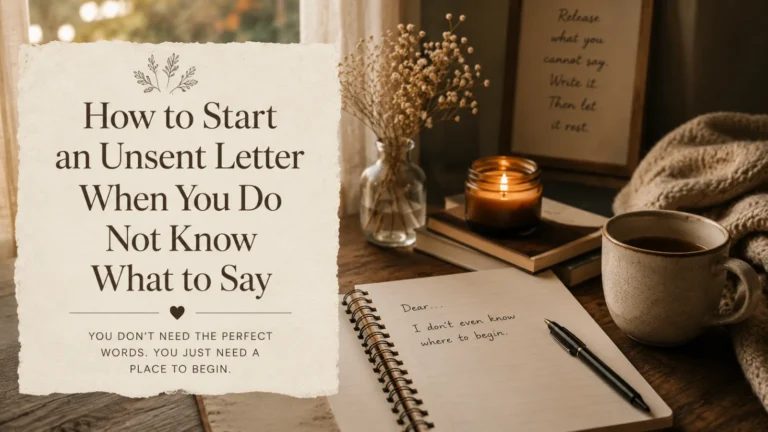
And if the hardest part is that you still haven’t written one because you can’t get past the opening line, start with how to begin when you do not know what to say.
Put it in an envelope and date it.
Move the file into an archive folder.
Set a reminder for a month from now.
Shred one copy and keep one.
Ask yourself whether you want memory, release, protection, or action. Usually one of those is louder than the others once you stop trying to pick the “meaningful” option.
And if none of those answers come easily, that tells you something too. Sometimes the hardest part isn’t what to do with the letter. It’s admitting you’re not done with the person, or the loss, or the version of yourself who wrote it.
That doesn’t mean you need a bigger gesture. Sometimes it just means the letter was honest before you were ready to be.
If that’s where you are, you can leave it closed for now. Not everything unfinished needs to be forced into resolution on schedule.
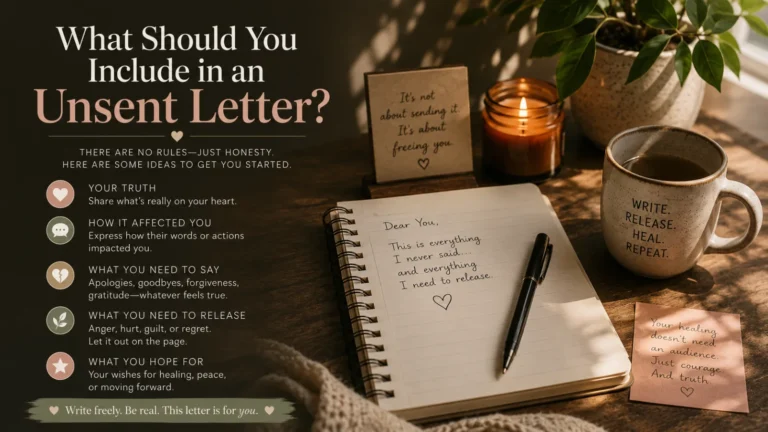
If you’re still deciding what belongs in the letter itself, it helps to get clearer on what to include and what people often leave out before you decide whether to keep it.
Not sure whether to keep it, delete it, or send it?
Use a simple guided prompt to figure out what the letter actually did for you and what next step will feel most honest.