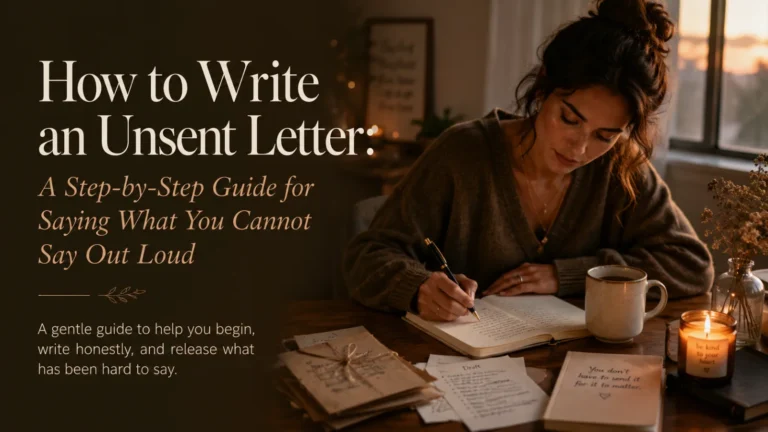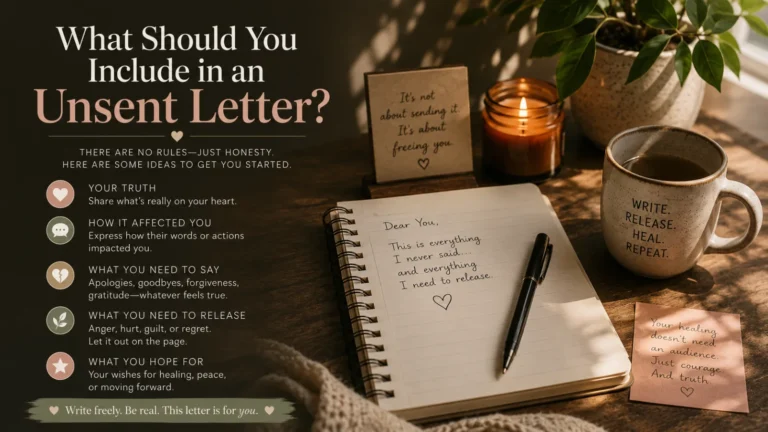
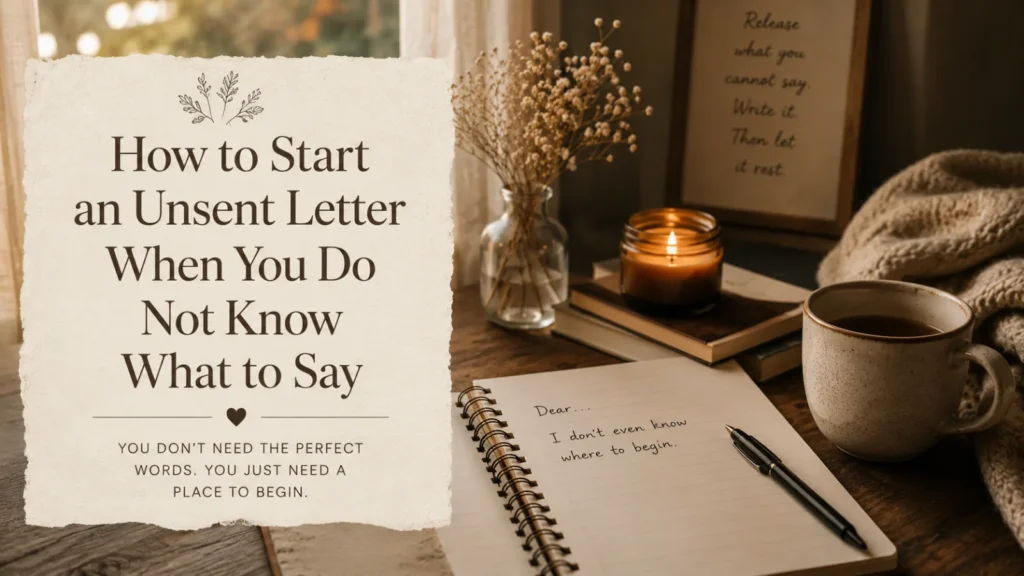
You don’t need the perfect first line. You need a line that lets you stop hovering and start writing. Most unsent letters begin better when you stop trying to sound clear, kind, wise, or finished, and just tell the truth about what is hard to say.
That’s the part that catches people. Not the feelings, usually. The opening.
Because once the page is there, you can suddenly hear every bad version at once. Too dramatic. Too cold. Too angry. Too late. Too vague. You end up staring at the top of the page like it personally offended you.
An unsent letter is strange that way. You’re not writing to persuade someone. You’re not writing to fix the relationship in real time. You’re not even writing for a reply. You’re trying to get honest without needing the other person to make it easier, and 101 unsent letter prompts for the words you have never been able to say can help when the first honest sentence feels hard to find.
So if you don’t know what to say at the beginning, that doesn’t mean you’re doing it wrong. It usually means you care enough to feel exposed.
Start smaller than you think
A lot of people freeze because they think the first sentence has to explain everything. What happened, why it mattered, how long it’s been sitting in your chest, what you now understand. That’s too much for one line. No wonder your brain goes blank.
It helps to treat the opening like cracking a door, not delivering a speech.
You can start with:
- I haven’t known how to say this.
- I’ve started this a few times.
- There’s more here than I know how to explain yet.
- I don’t even know if this letter makes sense, but I need to write it.
- This has been sitting with me for a long time.
None of those are flashy. That’s the point. They’re real enough to carry weight, and simple enough that you can keep going.
If you’re waiting for a beautiful opening, you’ll probably stay stuck. If you allow yourself an honest, slightly awkward one, the rest of the letter usually starts moving.
Say what this is before you say everything else
Sometimes the easiest way in is to name the moment you’re in.
Not the whole backstory. Just the truth of the page you’re sitting in right now.
That can sound like this:
- I’m writing this because I need somewhere to put what I never got to say.
- I’m not sending this, which is probably the only reason I can be honest.
- I don’t expect anything from this. I just need to say it plainly.
- Part of me still wants to explain this carefully, and part of me is too tired to do that.
This works because it takes the pressure off performance. You’re not pretending to be calm if you’re not calm. You’re not pretending to be above it if you’re not above it. You’re just telling the truth about what this letter is for.
And honestly, that’s often the first real sentence.
When your mind is blank, use the most basic truth
If you truly do not know what to say, go simpler.
Start with the fact that feels impossible to get around. The thing that keeps circling.
Maybe it’s:
- I’m still hurt.
- I miss you and I’m angry at you, which is inconvenient.
- I never felt like I got to finish the sentence.
- I keep replaying what happened.
- I wish this had been different.
You do not need a thesis. You need a foothold.
A good opening line for an unsent letter is often embarrassingly plain. People resist that because plain can feel exposed. It doesn’t have the protective layer of polished language. But plain is useful, especially when you’re focused on what belongs in an unsent letter. Plain gets you into the real part faster.
There’s also a mildly annoying truth here: the sentence you think is too obvious is often the sentence you’ve been avoiding because it’s the actual one.
If you’re trying too hard to sound generous, you’ll probably stall out
This happens a lot when the letter is to someone you loved, someone who hurt you, or someone you still feel pulled toward in a way you’d rather not discuss at dinner.
You may feel pressure to sound balanced right away. Mature. Fair. Regulated. Like someone reading over your shoulder might grade your emotional tone.
That pressure can make the opening weirdly stiff.
You’ll get lines that sound respectable and dead, something like: “I hope you are well and that life has been treating you kindly.” Maybe that’s true. Maybe it’s also not the real beginning.
If the honest start is messier, start there.
You can always become more nuanced as you go. You do not need to open with your most polished interpretation of events. Sometimes it’s better to begin with the uncool version and let the letter settle after that.
Something like:
- I keep trying to write this in a calm way, but that’s not where I’m starting from.
- I wanted to sound more detached than I am.
- I’ve rewritten this enough times to know I’m still trying to protect you in a letter you’ll never read.
That last kind of line matters because it names the hidden struggle under the struggle. And once that’s on the page, you usually stop circling.
Use the sentence you would only admit in private
This is where unsent letters become useful instead of just decorative.
The opening gets stronger when it contains the sentence you would hesitate to say out loud because it makes you feel a little foolish, needy, angry, or more affected than you wanted to be.
Not dramatic for the sake of drama. Just unguarded enough to be real.
For example:
- I still rehearse conversations with you, which feels ridiculous but here we are.
- I told myself I was over this, and that turned out to be untrue.
- I wanted to be the kind of person who could let this go neatly. I’m not, apparently.
- I put this off for longer than I want to admit because I knew once I started, I couldn’t pretend it didn’t matter.
That last kind of admission is often the turning point. A letter written from the neck up stays careful. A letter that includes one slightly unflattering truth starts to breathe.
You don’t need to confess everything. Just enough that the page stops sounding like a witness statement.
Different openings work for different kinds of letters
The first line usually gets easier when you stop asking, “What should this kind of letter sound like?” and start asking, “What kind of letter is this?”—which is the same shift you build with a full unsent letter writing process.
If it’s mostly grief
Grief doesn’t always want an introduction. Sometimes it wants recognition.
You might start with:
- I still don’t know where to put all of this.
- You’re gone, and my mind still keeps reaching for you.
- There are things I never got to say, and they’ve been heavier than I expected.
That kind of opening doesn’t force meaning too early. It lets the loss be the first fact.
If it’s mostly anger
Anger usually gets tangled when you try to make it sound immediately reasonable.
A better start is often direct and contained:
- I’m angrier than I wanted to be.
- I keep thinking about what happened, and it still feels wrong.
- There are things you did that I minimized at the time, and I can’t do that anymore.
You can refine later. The opening just needs to be honest enough that you don’t disappear inside your own politeness.
If it’s mostly love or longing
This is the category where people tend to edit themselves into dust.
You may want to sound dignified. Understandable. Not too much.
But if longing is the truth, a distant opening usually makes the whole letter feel false.
You can begin with:
- I miss you in ways that are hard to admit.
- I didn’t expect you to stay with me like this.
- Some part of me is still talking to you.
It’s tender, yes. Also cleaner than performing indifference.
If it’s mostly unfinished business
Some unsent letters aren’t about missing someone or forgiving someone. They’re about finally saying the part that got swallowed.
Then the opening can be as simple as:
- There was more I needed to say.
- I left that conversation without telling the truth.
- This is the version I should have said then.
That gives the letter a clear lane right away.
What to do when every opening sounds fake
If everything you write sounds forced, you’re probably still writing the version that sounds acceptable, not the version that’s alive.
Try this instead. Write one of these sentences at the top of the page and refuse to edit it for five minutes:
- The truth is,
- What I can’t seem to say is,
- What still bothers me is,
- What I wish you knew is,
- If I’m being honest,
Then keep writing without trying to make it good.
That last part matters. A lot.
Because the opening problem is often not actually an opening problem. It’s an editing-too-soon problem. You write one line, judge it, rewrite it, flatten it, and then wonder why you can’t get started.
Your first line is allowed to be clunky. It is allowed to sound like someone finally telling the truth after avoiding it for months. That’s a perfectly decent voice when you’re trying to write one honestly.
Maybe even the right one.
You can start with the body and come back later
This sounds obvious, but people forget it in very sincere ways.
You do not have to write the first sentence first.
If the top of the page feels cursed, start in the middle. Write the sentence you know is in there somewhere:
- What hurt most was…
- I never told you this, but…
- The part I keep coming back to is…
- I think I needed…
Once you’ve written a paragraph or two, the opening usually shows itself. And it’s often much simpler than what you were trying to force at the beginning.
This is especially helpful if your mind keeps trying to make the letter elegant. Elegance is overrated here. Clarity is better. A live sentence is better. A sentence that sounds like a person and not a performance is better.
What the first line is really doing
The first line isn’t there to impress anyone. It isn’t even there to summarize the whole letter.
It’s there to make honesty possible.
That’s why the strongest openings are usually the ones that lower the mask instead of decorating it. They let you enter the letter as you actually are on that day. Confused. relieved. angry. softer than expected. still tangled. still not sure what you’re asking for, if anything.
An unsent letter doesn’t need a perfect opening because it doesn’t need to earn its existence. It just needs a real one.
So if you’re stuck, start with the sentence that feels a little too plain, a little too exposed, or a little less polished than you’d prefer. That’s often the doorway.
And if all you can write is, “I don’t know how to begin this,” that counts. More than people think.
Need help finding the first sentence?
Use a guided prompt to get past the blank page and start your unsent letter without overthinking every word.