
Sometimes the healthiest letter is the one that says goodbye without opening the door again. Not because your feelings aren’t real, and not because the relationship meant nothing. Just because contact can keep tearing the same place open.
If you’re thinking about writing a final letter when contact is not healthy, the point usually isn’t to fix anything. It’s to say what needs saying in a way that protects you. That’s a very different kind of letter, and it helps to know that before you start.
What this kind of letter is really for
A final letter isn’t a debate. It isn’t a last attempt to be understood perfectly. It isn’t a secret way to get a better response, a softer ending, or the version of them you’ve been hoping would finally show up.
It’s more like drawing a line with words.
You might write one because every conversation turns into confusion. Because they pull you close and push you away. Because they apologize just enough to keep you engaged and then do the same thing again. Because every time you reach out, you end up shaky, angry, guilty, or weirdly hopeful for a few days after.
And sometimes the truth is less dramatic than that. Sometimes contact just keeps you stuck. You keep rereading old messages, mentally drafting replies, checking for signs, waiting for a tone shift that never comes. A final letter can help you stop performing the relationship after it has already stopped being safe, mutual, or sane.
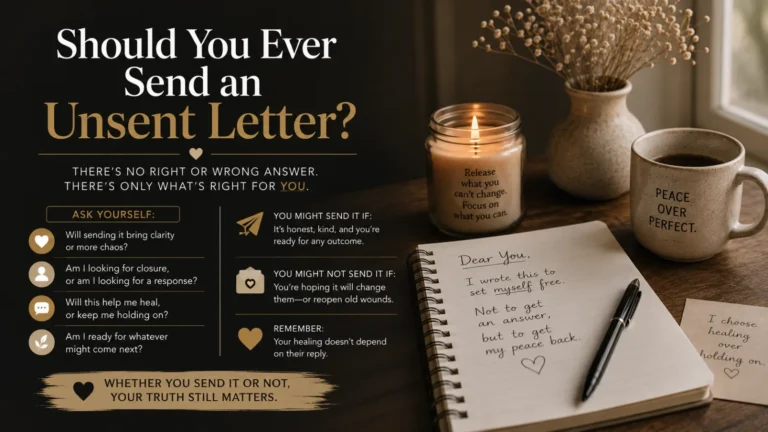
If you already know sending something would only restart the cycle, you may actually need a closure letter you do not send rather than a final message delivered to them. That’s not avoidance. That’s discernment.
Before you write, get honest about the goal
This matters more than the wording.
If the real goal is “maybe this will finally make them get it,” you’re probably still writing toward connection. Which is human, but it changes the whole letter. It makes you explain too much. It makes you soften what should be clear. It makes you leave little emotional windows open.
A healthier goal sounds more like this:
- to say what is true once
- to set a boundary clearly
- to end contact without cruelty
- to leave yourself with less unfinished business
You don’t need a perfect motive. Almost nobody has one. Part of you may want peace, and part of you may still want them to feel the weight of what happened. Both can be true. The useful thing is noticing which part is holding the pen.
The slightly awkward reality here is that people often write “final” letters while still checking their phone every six minutes afterward. That’s not a character flaw. It’s just a sign that your nervous system may be more involved than your logic is. So if you’re going to send anything, it helps to plan for the after part too, not just the writing part.
What to include, and what to leave out
A final letter usually works better when it stays narrow. Not small. Just narrow.
You do not need to retell the whole relationship. You do not need a courtroom timeline. You do not need to prove that your pain counts. If they only understand your experience when it’s arranged like evidence, they may not be misunderstanding you by accident.
What helps
Usually, some version of these pieces is enough:
- what you now understand
- what is no longer okay for you
- what boundary you’re setting
- what happens next
That might sound like:
“This relationship has become too painful and confusing for me to stay in. I am not available for further contact after this message. I’m not asking for a response. I genuinely wish you well, but I need this to end.”
Not fancy. Not dramatic. Just clear.
What usually makes it worse
Long explanations. Point-by-point rebuttals. Bringing up ten old incidents in case they try to argue with number three. Slipping in one last emotional test, like “If you ever really cared, you’ll respect this.”
That last one is understandable. It also keeps the emotional hook in place.
If the person has a habit of twisting your words, minimizing your feelings, or using vulnerable things against you, simpler is safer. You are not writing a memoir for the record. You’re ending contact.
And if what you really need to say is more emotional than that, it may belong in a different kind of letter first. Something like writing to someone who hurt you without reopening the wound can help you get the truth out before you decide whether any of it should actually be sent.
The tone that tends to protect you best
Calm is useful. Cold isn’t required.
You don’t have to sound detached to be firm. You also don’t have to pour your whole heart onto the page to prove this mattered. The safest tone is usually plain, steady, and a little boring. Which feels unfair, honestly, because your inner draft may be absolutely glowing with grief and rage and six paragraphs of things they should have understood years ago.
But “boring” letters are harder to argue with.
Think less “final speech in a movie” and more “clear statement from someone who is done negotiating.”
That means avoiding:
- threats
- insults
- diagnosing them
- promises you can’t keep
- anything written mainly to wound them back
Not because they deserve your gentleness. Because you deserve not to send something you’ll replay later with your stomach in knots.
When sending it may not be the right move
Sometimes the most loving thing you can do for yourself is not deliver the letter.
If the person is volatile, manipulative, threatening, or likely to escalate when they feel rejected, contact may not be emotionally safe. In some situations it may not be physically safe either. A letter is not worth the risk if it gives them a fresh opening into your life.
There are also situations where sending it just keeps the bond alive in a different form. You say goodbye, they reply with something tender or cruel or confusing, and suddenly you’re back inside the same exhausting weather system.
In that case, writing without sending can still do a lot. Especially if your grief is tangled up with love. There are moments when writing a goodbye letter to someone you still love gives you more relief than another actual exchange ever could.
You don’t have to prove your courage by pressing send.
A simple shape for the letter
If you’re getting lost, use a short structure and stop there.
Start with the truth now
Not the whole history. Just where things stand.
“I’ve reached the point where continued contact is not healthy for me.”
That sentence does a lot of work. It centers your decision without inviting a debate about every past event.
Name the boundary clearly
Be specific enough that it can’t be “misunderstood” into ongoing contact.
“After this letter, I won’t be responding to calls, texts, emails, or messages through other people.”
If there are practical exceptions, name only those.
“If there is one remaining logistics issue, it needs to be handled by email only before Friday.”
Keep the emotional middle brief
This is the part people usually overfill. You can say the relationship mattered. You can say you’re hurt. You can say this is painful. Just don’t turn the center of the letter into an opening for negotiation.
“This has been deeply painful, and I don’t say any of this lightly.”
That may be enough.
End without a loose thread
No “maybe someday.” No “unless things change.” No “I hope we’ll talk when you’re ready.”
If the letter is final, let it be final.
“I won’t be continuing contact. I wish you well, and I’m stepping away.”
If the relationship was on-and-off, watch for this trap
People in messy, on-and-off dynamics often write letters that are technically boundaries and emotionally invitations. The words say goodbye. The subtext says, “Please come after me correctly this time.”
That doesn’t make you foolish. It makes you attached.
Still, it’s worth reading your draft once for mixed signals. Especially if the relationship has included breakups, reunions, late-night vulnerability, dramatic promises, or stretches where silence somehow became intimacy all by itself.
If your situation leans more breakup-shaped than broadly relational, you may notice overlap with writing an unsent letter to an ex after a breakup. A lot of people need to separate the letter that tells the truth from the message that actually gets sent, if anything does.
What to do after the letter matters almost more than the letter
This is the part people skip because the writing feels like the hard part. It isn’t always.
The hard part can be the hour after sending. Or the next morning. Or day four, when nothing has happened and your brain suddenly decides that means you were cruel, impulsive, unfair, dramatic, immature, heartless, wrong. Brains get very creative when separation kicks up old fear.
So make the after-plan before the letter goes out.
- Decide whether you’ll block, mute, or filter messages
- Tell one trusted person what you’re doing
- Remove easy ways to reread old threads if that’s your habit
- Write down why this boundary exists, because you may forget on a lonely day
If you’re not sending it, give the letter an ending anyway. Print it. Put it in an envelope. Delete the draft from the app where you usually message them. Read it once out loud and put it away. Ritual helps more than people expect, even when it feels a little cheesy.
It does not have to sound beautiful to be real
Some of the strongest final letters are almost plain to the point of disappointment. People expect a closing statement worthy of the emotional damage. What they actually need is a few honest sentences that don’t leave the door cracked.
You are allowed to write something simple because simple is all that keeps you safe.
You are allowed to stop trying to be perfectly fair to someone who benefited from your constant over-explaining.
You are allowed to care about them and still end contact.
And if the draft in front of you keeps turning into a plea, a defense, or a performance, that tells you something useful. It may mean the letter you need most is not the one you send. It may mean you’re still writing from the part of you that wants resolution from the same place that kept taking it away.
That part deserves compassion. It just shouldn’t be the one making the final edit.
Need help putting the boundary into words?
Use a guided prompt to write a final letter that says what’s true without reopening contact you already know is unhealthy.