
ometimes the hardest part isn’t what you want to say. It’s how to say it without ending up shaken for the rest of the day. If you’re writing to someone who hurt you, the safest version is usually slower, shorter, and more boundaried than your first draft wants to be.
That matters because writing can help you get clear, but it can also pull you right back into the part of the story where you were trying to be understood by someone who may never fully understand. Those are two very different things. You want the first one.
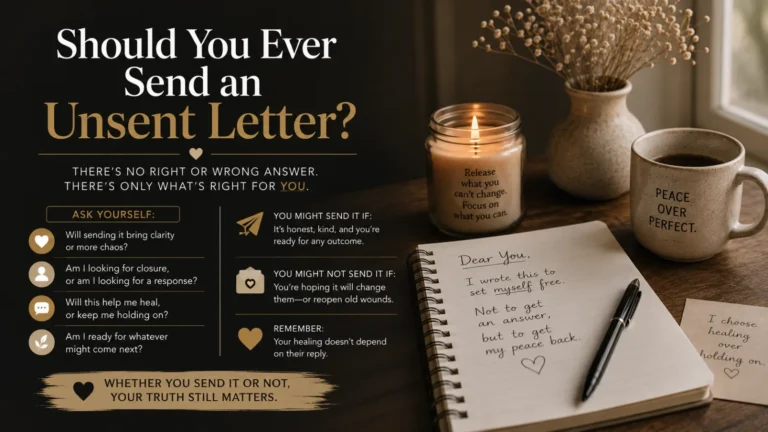
If you’re staring at a blank page, it may help to separate the real goal before you write a single sentence. Are you trying to tell the truth? Set a boundary? Ask for something specific? End contact? Say what happened in your own words because you’ve been carrying it around too long? All of those are valid. They just create very different letters.
Start by deciding what this letter is for
A lot of pain comes from writing one kind of letter and secretly hoping it will do five jobs at once. You may want release, accountability, repair, apology, closure, and one perfect sentence that finally makes them get it. That’s a very human wish. It’s also a rough setup. When the goal is unclear, the complete guide to writing unsent letters for healing can help you sort out whether the letter is meant to communicate something or simply let you release it.
Before you write, try finishing this sentence: “When this is done, I want this letter to…”
Not forever. Not ideally. Just in reality.
Maybe you want it to say, clearly, that what happened was not okay. Maybe you want it to create distance. Maybe you want to ask for one conversation, or no more conversations. Maybe you don’t even want to send it, and the letter is really for your own nervous system. If that’s where you are, writing a closure letter you do not send may fit better than trying to force a message into a relationship that no longer feels safe.
The point isn’t to lower the importance of what happened. It’s to stop making the letter carry more than it can.
Write the first draft for honesty, not contact
Your first draft does not need to be sendable. Honestly, it probably shouldn’t be.
This is the part where people often do the opposite of what helps. They try to sound calm before they actually are calm. They over-explain. They try to be fair in a way that erases themselves. Or they write something so sharp it feels good for twelve minutes and terrible after that.
A better first move is to write the raw version privately. Let it be messy. Let it contradict itself a little. Let the angry sentence show up next to the sad one. You’re not building the final letter yet. You’re finding out what’s actually in it.
Then stop. Not for five minutes. Longer if you can.
There’s a reason for that pause. A fresh wound wants urgency. A steadier letter usually comes from letting the first emotional surge pass before you decide what belongs on the page.

What keeps a letter from reopening the wound
The safest letters usually have a few things in common. Not because there’s one correct formula. Just because certain choices protect you better than others.
They stay close to what happened
Specific is safer than sprawling. “When you shared that private information after I asked you not to, it broke trust” is easier to stand on than “You’ve always disrespected me in every possible way.” One names an event. The other invites an argument about your memory, your tone, and your right to say it at all.
You don’t need to prove your entire history to say one true thing.
They don’t beg for agreement
This one is hard. Especially if part of you still wants the person to finally say, yes, that happened, and yes, it hurt you, and yes, they were wrong.
But if your letter depends on them agreeing with your version in order for your truth to count, you’re handing them the last word before they’ve even replied.
You can write, “This is how I experienced what happened.” You can write, “It changed how safe I felt with you.” You can write, “Whether or not you see it the same way, I need distance now.” That’s very different from building the whole letter around convincing them.
They ask for very little, or one thing
If you need a practical outcome, keep it narrow. One request. One boundary. One next step.
Things like:
- don’t contact me again
- only contact me by email
- I’m not available for a phone call
- I need you to stop discussing me with other people
That kind of clarity protects you. A long list of emotional demands usually doesn’t.
You do not have to explain every layer of your pain
There’s a version of writing that sounds mature on the surface but is really self-abandonment in nicer clothes. It’s when you spend six paragraphs softening, contextualizing, justifying, and translating your hurt so the other person won’t feel too uncomfortable reading it.
You do not owe that much access.
You can be plain without being cruel. You can be restrained without being vague. You can say, “What you did hurt me, and I’m not willing to continue as if it didn’t,” and leave it there.
That’s enough more often than people think.
If the person never apologized and you keep trying to write your way into the apology you should have already gotten, that can become its own trap. There’s a different kind of relief in writing to someone who never apologized when the goal shifts from changing them to saying what’s yours to say.
Keep the letter inside your actual capacity
This part gets ignored a lot, but it matters. The right letter is not just the truest one. It’s the truest one you can live with after sending.
That means thinking about your body, not just your wording.
If hitting send is going to wreck your whole week, that tells you something. If waiting for a reply will have you checking your phone every six minutes, that tells you something too. If you know this person tends to twist language, deny specifics, or pull you into circular arguments, that belongs in the decision.
Sometimes the most self-protective choice is to write the letter and not send it yet. Sometimes it’s to send a much shorter version than the one in your notes app. Sometimes it’s to have someone you trust read it first, not to correct your feelings, just to notice where the letter stops sounding like truth and starts sounding like an opening for more harm.
That outside read can be especially helpful if the relationship has trained you to doubt yourself. A lot of people think they need help making the letter kinder. What they often need is help noticing where they’ve made it smaller than what happened.
A simple shape helps when your thoughts are all over the place
You don’t need a script, but structure can keep you from spiraling. A letter like this often works best when it stays close to three parts.
What happened
Name the action, pattern, or moment. Keep it concrete.
“When you…”
What it did
Say what changed for you. Trust, safety, closeness, contact, peace. Whatever is true.
“That affected me by…”
What happens now
This is the boundary, request, or ending.
“Because of that, I’m…”
That’s it. Not tiny because your pain is tiny. Tiny because containment matters.
Watch out for the line that’s really written to get a reaction
Most letters like this have one sentence that doesn’t belong. It’s the sentence written for impact. The one meant to sting, wake them up, force remorse, or make sure they suffer at least a little while reading.
It’s understandable. Also usually expensive.
If a line is there mostly because you want them to feel what you felt, pause on it. Sometimes that line says something true in the wrong way. Sometimes it’s the sentence that turns a grounded letter into a fight. Sometimes it’s the sentence that makes you feel exposed later, because now the focus is your sharpness instead of their behavior.
You don’t have to make the letter gentle. But it helps to make it clean.
Some situations need a different kind of letter entirely
Not every hurt fits the same frame.
If this is really about someone you still love and can’t neatly detach from, the letter may need to hold grief more than boundary language. That’s a different emotional task, closer to writing a goodbye letter to someone you still love than drafting a tidy statement of harm.
If the person who hurt you is a parent, things can get tangled fast. Old roles show up. So does the familiar urge to make yourself understandable enough to finally be treated with care. In that case, something like an unsent letter to a parent who hurt or disappointed you can be safer than trying to force a direct exchange before you know what you need.
Different letters for different kinds of pain. That’s not overcomplicating it. It’s just honest.
What to do after you write it
This is the part people rush, usually because finishing the letter creates a weird burst of energy. Relief mixed with panic. Like now something must happen immediately because the words finally exist.
Usually, no.
After you write, do something that brings you back into the room you’re actually in. Drink water. Take a walk. Fold laundry badly. Anything ordinary. The point is to give your body evidence that writing the truth did not erase the floor under you.
Then read the letter once as the person who wrote it and once as the person who will have to live with the consequences of sending it.
Those are not always the same person.
And if you notice that the letter is really a plea to be understood by someone who has already shown you they protect themselves from understanding, that’s painful information, but it’s still useful. It may mean the letter belongs to you more than it belongs to them.
There’s no prize for sending the hardest thing. Sometimes the most honest sentence is the one you keep. Sometimes it’s the one you send. The trick is knowing which choice leaves you less torn open tomorrow.
Need help finding words that protect your peace?
Use a guided unsent letter to say what happened, name the boundary, and stop before the writing turns into another wound.